
Flashcards
IB Biology 7.3 Transcription (HL)
Cards in this deck (6)
- 17.3.1 State in which direction transcription is carried out in.Transcription is carried out in a 5' - 3' direction (of the new RNA strand
- 27.3.2 Distinguish between the sense and antisense strands of DNADNA consists of two polynucleotide strands, only one of which is transcribed into RNA
The antisense strand is transcribed into RNA
Its sequence will be complementary to the RNA sequence and will be the "DNA version" of the tRNA anticodon sequence
The sense strand is not transcribed into RNA
Its sequence will be the "DNA version" of the RNA sequence (identical except for T instead of U) - 37.3.3 What is a gene and what three parts does it contain?A gene is a sequence of DNA which is transcribed into RNA and contain three main parts:
Promoter: Responsible for the initiation of transcription (in prokaryotes, a number of genes may be regulated by a single promoter - this is an operon)
Coding Sequence: The sequence of DNA that is actually transcribed (may contain introns in eukaryotes)
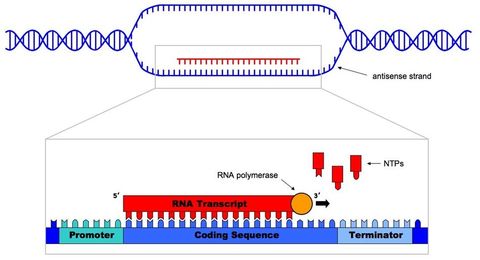
Terminator: Sequence that serves to terminate transcription (mechanism of termination differs between prokaryotes and eukaryotes) - 47.3.3 Explain the process of transcription in prokaryotesTranscription is the process by which a DNA sequence (gene) is copied into a complementary RNA sequence and involves a number of steps:
RNA polymerase binds to the promoter and causes the unwinding and separation of the DNA strands
Nucleoside triphosphates (NTPs) bind to their complementary bases on the antisense strand (uracil pairs with adenine, cytosine pairs with guanine)
RNA polymerase covalently binds the NTPs together in a reaction that involves the release of two phosphates to gain the required energy
RNA polymerase synthesises an RNA strand in a 5' - 3' direction until it reaches the terminator
At the terminator, RNA polymerase and the newly formed RNA strand both detach from the antisense template, and the DNA rewinds
Many RNA polymerase enzymes can transcribe a DNA sequence sequentially, producing a large number of transcripts
Post-transcriptional modification is necessary in eukaryotes - 57.3.3 Draw a diagram that overviews transcription
- 67.3.4 State that eukaryotic RNA needs the removal of introns to form mature mRNAEuakaryotic genes may contain non-coding sequences called introns that need to be removed before mature mRNA is formed
The process by which introns are removed is called splicing
The removal of exons (alternative splicing) can generate different mRNA transcripts (and different polypeptides) from a single gene
Information
- Description
- Biology (Topic 7 Nucleic Acid & Protein (HL)) Flashcards on IB Biology 7.3 Transcription (HL), created by robertospacey on 23/03/2015.
- Created by
- robertospacey
- Views
- 138
- Tags
- Rating