
Dental Anatomy and Tooth Morphology
13 resources created by 10 users
This Dental Anatomy and Tooth Morphology page on GoConqr gathers community-made quizzes, mind maps, flashcards and notes, from enamel structure and dentine to incisors, canines, premolars, molars and eruption dates. It's built for university students and professional candidates revising tooth form, plus teachers after ready-made material. There are over 130 resources here, including more than 30 quizzes, over 30 mind maps and over 60 flashcard decks. Pick a topic, try a quiz to find your gaps, then make your own revision set.
Top Dental Anatomy and Tooth Morphology resources
-
Mind map Enamel composition and structure
-
24 questionsAdult mandibular tooth eruption and calcification dates When do the mandibular central incisors erupt?
-
12 cardsTOOTH MORPHOLOGY Permanent Maxillary Central incisor features
-
15 questionsDeciduous tooth eruption and calcification dates When does the deciduous central incisor (A) erupt?
-
151 cardsDental Anatomy Facts
-
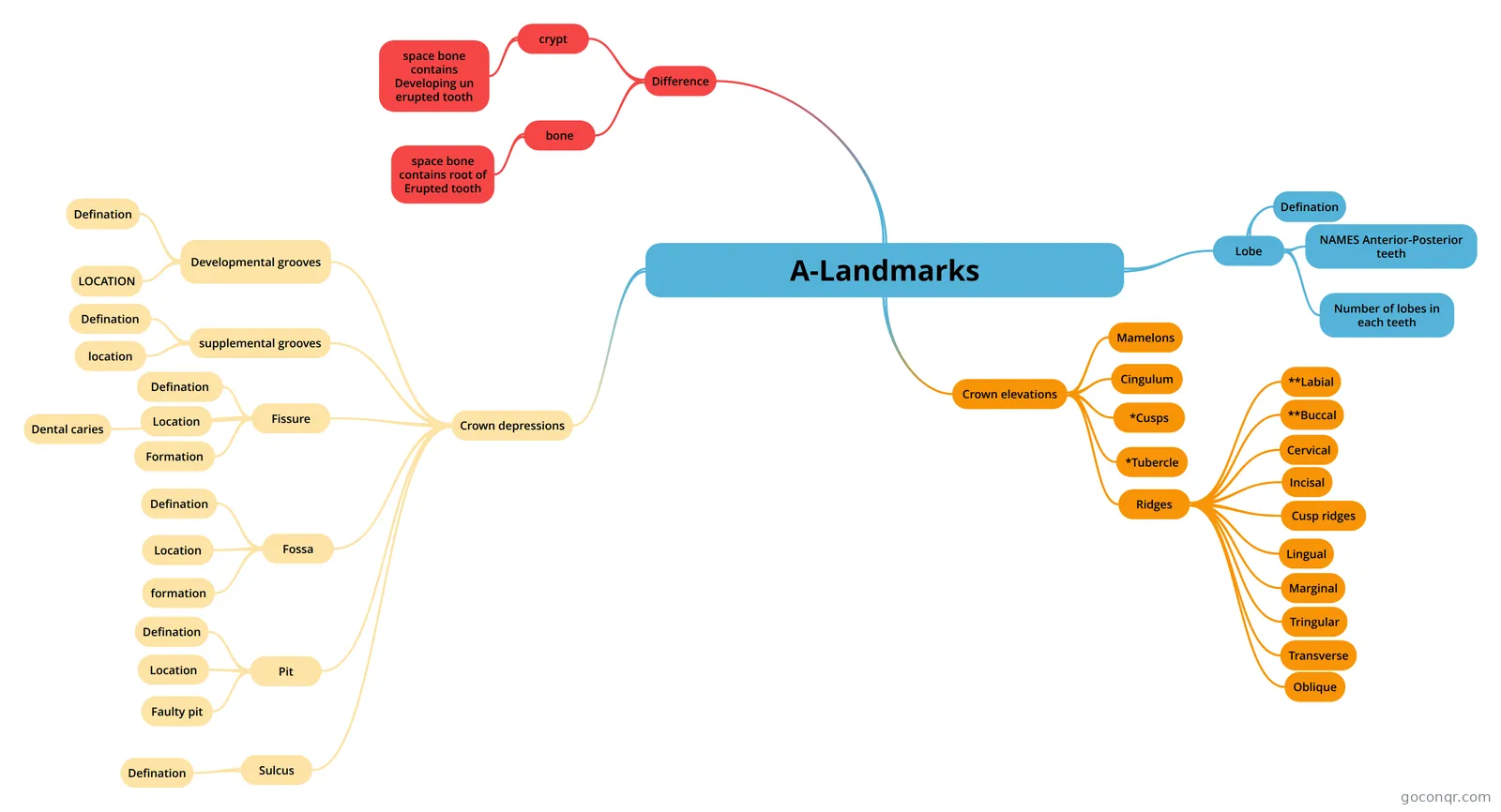 Mind map A-Landmarks Anatomical landmarks
-
15 cardsRoot Canal Morphology Maxillary Central Incisor
-
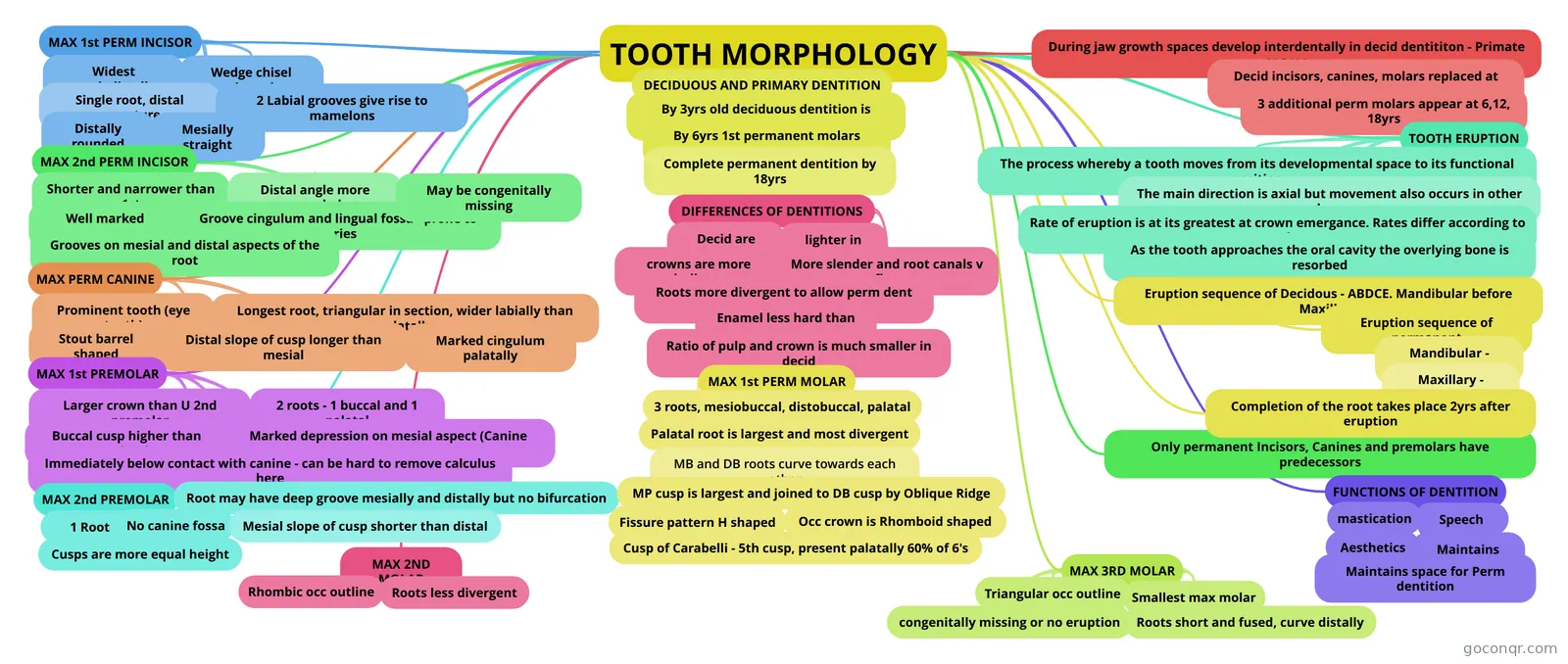 Mind map TOOTH MORPHOLOGY
Quizzes
Mind maps
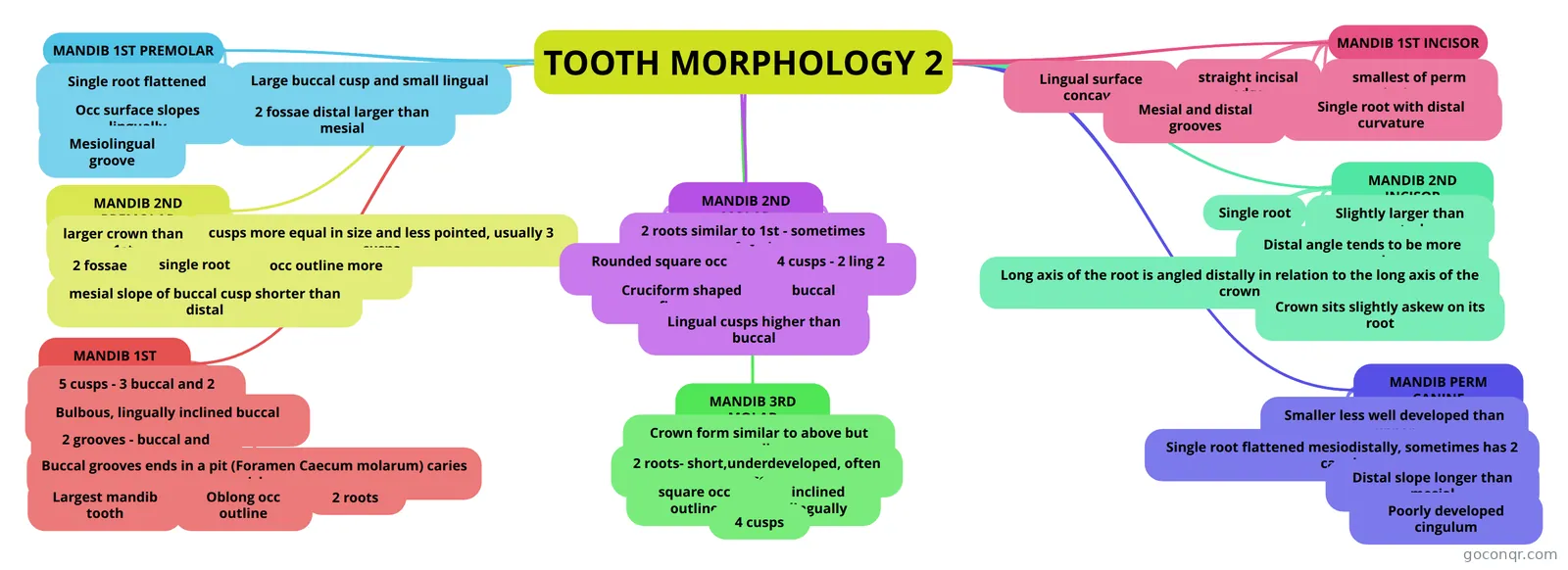
Flashcards
Notes
More Dentistry topics
About Dental Anatomy and Tooth Morphology
GoConqr OriginalWhat this unit covers
The resources sit in the Oral Biology: Anatomy, Histology and Development strand of Dentistry. They work through tooth tissues, individual tooth types, eruption timing and the landmarks around the mouth and face.
- Tissues: the Enamel composition and structure mind map covers physical and chemical properties, and notes that enamel is brittle and supported by dentine. The Mineralisation mind map looks at how enamel and dentine form.
- Tooth types: maps on Canines, Maxillary Central Incisors, Mandibular Premolars and Maxillary Molars, plus decks on incisors, premolars and cuspids.
- Nerves and landmarks: maps on the Trigeminal nerve, Maxillary Nerve and anatomical landmarks.
Where to start
Begin with the TOOTH MORPHOLOGY flashcard deck. It runs through permanent and deciduous teeth side by side, starting with the maxillary central incisor. Then open Dental Terminology and Tooth Naming so the directions and surfaces, such as mesial, distal and occlusal, feel familiar before you tackle detail.
Using maps and quizzes together
Read a mind map first, for example the one on Canines, which lists eruption ages and calcification stages. Then test yourself with the Deciduous tooth eruption and calcification dates quiz, or the Adult mandibular tooth eruption and calcification dates quiz. Note what you missed and go back to the map for those branches only.
For longer practice, the numbered Dental Anatomy decks each hold 100 flash cards, and there is a run of Dental Anatomy quizzes to match. Tooth Morphology Past Papers and Dental Anatomy Final Review suit the weeks before an assessment.
For teachers
Teachers can pick a mind map as a ready-made class handout, or set a quiz as a quick check after a session on one tooth group.
Next step
Choose one tooth group, work through its map, then see how many quiz questions you can answer from memory.
Frequently asked questions
Which resource should I open first?
Start with the TOOTH MORPHOLOGY flashcard deck. It covers permanent and deciduous incisors and canines in turn, which gives you a base for the maps and quizzes. If the vocabulary is unfamiliar, open Dental Terminology or Tooth Naming alongside it.
What do the mind maps cover?
They cover enamel composition, mineralisation, dentine, the dentino-enamel junction and the pulpo-dentinal complex, plus individual tooth groups such as canines, incisors, premolars and maxillary molars. Others cover the trigeminal and maxillary nerves and anatomical landmarks.
Are there quizzes on eruption dates?
Yes. One quiz asks when each deciduous tooth erupts, and another asks the same for adult mandibular teeth, including incisors, canines and first premolars. The Canines mind map is a useful companion for checking the ages.
Who are these resources for?
They suit university students and professional candidates studying tooth form and oral anatomy, and teachers who want ready-made material. Most of the resources are at university level, with a smaller share aimed at professional study.
Are the resources free, and who made them?
Everything listed here is free to open, study and take, with no account needed. The resources were made by GoConqr users, not by GoConqr. A free account also saves your quiz scores and lets you create your own sets.
What if I can't find a tooth or topic?
Try the broader decks such as Dental Anatomy or Dentition Overview, which range across several tooth groups. You can also make your own mind map or flashcards for the missing topic and use them in your revision.