
Orthodontics and Craniofacial Growth
91 resources created by 45 users
This Orthodontics and Craniofacial Growth page on GoConqr gathers community-made quizzes, mind maps, flashcards and a note, from the development and growth of the jaws to appliances, extraction space closure and retention. It's built for university students and professional candidates revising a topic, and for teachers after ready-made material. There are over 80 resources here, including more than 10 quizzes, over 30 mind maps and over 30 flashcard decks. Pick a topic, try a quiz to find your gaps, then see what you can add yourself.
Select topic
- Craniofacial Growth and Development13
- Occlusion and Classification of Malocclusion7
- Types of Malocclusion8
- Causes of Malocclusion5
- Dental Anomalies and Missing Teeth6
- Cleft Lip, Palate and Craniofacial Syndromes6
- Orthodontic Diagnosis and Cephalometrics7
- Orthodontic Treatment Planning and Interceptive Treatment6
- Orthodontic Appliances and Instruments10
- Orthodontic Tooth Movement and Space Management6
Top Orthodontics and Craniofacial Growth resources
-
25 questionsDental OSCE quiz 1 Is this impacted canine palatal or buccal to the centrals?
-
Mind map Development and growth of the jaws
-
29 cardsOCB02-1007-Mechanisms of Post-Natal Growth What are the 3 regions of the craniofacial complex?
-
20 questionsGeneral Concepts of Growth (CF12-14) The cranial vault develops via intramembranous ossification. The mandible and maxilla develop via endochond...
-
Mind map Orthodontics Week 1 - Dentistry intro
-
21 cardsOrthodontic pliers and instruments
-
7 questionsCCP2 Facial growth and development (CF 15) Which of the following is correct?
-
12 cardsCleft palate Define a primary cleft palate?
Quizzes
See all 11 quizzes-
25 questionsDental OSCE quiz 1 Is this impacted canine palatal or buccal to the centrals?
-
20 questionsGeneral Concepts of Growth (CF12-14) The cranial vault develops via intramembranous ossification. The mandible and maxilla develop via endochond...
-
7 questionsCCP2 Facial growth and development (CF 15) Which of the following is correct?
Mind maps
See all 38 mind maps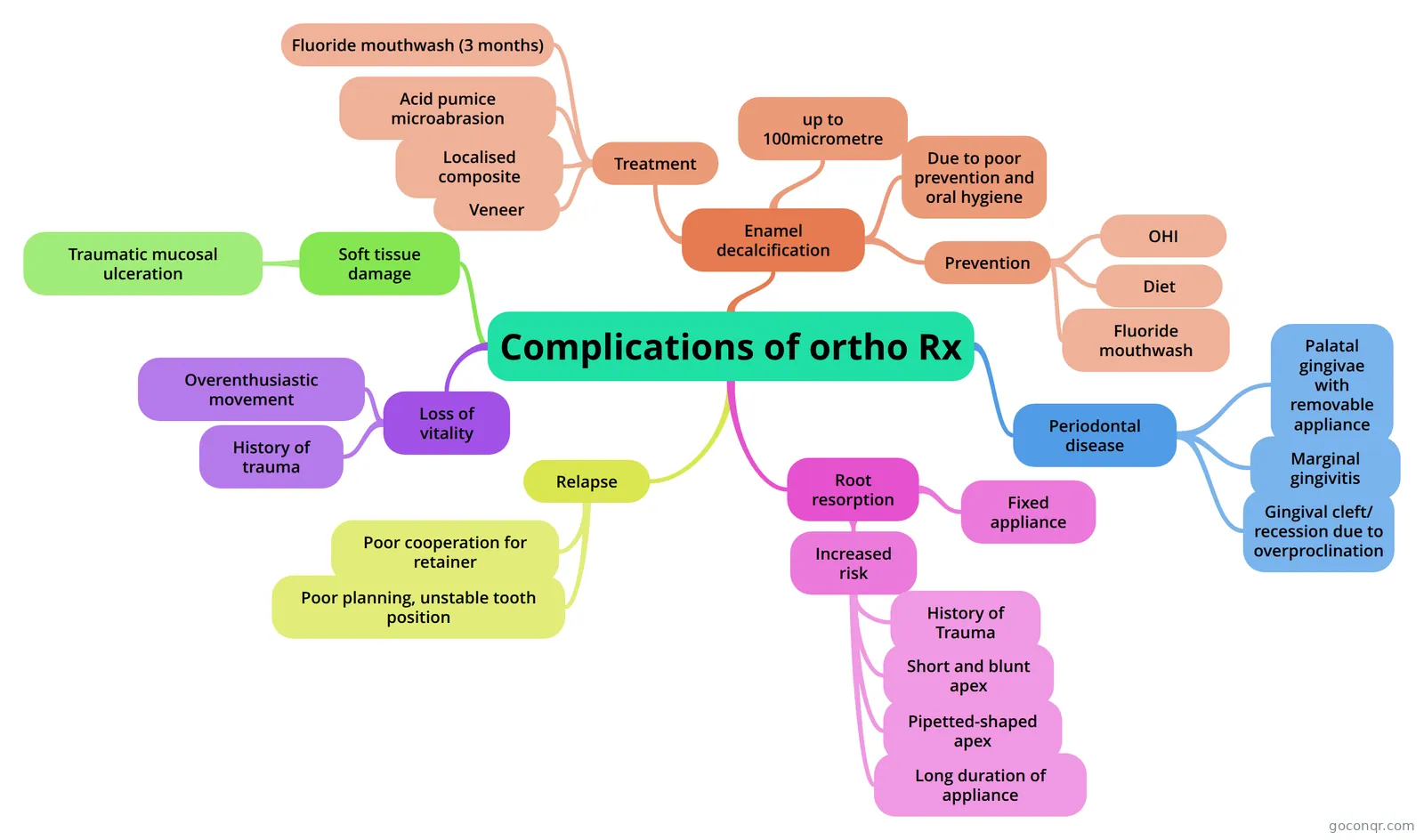
Flashcards
See all 39 flashcardsTopics in Orthodontics and Craniofacial Growth
More Dentistry topics
About Orthodontics and Craniofacial Growth
GoConqr OriginalWhat this unit covers
The page brings together growth and clinical orthodontics. On the growth side, the mind map Development and growth of the jaws walks through secondary palate formation, including the two palatine shelves growing from the maxillary process toward the midline. The flashcard deck on the mechanisms of post-natal growth asks about the regions of the craniofacial complex and the fontanelles. Further decks cover endochondral and intramembranous bone formation.
On the clinical side you will find maps on the causes of malocclusion, crossbites, overbite, anterior open bite, and complications such as enamel decalcification, root resorption and relapse.
Where to start
- Begin with the growth maps, then the Growth and Development map.
- Move to the etiology of malocclusion and the local causes of malocclusion.
- Work through the vocabulary decks: Clinical Terms/Procedures and Appliances and Components.
- Then try the numbered flashcard series, which start with Orthodontics I and run through to Ortodontics X.
Using quizzes and maps together
Read a mind map first to see how a topic hangs together. Then take a quiz without notes. The Dental OSCE quiz 1 asks whether an impacted canine is palatal or buccal to the centrals, using a shift of the x-ray tube. It makes a good test of whether you can apply what you have read. Quizzes on general concepts of growth and on facial growth and development suit the growth topics.
When a question catches you out, go back to the matching map or deck and read that branch again.
Syndromes, referral and treatment planning
Several maps deal with conditions and decisions. Abnormalities of teeth (check RCS) links ectodermal dysplasia, hypodontia and cone-shaped teeth to Down's syndrome and cleft lip and palate. Others cover when to refer to an orthodontist, interceptive orthodontics and early treatment in mixed dentition.
Where it sits
This unit belongs to the Oral Surgery, Orthodontics and Paediatric Dentistry strand of Dentistry. Choose one map or deck today and see how far you get with it.
Frequently asked questions
Which resource should I open first?
Start with the mind map on the development and growth of the jaws if you want the growth background. If you would rather test yourself straight away, try Dental OSCE quiz 1 on impacted canines. Either way, follow up with a related flashcard deck.
What do the mind maps cover?
They range from jaw growth and secondary palate formation to the causes of malocclusion, crossbites, overbite, open bite, appliance types and complications of treatment. Others cover hypodontia, Down's syndrome, cleft lip and palate, and when to refer a patient to an orthodontist.
Are the resources free to use?
Yes. Every resource listed here is free to open, study and take, with no account needed. A free account additionally saves your quiz scores and lets you make your own quizzes, mind maps, flashcards and notes.
Who made these resources?
They were made by GoConqr users, not by GoConqr itself. Contributors have shared their own maps, decks and quizzes, so styles differ. It is worth checking anything important against your course materials.
Which levels do they suit?
Most of the resources are aimed at university students, with a smaller share for professional candidates. Teachers can also use them as ready-made material. No exams are named in the listed resources, so use them alongside your own syllabus.
What if the topic I need is missing?
Browse the maps and decks by title first, as many topics sit inside broader resources. If nothing fits, you can make your own quiz, map or flashcards with a free account and build the topic yourself.