
Laboratory Diagnostics mind maps
32 mind maps by 28 users
This Laboratory Diagnostics page gathers over 30 community-made mind maps on blood chemistry, electrolytes and urinalysis. They support university students and professional candidates practising laboratory diagnostics, and teachers looking for material at university and professional level. Choose a map to begin.
Mind maps
-
Diagnostic Procedure
-
Intro to Clinical Pathology & Clinical Biochemistry 1
-
Laboratory (Blood Chemistry)
-
Combur⁹ Test
-
CROMATEST uro
-
TECHNIQUE OF THE ELEMENTARY AND MICROSCOPIC EXAMINATION OF URINE
-
TECHNIQUE OF THE ELEMENTARY AND MICROSCOPIC EXAMINATION OF URINE
-
Laboratory tests (II)
-
A-SERIES : Urianalysis Reagent Strips
-
Combur⁹ Test Cobas
-
Combur 10 Test
-
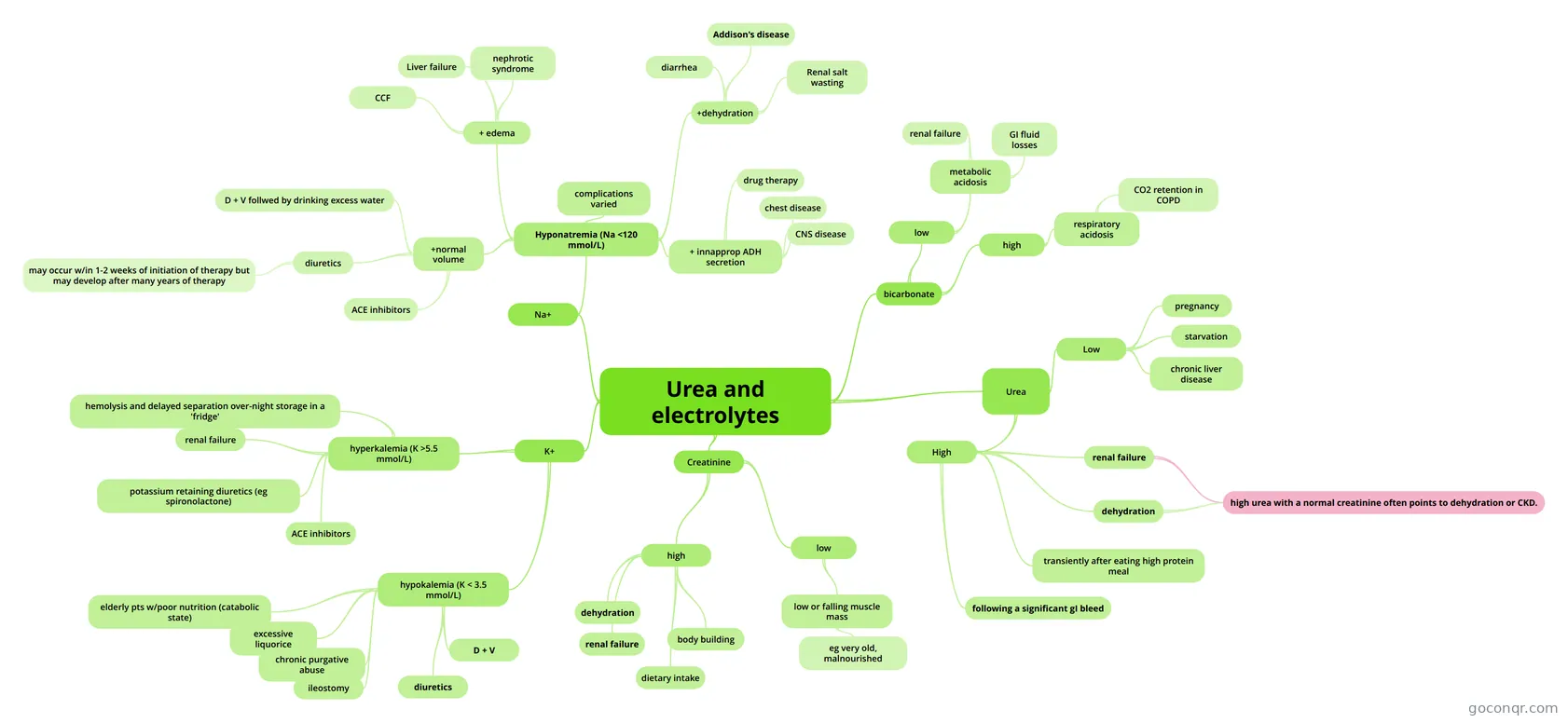 Urea and electrolytes
-
A-SERIES
-
Biochemistry
-
Urine Strip of Vademecum
-
DIAGNOSTIC PROCEDURES: COMPLETE BLOOD COUNT MODULE 11: DIAGNOSTIC PROCEDURES (COMPLETE BLOOD COUNT)
-
Method for performing microscopic examination of urinary sediment:
-
Routine Tests in Clinical Chemistry Section
-
Obesity
-
ELEMENTARY AND MICROSCOPIC URINE
-
Urinalysis
-
Clinical Pathology
-
A-Series
-
Urine Strip
-
Combur 10 Test
-
COMBUR INSERT
-
SIEMENS -Multistix
-
Liver disease - needs finshed
-
Detecting Proteinuria
-
Measuring Specific Gravity of Urine
-
Casts
-
cbc red flags
More Laboratory Diagnostics resources
About laboratory diagnostics mind maps
GoConqr OriginalLaboratory diagnostics mind maps
These maps organise laboratory topics into branches. Laboratory (Blood Chemistry) includes serum protein, lipase and amylase, while Urea and electrolytes covers electrolyte changes. Other maps focus on urine tests, including Combur 10 Test and a map on the microscopic examination of urinary sediment.
How to use the maps
Start with Laboratory (Blood Chemistry) if you want to follow several blood chemistry topics in one map. Read the main branches first, then return to the details under each one. For a narrower urine topic, look at Measuring Specific Gravity of Urine or Detecting Proteinuria.
After studying a map, try recalling its branches without looking. If you want to practise recall in a different way, switch to flashcards or a quiz on the unit page. Explore a map that matches the topic you are working on.
Frequently asked questions
Which mind map is a useful starting point?
Laboratory (Blood Chemistry) is a starting point for blood chemistry. Its branches include serum protein, lipase and amylase, so you can follow several related topics in one resource. For electrolytes, Urea and electrolytes offers a more focused map.
Are the mind maps free to use?
Yes. Every mind map listed here is free to open and study without an account. The resources were made by GoConqr users, not by GoConqr. A free account also lets you save quiz scores and make your own quizzes, mind maps, flashcards and notes.
What do the urinalysis mind maps cover?
The selection includes maps on urine test strips, microscopic examination of urinary sediment, specific gravity and proteinuria. Combur 10 Test is one of the strip resources, while Measuring Specific Gravity of Urine and Detecting Proteinuria focus on individual urine topics.