
Learning Styles and Multiple Intelligences mind maps
402 mind maps by 357 users · Page 1 of 11
This page gathers mind maps on learning styles and multiple intelligences, from VARK to Gardner’s intelligences. They give university students and school students ways to compare models, and teachers material to use in their teaching. There are over 300 maps made by more than 290 GoConqr users, covering school and university levels. Choose a map to explore.
Mind maps
-
MULTIPLE INTELLIGENCES BY HOWARD GARDNER Inteligencias múltiples de Howard Gardner
-
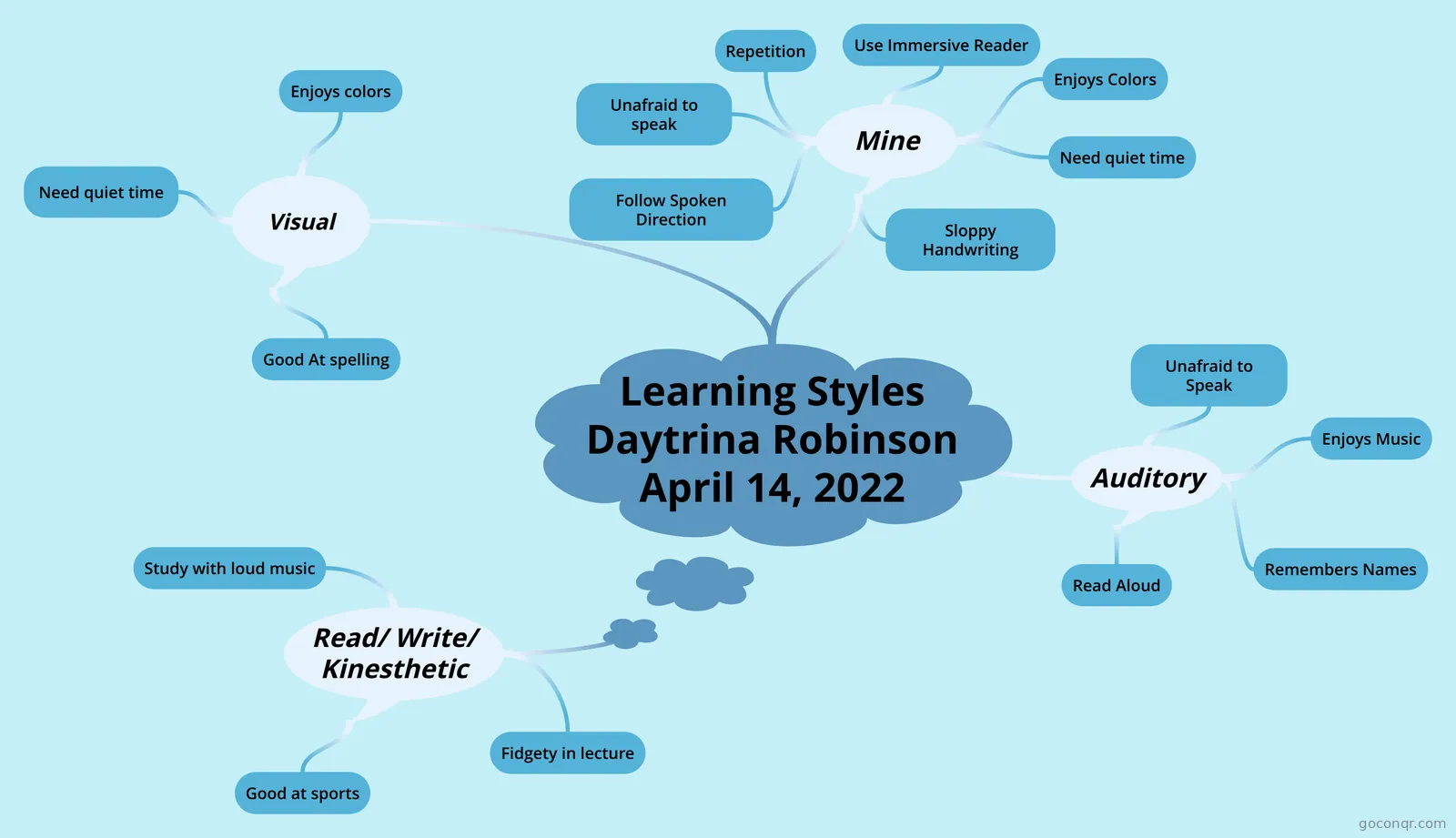 Learning Styles Daytrina Robinson April 14, 2022 3 Learning Styles vs. My Learning Style
-
KINESTHETIC LEARNERS A brief description of the Kinesthetic Learners.
-
Multiple Intelligences (MI)
-
Multiple intelligences
-
“STYLES AND STRATEGIES” (chapter 5)
-
How motivation affects learning and learning styles
-
MULTIPLE INTELLIGENCES IN EDUCATION
-
Learning Styles and Strategies
-
Class topic "hobbies", resource for the class board games as a strategy to facilitate learning by applying the Felder and Silverman Model and the Kolb's Model to enhance learning styles in 11-year-old students.
-
Visual and Auditory Learning Style
-
Howard Gardner’s Theory of Multiple Intelligences
-
INTROVERT STUDENTS
-
Learning Styles
-
MULTIPLE INTELLIGENCES
-
multiple intelligences
-
Theory of Multiple Intelligences, By: Rebecca Olli 5/9/22
-
Fleming´s VAK Models
-
Learning styles
-
Learning Styles and Teaching mind map learning styles
-
Visual and Auditory Learning Style
-
VARK
-
Gardner’s Multiple Intelligences
-
Main characteristics of learning style
-
Multiple intelligences
-
Learning Style Model.
-
Learning in Many Colors
-
MULTIPLE INTELLIGENCES
-
Learner Styles
-
Multiple Intelligences
-
Multiple Intelligences
-
The different multiple intelligences
-
MULTIPLE INTELLIGENCES
-
MULTIPLE INTELLIGENCES
-
LEARNING STYLES AND STRATEGIES
-
Multiple Intelligences
-
Gardner’s Multiple Intelligences
-
MULTIPLE INTELLIGENCES
-
Multiple Intelligences and Learning Styles
-
Enter text here
More Learning Styles and Multiple Intelligences resources
About learning styles and multiple intelligences mind maps
GoConqr OriginalLearning Styles and Multiple Intelligences mind maps
These maps organise ideas into branches, making it easier to see how terms and examples relate. Multiple Intelligences and Learning Styles is a useful starting point because it brings both topics together. Its branches include musical, interpersonal and bodily-kinaesthetic intelligences alongside learning styles.
For a closer look at one model, VARK sets out visual, aural, read/write and kinaesthetic categories. Gardner's Multiple Intelligences lists types of intelligence alongside activities such as reading, listening and composing.
Revise with the maps
Follow the branches of one map, then cover them and try to recall the main terms. Compare your notes with another map, such as Learning Styles and Strategies, which includes active and reflective learners. If you want to check recall in a different way, switch to flashcards or a quiz on the unit page. Then return to a map to revisit a branch.
Try a map and see which connections you can recall.
Frequently asked questions
Which mind map is a good place to start?
Multiple Intelligences and Learning Styles brings both topics onto one map, so it is a useful starting point for comparing them. Its branches include visual/spatial, musical/rhythmic and interpersonal intelligences. From there, VARK offers a closer look at one learning styles model.
What do the mind maps cover?
The maps cover learning styles, teaching, motivation and multiple intelligences. For example, Learning Styles and Strategies includes active and reflective learners, while Gardner's Multiple Intelligences lists types such as musical, spatial and interpersonal. The map on motivation also discusses analytic and global learning styles.
Are the mind maps free to use?
Yes. Every resource listed here is free to open and study without an account. The maps were made by GoConqr users rather than by GoConqr. A free account also lets you make your own quizzes, mind maps, flashcards and notes, and save quiz scores.