
Learning Styles and Multiple Intelligences
436 resources created by 386 users
This Learning Styles and Multiple Intelligences page on GoConqr gathers community-made mind maps, flashcards, quizzes and notes, from VARK and Fleming's VAK models to Howard Gardner's eight intelligences. It's built for university students, school students and teachers after ready-made material, and they can use it to compare models, sort out key terms and test what they remember. There are over 300 resources here, including more than 300 mind maps and 3 quizzes, pitched mostly at university and secondary level. Open a map, try a quiz, then build your own.
Top Learning Styles and Multiple Intelligences resources
-
Mind map MULTIPLE INTELLIGENCES BY HOWARD GARDNER Inteligencias múltiples de Howard Gardner
-
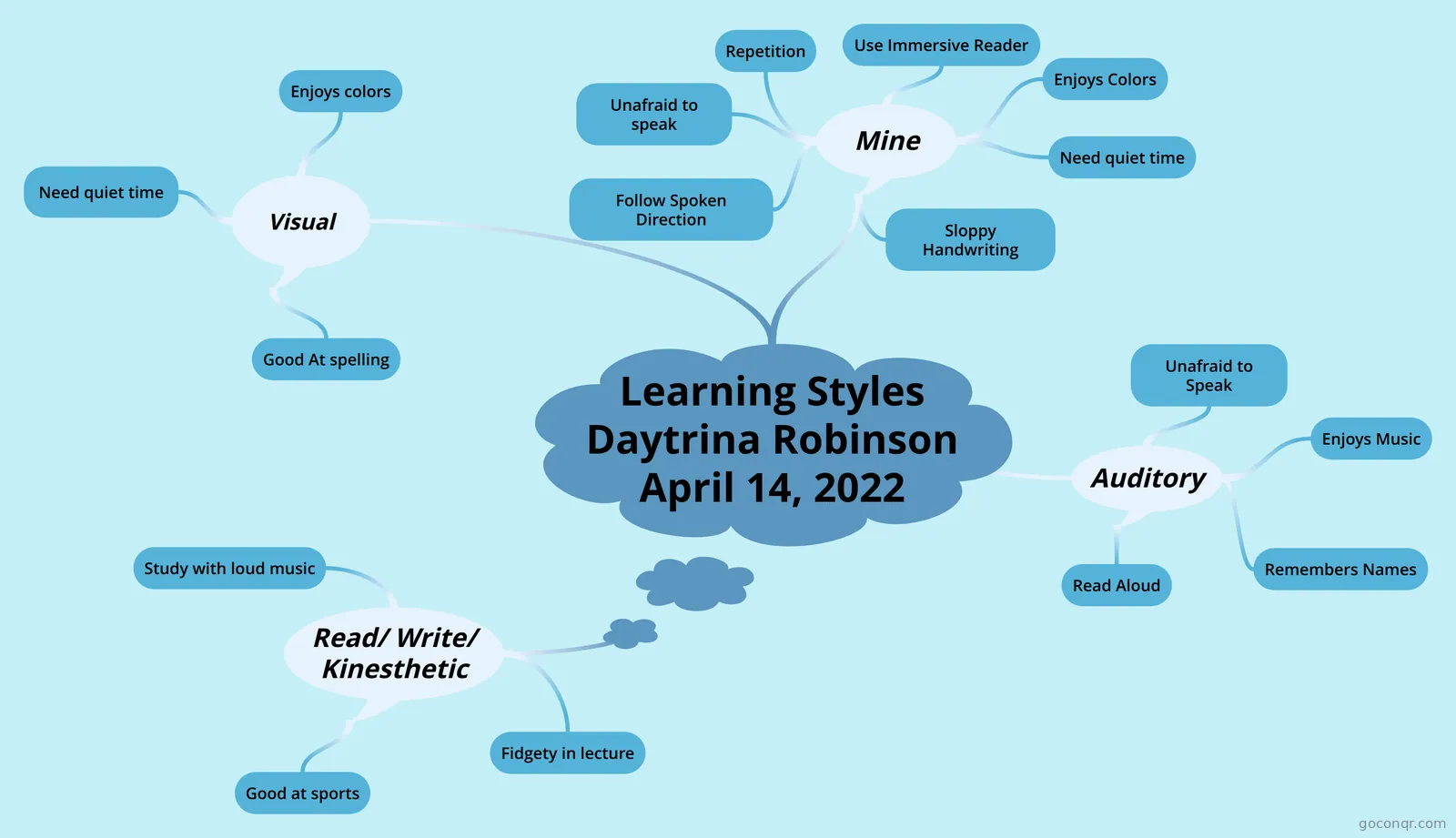 Mind map Learning Styles Daytrina Robinson April 14, 2022 3 Learning Styles vs. My Learning Style
-
Mind map KINESTHETIC LEARNERS A brief description of the Kinesthetic Learners.
-
4 cardsThe Social-Interpersonal learning style The Social - Interpersonal Learning Style
-
Mind map Multiple Intelligences (MI)
-
Mind map Multiple intelligences
-
Mind map “STYLES AND STRATEGIES” (chapter 5)
-
Mind map How motivation affects learning and learning styles
Quizzes
-
8 questionsMultiple Intelligences Connect it to your personal life, make choices with regard to it, reflect on it
-
5 questionsLearning Styles These learners like to use words. They like to write and speak.
-
5 questionsLearning styles The 3 types of learning styles are Visual, Auditory, and Kinesthetic ?
-
5 questionsLearning styles The 3 types of learning styles are Visual, Auditory, and Kinesthetic ?
-
5 questionsClass Survey How do you like to work?
-
1 questionsLearning Style Test I can remember more about something new by talking about it rather than reading about it.
Mind maps
See all 402 mind maps-
MULTIPLE INTELLIGENCES BY HOWARD GARDNER Inteligencias múltiples de Howard Gardner
-
Learning Styles Daytrina Robinson April 14, 2022 3 Learning Styles vs. My Learning Style
-
KINESTHETIC LEARNERS A brief description of the Kinesthetic Learners.
-
Multiple Intelligences (MI)
-
Multiple intelligences
-
“STYLES AND STRATEGIES” (chapter 5)
-
How motivation affects learning and learning styles
-
MULTIPLE INTELLIGENCES IN EDUCATION
Flashcards
-
4 cardsThe Social-Interpersonal learning style The Social - Interpersonal Learning Style
-
12 cardsWeek Seven What is intelligence?
-
8 cardsMultiple Intelligences
-
5 cardsMultiple intellligences II
-
4 cardsMultiple intelligences 1 Impact in teaching
-
3 cardsDifferent Learning Styles DIFFERENT LEARING STYLES
-
3 cardsUntitled
Flowcharts
Notes
-
INTROVERT STUDENTS - created from Mind Map Learning styles of introverts Lessons fit to introverts Conclussion
-
Activity one What Is Meant by Learning Style Learning styles are described above as “preferences” which is meant to suggest that one or another aspect of a learning style dimension is as good as the others. In order to make the me...
-
Multiple intelligences and language learning - created from Mind Map Visual-Spatial Intelligence Linguistic-Verbal Intelligence: Logical-Mathematical Intelligence
-
Mutiple Intelligeces - created from Mind Map linguistic :love reading writing telling stories playing word games LOVE:signing whistlin humming tappin feed and hands, listening.NEED:sing-along time , trips the concerts music playing at home and school,musical ins...
-
Learning Styles Elizabeth Fritzler June 2, 2022 - created from Mind Map Visual Auditory Verbal
-
VARK - created from Mind Map Visual Auditory Reading
-
Learning Styles - created from Mind Map Different Learning Styles Visual Kinesthetic
-
How to Improve Learning of the Right Side of the Brain - created from Mind Map Possible occupations Teaching Techniques Characteristics of Right Brain Learners
Slides
Topics in Learning Styles and Multiple Intelligences
More Education and pedagogy (incl. teaching methods, curriculum, educational psychology) topics
About Learning Styles and Multiple Intelligences
GoConqr OriginalWhat this page covers
The resources here look at two linked ideas: how people prefer to learn, and how many kinds of intelligence they might have. Most are mind maps made by GoConqr users, with a smaller set of flashcards, notes, flowcharts and quizzes.
Learning styles
Several maps set out the main models. VARK and Fleming´s VAK Models split learners into visual, auditory, read/write and kinesthetic types. KINESTHETIC LEARNERS lists hands-on ideas such as building models and doing science labs. LEARNING STYLES AND STRATEGIES covers active and reflective, sensing and intuitive, visual and verbal, and sequential and global learners. Another map looks at how motivation affects learning styles, including analytic and global learners.
The slide set Solitary-intrapersonal learning style describes learners who work best alone and quietly. The flashcard deck The Social-Interpersonal learning style covers strategies, techniques and activities for people who learn through talking with others.
Multiple intelligences
The map MULTIPLE INTELLIGENCES BY HOWARD GARDNER opens with Gardner's view that human life needs different kinds of intelligence. Others list the types, including visual-spatial, musical, logical-mathematical, intrapersonal, interpersonal, naturalist, bodily-kinesthetic and verbal-linguistic. The deck Week Seven asks what intelligence is, what Sternberg's Triarchic model is and what naturalist and existentialist intelligences are.
Where to start
- Open Multiple Intelligences and Learning Styles to see both ideas on one map.
- Move to a single model, such as VARK or Gardner's eight intelligences.
- Check your recall with the flashcard decks.
- Take one of the quizzes, such as Learning Style Test, and revisit any map where you hesitated.
How it fits
This unit sits in the Learning and Development strand of Education and pedagogy. Pick a map that matches your level, then make a version of your own with your examples.
Frequently asked questions
Where should I start on this page?
Start with the mind map Multiple Intelligences and Learning Styles, which puts both ideas side by side. After that, choose a single model, such as VARK or Gardner's eight intelligences, and use the flashcard decks to fix the key terms in your memory.
What do the mind maps cover?
Most of the resources are mind maps. They cover VARK and VAK, kinesthetic learners, active and reflective learners, analytic and global styles, motivation, and Gardner's intelligences such as visual-spatial, musical, naturalist and interpersonal. Some also link the ideas to classroom activities.
Are the resources free to use?
Yes. Every resource listed here is free to open, study and take, with no account needed. They were made by GoConqr users, not by GoConqr itself. A free account also saves your quiz scores and lets you make your own quizzes, mind maps, flashcards and notes.
Which quizzes are there?
There are 3 quizzes, including Learning Style Test and Multiple Intelligences. Some resources share similar titles, so open a couple to see which suits you. Use them after reading a map to find what you still need to review.
Who is this page for?
It suits university students, school students and teachers. Students can compare models and test their recall. Teachers can use ready-made maps, slides and flashcards as a starting point. The mix leans towards university and secondary level.
What if I can't find what I need?
Try a neighbouring term, such as VARK, VAK or Gardner, since the same idea often appears under different titles. If a topic is still missing, you can make your own map or flashcards from the material you already have.