
Legal Systems and Traditions
71 resources created by 64 users
This Legal Systems and Traditions page on GoConqr gathers community-made mind maps, quizzes, flashcards and notes, from court hierarchies and sources of law to juries, magistrates and comparative traditions such as Islamic, Hindu and Roman law. It's built for university students and professional candidates, school students, and teachers after ready-made material. There are over 400 resources here, including more than 30 quizzes and over 200 mind maps, with material suited to A-level Law and GCSE Law as well as university study. Pick a topic, try a quiz, then make your own set.
Top Legal Systems and Traditions resources
-
32 questionsAccess to Justice Why is access to justice important? a) In civil cases: b) In criminal cases:
-
 Mind map MALAYSIAN LEGAL SYSTEM
-
 Mind map Irish Law/ Court System 07.02.16
-
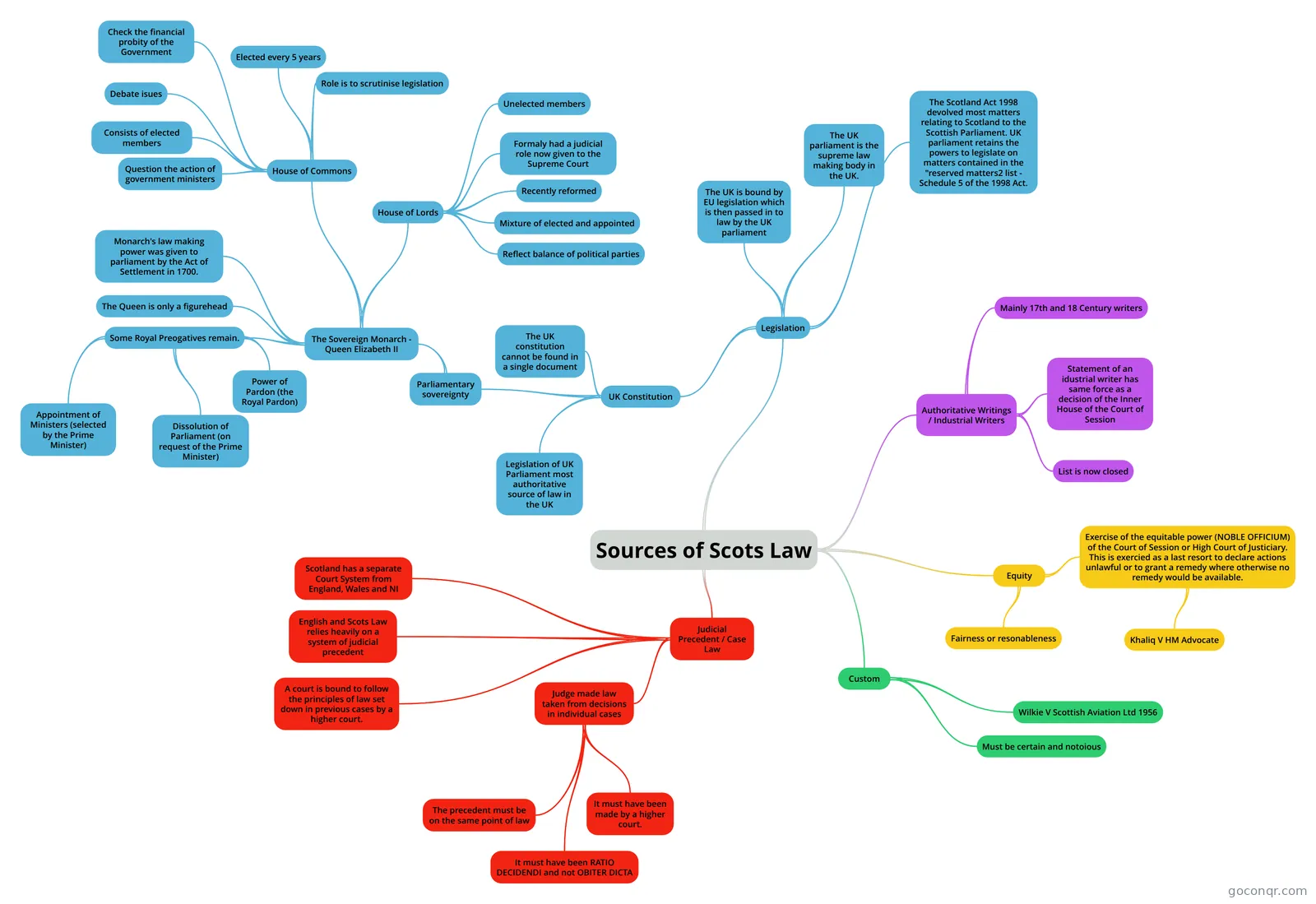 Mind map Sources of Scots Law Highlights the main sources of Scots law
-
Mind map The Australian Court System Loading...
-
Mind map Our Legal System Mind Map Ch. 15 & 16
-
33 questionsAlternative Dispute Resolution Why is ADR becoming more popular?
-
Mind map Legal System Legal
Quizzes
See all 10 quizzes-
32 questionsAccess to Justice Why is access to justice important? a) In civil cases: b) In criminal cases:
-
33 questionsAlternative Dispute Resolution Why is ADR becoming more popular?
-
20 questionsLegal Studies Year 11 half-yearly Wendy appeals to the district court against a local court decision. this relates to which of the following ...
-
10 questionsLegal Term 1 Influences on our Laws include...
-
7 questionsLegal Proffession Barristers What does it mean when barristers provide opinions on point of law?
-
6 questionsThe Legal System Laws, Rules and Social Customs. The Rule of Law.
-
7 questionsTopic 1 Legal Studies (2) What are the three features of the Australian Federation?
-
16 questionsUntitled_4 “Vishakha case decision" of the Apex Court relates to subject of
Mind maps
See all 37 mind maps
Flashcards
See all 21 flashcards-
43 cardsUnit 1 - The legal system - The criminal courts What are the three classifications of criminal offences within England and Wales?
-
60 cardsCPCU 530 Civil Law Systems
-
77 cardsCONTRACT LAW Corpus Iuris Civilis comprised four parts:
-
10 cardsAustralian Legal System WHY DO WE HAVE LAWS?
-
29 cards01 – The Canadian Legal System Law is a
-
36 cardsJURIES WHICH CASE ESTABLISHED THAT JUDGES CAN NOT CHALLENGE THE DECISION OF THE JURY?
-
23 cardsClassic domicile Domicile determined per the lex fori
-
55 cardsRoman Law June 2019 Communio est mater rixarum
Notes
-
English Legal Terminology - Legal System (Summary of: Helen Gubby - English Legal Terminology 3rd edition)) INTRODUCTIONIn this world there 2 most used Legal System; the Common Law System (USA, UK, HK etc) and the Civil Law System (Most EU Countries etc). Here we will talk about them. A. Common Law System C...
-
Court Hierarchy
Slides
More Law (general and introduction) topics
About Legal Systems and Traditions
GoConqr OriginalWhat the page covers
The resources compare how different jurisdictions are organised. Several mind maps map out national systems: The Australian Court System, MALAYSIAN LEGAL SYSTEM, Irish Law/ Court System 07.02.16 and Sources of Scots Law. They set out the courts, the split between criminal and civil law, and where law comes from, such as the constitution, legislation, custom and judicial precedent.
Where to start
Begin with a broad overview. Our Legal System is a mind map that separates criminal, civil, constitutional and administrative law. Sources of Law sets out common law, customary law and statute law. Once those ideas are clear, move to the court-focused maps and the flashcards on the legal system in your own jurisdiction.
Going deeper
The page also covers the people and processes inside a legal system. You will find material on juries, lay magistrates, tribunals, the judiciary and the legal profession. For dispute resolution, the Alternative Dispute Resolution quiz asks why ADR is becoming more popular and what arbitration is, while the Access to Justice quiz looks at legal aid.
There is also a historical and comparative strand, with resources on Roman law, codifications, Islamic law, Hindu law and civil versus common law.
Using maps and quizzes together
- Read a mind map and try to explain each branch aloud.
- Take a quiz on the same topic, such as Tribunals or Civil vs Common Law.
- Note the questions you missed and go back to the map.
- Use flashcards for definitions and case names.
Where it fits
This unit sits in the Legal Systems and Institutions strand of Law (general and introduction). Every resource here was made by GoConqr users, so check a map against your own course materials and choose the ones that match your syllabus. Open a quiz to see what you already know, then build your own flashcards for the gaps.
Frequently asked questions
Which resource should I open first?
Start with the mind map Our Legal System for a quick split between criminal, civil, constitutional and administrative law. Then open Sources of Law to see how common law, customary law and statute fit together. After that, pick the map for your own jurisdiction, such as the Australian, Irish, Scottish or Malaysian system.
Which legal systems do the mind maps cover?
The maps cover several systems, including Australian, Irish, Scottish, Malaysian, Canadian and American material across the wider page. They also include Islamic legal maxims, Roman law and codification history. Check the title and excerpt first, since each resource was made by a different user and may follow a different course.
Are the quizzes and flashcards free to use?
Yes. Every resource listed here is free to open, study and take, with no account needed. If you want your quiz scores saved, or want to make your own quizzes, mind maps, flashcards and notes, a free account lets you do that.
Which levels and exams does this suit?
The page mixes university and school material in roughly equal parts, with a small share for professional candidates. Listed resources mention A-level Law, GCSE Law and Legal Studies. Teachers can use the ready-made maps and quizzes in lessons or revision.
What topics beyond court structure are included?
You will find juries, lay magistrates, tribunals, the judiciary and legal professions such as barristers. There are also resources on alternative dispute resolution, access to justice and legal aid, fair trials, and comparative traditions including Hindu law and Islamic law.
What if my topic is missing?
Try a nearby title, as similar topics often appear under different names, such as Juries or Magistrates. If you still cannot find what you need, you can make your own mind map, flashcards or notes with a free account and build exactly the set you want.