
Media Effects and Influence
109 resources created by 98 users
This Media Effects and Influence page on GoConqr gathers community-made mind maps, flashcards, quizzes and notes, from the hypodermic needle theory and cultivation theory to violent media, advertising and moral panics. It's built for school students, university students and professional candidates revising theories and building essay arguments, and for teachers after ready-made material. There are over 100 resources here, including more than 60 mind maps, 29 flashcard decks and 10 quizzes, pitched mostly at school level with a good share for university. Start with a quiz to spot your gaps.
Top Media Effects and Influence resources
-
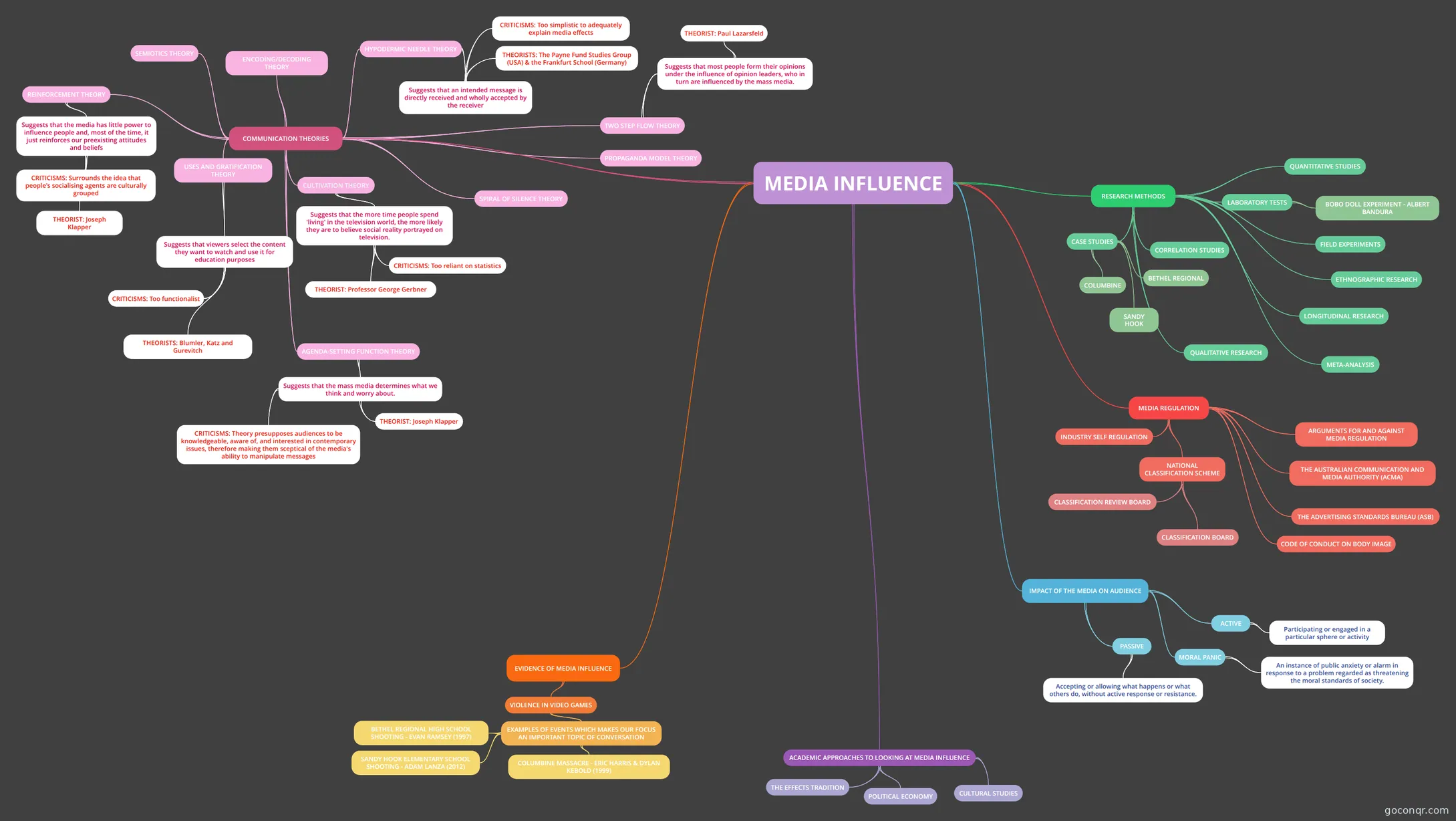 Mind map MEDIA INFLUENCE ~
-
70 questionsCOMM Which of the following could be described as a media effect?
-
42 questionsM who said criminology and social psychology has public attitudes at the centre of it?
-
55 questionsChildren & The Media OFCOM released statistics from a survey conducted in 2009, representative of more than a thousand families ...
-
Mind map Media
-
41 cardsMMAS2 High Risk contexts that encourage violence
-
Mind map Silverstone-mediation - conceptualizing media
-
Mind map MEDIA IMPACT ON CHILDHOOD
Quizzes
See all 11 quizzes-
70 questionsCOMM Which of the following could be described as a media effect?
-
42 questionsM who said criminology and social psychology has public attitudes at the centre of it?
-
55 questionsChildren & The Media OFCOM released statistics from a survey conducted in 2009, representative of more than a thousand families ...
-
28 questionsGauntlett's ten flaws with the effects model Tests your knowledge on Gauntlett's ten flaws.
-
16 questionsStudies for Media Effects Quizzes knowledge of different studies that argue for the media effects debate
-
7 questionsThe Hypodermic Syringe Model Is the hypodermic syringe an active or passive model of media?
-
4 questionsReferences
-
5 questionsQuotes supporting media effects Quotes supporting media effects
Mind maps
See all 65 mind mapsFlashcards
See all 29 flashcards-
41 cardsMMAS2 High Risk contexts that encourage violence
-
11 cardsLecture 9: TV & Videogames US TV statistics
-
14 cardsCOM101_14 Mass Media Scholarship
-
7 cardsThe Effects Debate Who developed the Catharsis Theory?
-
4 cardsDigital Age Flash Cards This theory that presumes that society’s technology drives the development of its social structures and cul...
-
4 cardsChildren and Young people in the Digital Age - Week 46 A perspective which assumes a society’s technology stimulates the development of its social structure and c...
-
4 cardsDigital Technology Definitions A perspective that assumes digital technology is influencing the development of cultural and structural val...
-
4 cardsKey terms A perspective that dis-empowers people as a powerless to stop these changes, unless new technologies are in...
Notes
-
Class 2 Notes (Monday, February 2nd) -The film is the message. No longer suspicious of emotionNo longer suspicious/resistant to Hollywood FilmNo longer reading the film for ideological messagesPaying attention to how the movies make us feelIdeology comes...
-
Reading Quotes Week 1 Dillon Just Reading Quotes 1 1. “Media use may also have the benefit of helping individuals expand their horizons. Transportation creates an openness to new information. By leading individuals to appreciate truths abo...
-
Media Pro-Social BehaviourAnti-Social BehaviourIntense FandomStalkingEffects of Video Games - AggressionEffects of Video Games - PositiveHovland-YaleElaboration Likelihood ModelAttraction of Celebrity Pro-Social BehaviourSo...
Slides
Topics in Media Effects and Influence
More Media studies topics
About Media Effects and Influence
GoConqr OriginalWhat this unit covers
This page sits in the Media, Society and Culture strand of Media studies. It brings together the big question of whether and how media shape what people think and do. The resources were made by GoConqr users, and several mention A-level Media Studies.
Theories to start with
Begin with the mind map MEDIA INFLUENCE. It lays out the main communication theories side by side: hypodermic needle, agenda-setting, cultivation, spiral of silence, propaganda model, reinforcement and two step flow. Then try Media Persuasion: The Hovland-Yale Model for how persuasion is explained, including parental mediation.
Next, look at the debate. The map Essay Question: Direct media effects are very difficult to prove compares hypodermic needle, two-step flow, reception theory, cultivation and uses and gratification. Active audience approaches and Selective Filter Model show the other side of the argument.
Case studies and debates
- Violent media: the map Violent Media, plus Does violent media affect behaviour? and Bandura's Media Effects.
- Children: the map on media impact on childhood, which notes how new technology is often feared.
- Advertising: the map on explanations for the persuasiveness of TV ads covers endorsement, children and hard-sell versus soft-sell.
- Critique: 10 Things Wrong with the Media Effects Model.
Using quizzes and maps together
Read a map first, then test yourself. The quiz The Hypodermic Syringe Model checks one theory, while Gauntlett's ten flaws with the effects model tests the criticisms. Studies for Media Effects and Quotes supporting media effects help with evidence for essays. If a quiz answer surprises you, go back to the matching map and note the gap.
Revision routine
Use the flashcard decks for key terms, such as The Effects Debate, then write a short essay plan from a map. Pick one theory today, work through its map and quiz, and see how much you can explain from memory.
Frequently asked questions
Which resource should I open first?
Open the mind map MEDIA INFLUENCE. It sets out the main communication theories in one place, including hypodermic needle, agenda-setting, cultivation, spiral of silence and two step flow. Once you know the names, move on to the persuasion and violent media maps.
Are there quizzes on this page?
Yes, there are over 10 quizzes. They include The Hypodermic Syringe Model, Children & The Media, Gauntlett's ten flaws with the effects model and Studies for Media Effects. Each is free to take with no account, so you can test yourself straight after reading a map.
Who are these resources for?
They suit school students, university students and professional candidates revising theories, evidence and essay arguments, plus teachers looking for ready-made material. Most are at school level, with a good share for university. Some mention A-level Media Studies.
Do the resources cover specific topics like violence or advertising?
Yes. There are maps on violent media, video game violence, TV advertising persuasion, moral panics, body image, social media and teenagers, and the CSI effect. Together they give you case studies to back up the general theories in your essays.
Are these free, and who made them?
Every resource listed here is free to open, study and take, with no account needed. They were made by GoConqr users, not by GoConqr itself. A free account lets you save quiz scores and make your own quizzes, mind maps, flashcards and notes.
What if I can't find the topic I need?
Try the broader maps such as Media Effects or Media influence, which may touch on it. You can also make your own mind map, flashcard deck or quiz on the missing topic, so your revision fits your course.