
Primates and Primatology
5 resources created by 5 users
This Primates and Primatology page on GoConqr gathers community-made flashcards, quizzes, mind maps, slides and a flowchart, from primate classification and anatomy to behaviour, diet and communication. It's built for university students revising a topic and teachers after ready-made material. There are more than 30 resources here, including more than 5 quizzes, more than 5 mind maps and over 15 flashcard decks, all shared by over 25 contributors. Pick a deck, try a quiz to find your gaps, then build your own.
Top Primates and Primatology resources
-
128 cardsAnthropology 154BN Five reasons why we should study Primates
-
109 cardsExam 2: Primates species: egg laying, most primitive
-
Mind map Lecture 2A ANTH Midterm 2
-
3 cardsSub-orders Sub-orders of Primates with respective traits, including dental formula and skull features.
-
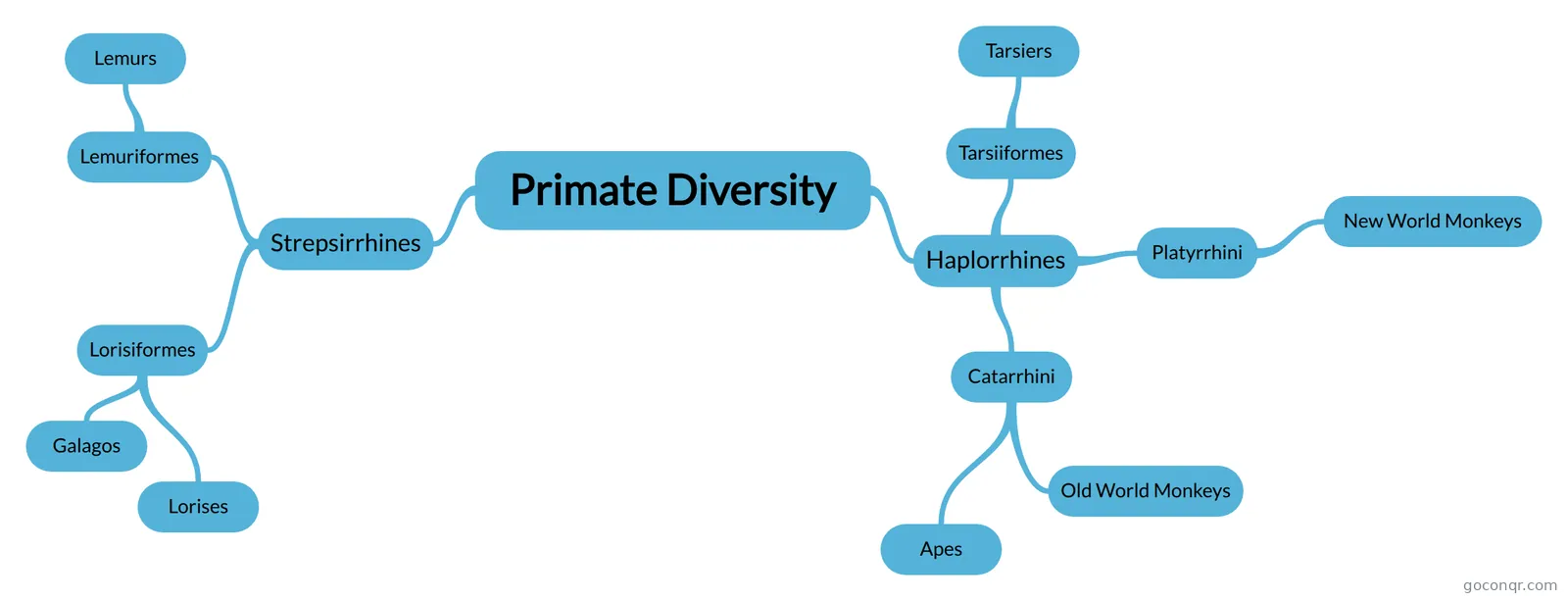 Mind map Primate Diversity Mind map detailing the types of primates and characteristics that define them.
Mind maps
Flashcards
More Anthropology topics
About Primates and Primatology
GoConqr OriginalWhat this unit covers
This unit collects university-level material on primates, mostly as flashcards. Several decks deal with classification. The deck titled Primates walks through suborders, Strepsirhini and Haplorhini, and the New World and Old World monkeys. Bio Anthro Final Chapter 6-7 adds terms such as Euarchonta, Catarrhini, Platyrrhini, Cercopithecine and Colobinae, and asks what characterises a primate.
Where to start
Begin with the classification decks, since later topics build on the names and groups. Then move to Anthropology 154BN, which asks why we should study primates, what an a priori prediction is and how primates act as an umbrella species in conservation. Primate Behaviour Flashcards 1 covers the wider field, including the four types of anthropology, homology, and the referential and strategic models.
- First: classification decks and the Sub-orders deck.
- Second: reasons to study primates and research method.
- Third: behaviour, diet and social systems.
Using quizzes and mind maps together
Read a mind map first to see how ideas connect. Primate Diversity, Primate origins and Primate Communication And Sociality give you the overview. Human Behavioural Ecology sets out Tinbergen's four why questions, split into proximate and ultimate. Then test yourself. The quiz called Quiz questions asks about dental formulas, male philopatry, dispersal in both sexes and folivores. ANT331 Lecture 4 is a fill-in-the-blank quiz on general primate traits such as stereoscopic vision and the clavicle.
Where it sits
This unit belongs to the Biological Anthropology strand of Anthropology. Some resources also touch on earlier evolutionary history, such as the deck ANT 152 MIDTERM 1, which asks about the Paleozoic Era and tetrapods.
Next step
Teachers can pick decks and quizzes to share with a class. Students can choose one topic today, try a quiz and see what is left to learn.
Frequently asked questions
Which resource should I open first?
Start with the flashcard deck called Primates. It sets out the suborders and the main groups of monkeys, which most other resources here assume you know. Then try the Bio Anthro Final Chapter 6-7 deck for more terms, and test yourself with a quiz.
What do the mind maps cover?
There are mind maps on Primate Diversity, Primate origins, Primate Communication And Sociality, Lecture 2A and Human Behavioural Ecology. Together they run from where primates came from and how they differ to how they communicate, live in groups and explain behaviour.
What can the quizzes help me practise?
The quizzes test dental formulas, social systems such as male philopatry and dispersal, diet groups like folivores, and general traits such as stereoscopic vision. Chapter 9 and Chap 7 are also listed. They suit checking recall after you have read a deck or map.
Are these resources free, and who made them?
Yes. Every resource on this page is free to open, study and take, with no account needed. They were made by GoConqr users, not by GoConqr itself, so wording and focus vary between contributors. Check a few before choosing the ones that match your course.
Who is this page for?
It is aimed at university students revising primates and biological anthropology, and at teachers who want ready-made material. All the listed resources are university level, so they suit degree courses rather than earlier school stages.
What if my topic is missing?
Try the neighbouring decks first, since topics such as taxonomy and sub-orders appear in several. If you still cannot find it, a free account lets you save quiz scores and make your own quizzes, mind maps, flashcards and notes.