
The Night Sky and Celestial Sphere
57 resources created by 52 users
This Astronomy page on GoConqr gathers community-made quizzes, mind maps, flashcards, notes and slide sets on The Night Sky and Celestial Sphere, from celestial coordinates and diurnal motion to constellations, equinoxes and eclipses. It's built for school students, university students and professional candidates revising a topic or filling gaps, and for teachers after ready-made material. There are more than 40 resources here, including more than 8 quizzes, with GCSE Physics among the exams mentioned. Pick a resource, try a quiz to find your gaps, then make your own maps and flashcards.
Top The Night Sky and Celestial Sphere resources
-
50 cardsAstronomy - Charting the Heavens The foundations of astronomy--our place in space, constellations, the celestial sphere, Earth's orbital mot...
-
35 cardsLecture 2: Looking up to the sky
-
20 questionsAstronomy Exam 1 - 4 The amount of time between successive passes of the star Sirius across the meridian is
-
46 cardsscience
-
39 cardsUntitled In the system of celestial coordinates that matches latitude and longitude on the Earth, which is the coord...
-
Mind map Exam 1
-
31 cardsUntitled
-
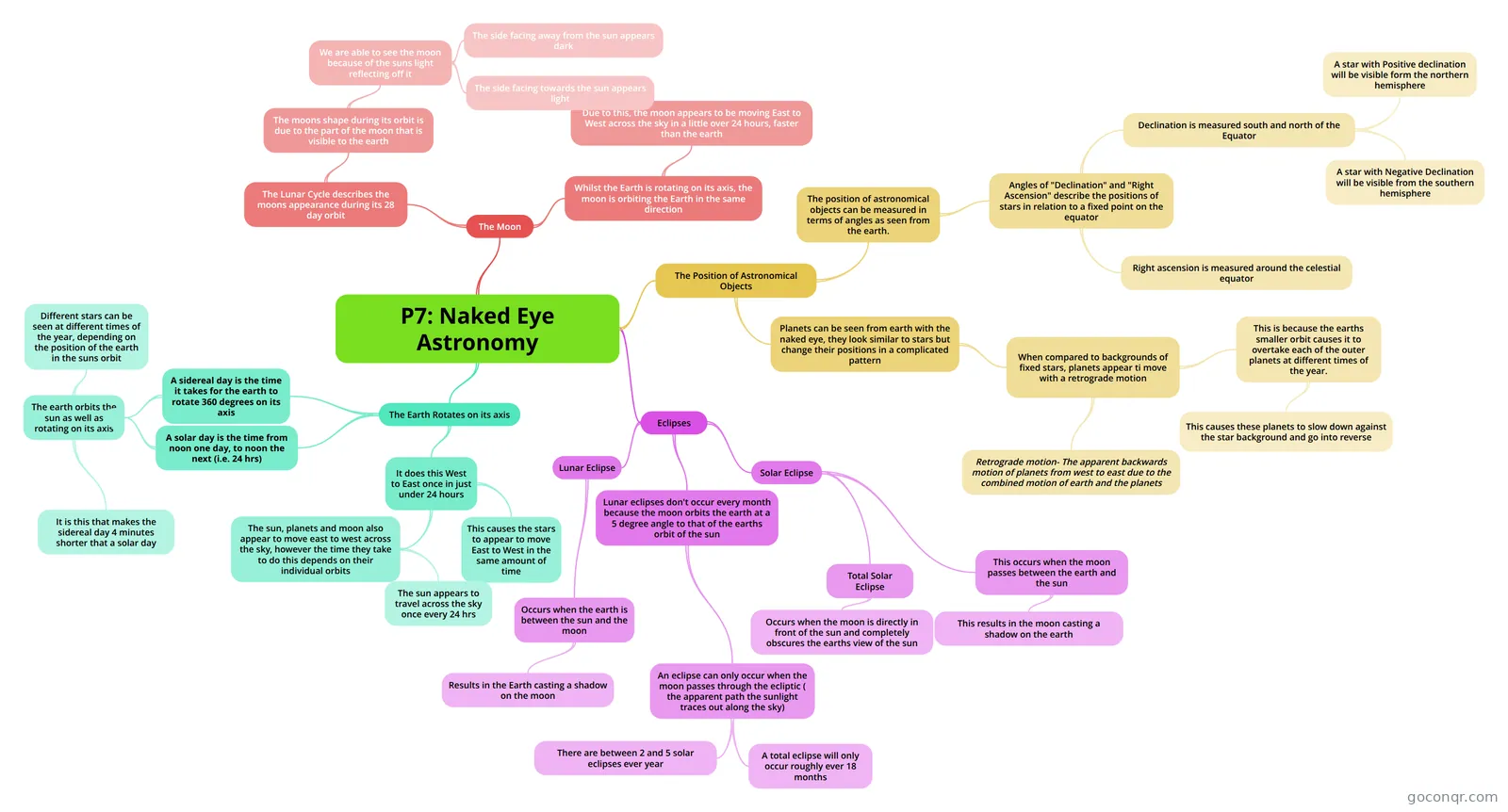 Mind map P7: Naked Eye Astronomy
Quizzes
-
20 questionsAstronomy Exam 1 - 4 The amount of time between successive passes of the star Sirius across the meridian is
-
15 questionsCQ2 no moon You are watching the stars overnight. If the motion of the stars is indicated by the dots, which way are yo...
-
13 questionsCQ1 Observing
-
10 questionsPHYS 1830 What is the Celestial Sphere?
-
32 questionsAstronomy 1 What can be best said about the astronomical events during this fall?
-
10 questionsQUIZ IN SCIENCE 5- CONSTELLATIONS It is a group of stars that form a pattern or outline in the sky.
-
2 questionsUntitled Both the Sun and Moon subtend an angle of about 1/2 degree on the sky. What is the angular size of the Sun ...
-
6 questions8.1 - The night sky - Amir Habib What is the biggest/brightest object in the night sky?
Mind maps
See all 11 mind mapsFlashcards
See all 33 flashcards-
50 cardsAstronomy - Charting the Heavens The foundations of astronomy--our place in space, constellations, the celestial sphere, Earth's orbital mot...
-
35 cardsLecture 2: Looking up to the sky
-
46 cardsscience
-
39 cardsUntitled In the system of celestial coordinates that matches latitude and longitude on the Earth, which is the coord...
-
31 cardsUntitled
-
21 cardsFall-Winter
-
24 cardsAstronomy 1030 What is a constellation?
-
25 cardsSky Science
Notes
-
Untitled Chapter 6: The mysterious universe… 6.1: Observing the night sky… ¨ The celestial sphere rotate above our heads, carrying with it constellations of gleaming stars ¨ Stars appear to wander among the ...
-
astronomy test study material celestial sphere- the apparent dome or sphere of sky surrounding the earth. horizon- the line formed in the distance where the earth and sky appear to meet, 0 degree altitude zenith- the highest point in the celestial...
-
Note 1: The Night Sky There are two different coordinate systems: 1. Right Ascension-Declination Right ascension is analogous to longitude and is measured in hours, minutes, and seconds, from the point of vernal equinox Measur...
Slides
Topics in The Night Sky and Celestial Sphere
More Astronomy topics
About The Night Sky and Celestial Sphere
GoConqr OriginalWhat the resources cover
This unit sits in the Observing the Sky strand of Astronomy. The listed material starts with the basics of what you can see overhead and why it seems to move. The mind map P7: Naked Eye Astronomy explains that the Earth rotates west to east in just under 24 hours, which makes the stars appear to travel east to west. The mind map Physics: Coordinates in Astronomy shows how star positions are measured as angles seen from Earth.
Where to start
Begin with the flashcard deck Astronomy - Charting the Heavens. It defines terms such as celestial sphere, celestial equator, declination, diurnal motion, ecliptic and equinox. Then move to P7: Coordinates in Astronomy, which asks what the pole star is and which two angles are used to fix a position in the sky.
- Read a mind map to see the overall picture.
- Learn the vocabulary with a flashcard deck.
- Test yourself with a quiz.
Using quizzes and maps together
The quiz CQ1 Observing asks about lines of latitude and longitude. CQ2 no moon shows star-trail dots and asks which way you are looking. Try a quiz first, note what you missed, then return to the matching mind map. The mind map Exam 1 is useful here, because it sets out how star motion depends on the Earth's revolution, rotation and your location.
Time, the Moon and constellations
The deck P7: Observing the Sky - Eclipses and The Moon asks how long a sidereal day is compared with a solar day. The deck Sky Science covers seasons and circumpolar constellations. Many other decks and mind maps focus on constellations, including Winter Circle Stars and Northern Hemisphere Constellations.
Make it your own
Once you have worked through a few of these, pick a topic that felt shaky and build your own mind map or flashcard set for it. Teachers can use the slide sets and notes as a ready starting point for a lesson.
Frequently asked questions
Which resource should I start with?
Start with the flashcard deck Astronomy - Charting the Heavens. It covers core terms such as celestial sphere, celestial equator, declination and diurnal motion. After that, move on to the mind map Physics: Coordinates in Astronomy to see how star positions are measured as angles seen from Earth.
What do the mind maps on this page cover?
They cover why stars appear to move east to west as the Earth rotates, how star motion depends on rotation, revolution and your location, and how positions are measured with angles. Others focus on constellations and following the stars across the night sky.
Are the resources free to use?
Yes. Every resource listed here is free to open, study and take, with no account needed. They were made by GoConqr users, not by GoConqr itself. If you create a free account, your quiz scores are saved and you can make your own quizzes, mind maps, flashcards and notes.
Which levels and exams do these resources suit?
The mix leans towards secondary and university material, with some general-interest resources too. GCSE Physics is the exam named in the listed resources. School students, university students and professional candidates can all find something, and teachers can use the notes and slide sets.
Is there anything on eclipses and the Moon?
Yes. The flashcard deck P7: Observing the Sky - Eclipses and The Moon compares a sidereal day with a solar day and asks about the Moon. The deck Astronomy - Charting the Heavens also includes the term annular eclipse in its vocabulary.
What if I can't find the topic I need?
Try a nearby resource first, such as a constellation deck or a coordinates mind map, as they often overlap. If the exact topic is still missing, you can make your own flashcards, mind map or quiz and use the existing ones as a model.