
Fichas
Final Exam Study Guide (Chapter 8)
Fichas del conjunto (29)
- 1Define ConflictConflict is an expressed struggle between at least two interdependent people who perceive incompatible goals, scarce resources, and interference from others to achieve specific goals
- 2When does conflict have a negative impact on a group?When it
- keeps the group from completing its task
- interferes with the quality of group's decisions/productivity
- threatens the existence of the group - 3True or False: Conflict is always detrimental to group interaction and should be avoided at all costsFalse
- 4Name Aubrey Fisher's four phases of group conflict1. Orientation
2. Conflict
3. Emergence
4. Reinforcement - 5Name three misconceptions about group conflict1. Conflict should be avoided at all costs
2. All conflict occurs because people do not understand one another.
3. All conflict can be resolved - 6What are the three types of conflictPseudo Conflict
Simple Conflict
Ego Conflict - 7Define Pseudo-ConflictOccurs when individual agree, but because of poor communication, they think they disagree
- 8Define Simple ConflictOccurs when two people's goals or ideas are mutually exclusive or incompatible
- 9Define Ego ConflictOccurs when individuals become defensive about their positions because they think they are being personally attacked
- 10Name the 5 conflict management stylesAvoidance
Accommodation
Competition
Compromise
Collaboration - 11Define Avoidance (as a conflict management style)A conflict-management style in which a person attempts to ignore disagreements
- 12Define Accommodation (as a conflict management style)A conflict-management style in which a person tries to make conflict go away by giving in to the wishes of others.
- 13Define Competition (as a conflict management style)A conflict-management style in which people stress winning a conflict at the expense of one or more other people
- 14Define Compromise (as a conflict management style)A conflict-management style which attempts to find a middle ground - a solution that somewhat meets the needs of all concerned.
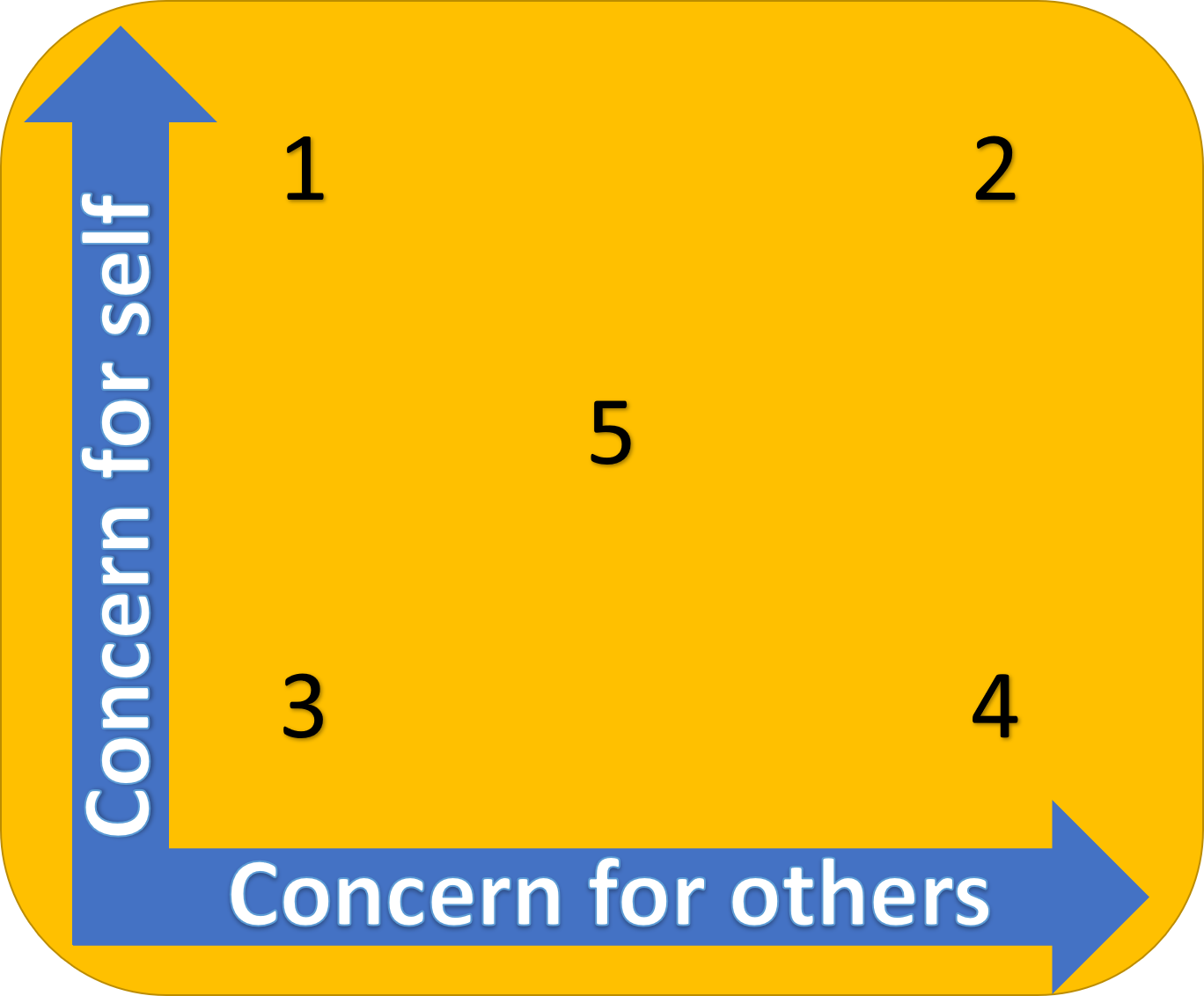
- 15Define Collaboration (as a conflict management style)A conflict-management style that demonstrates a high concern for both yourself and others, to collaborate is to take the time to find a solution in which all parties are comfortable with the outcome rather than harboring a sense of loss and sacrifice.
- 16Label each number in the figure to the left with the correct conflict management style1. Competition
2. Collaboration
3. Avoidance
4. Accommodation
5. Compromise - 17What are the four conflict-management principles developed by Roger Fisher and William Ury?Separate the people from the problem
Focus on shared interests
Generate many options to solve problems
Based decisions on objective criteria - 18Name five strategies you can use to help you manage your emotions in a conflict situationBe aware of your anger level
Breathe
Use self-talk
Monitor your nonverbal messages
Avoid personal attacks - 19Define groupthinkthe illusion of agreement - a type of thinking that occurs when a group strives to minimize conflict, maximize cohesiveness, and reach a consensus without critically testing, analyzing, and evaluating ideas
- 20Name the 6 symptoms of groupthink1. Critical thinking is not encouraged or rewarded
2. Members believe that their group can do no wrong
3. Members are too concerned about justifying their actions
4. Members apply pressure to those who do not support the group
5. Members often believe they have reached a true consensus
6. Members are too concerned about reinforcing the leader's beliefs - 21Name 6 suggestions for reducing groupthink1. encourage critical, independent thinking
2. be sensitive to status differences that may affect decision making
3. invite someone from outside the group to evaluate the group's decision-making process
4. assign a group member the role of Devil's Advocate
5. Ask group members to subdivide into small groups to consider potential problems with the suggested solutions
6. consider using technology to help your group gather and evaluate ideas - 22Define ConsensusOccurs when all group members support and are committed to a decision
- 23If your group quickly comes to a consensus you may be a victim ofgroupthink
- 24What are the textbook's three key pieces of advice to keep in mind when striving for group consensus?1. Keep the group on track
2. Be other-oriented
3. Promote honest interaction & dialogue - 25What four strategies can you use to keep the group oriented toward its goal?1. Use metadiscussional phrases
2. Keep the focus on the group's goal rather than strategies to achieve the goal
3. Display known facts for all group members to see
4. Do not wait until the very end of the deliberation to suggest solutions - 26Define MetadiscussionDiscussion about discussion
- 27What are some examples of metadiscussional phrases?"Aren't we getting a little off the subject?"
"Let's summarize our areas of agreement"
"John, we haven't heard from you yet, what do you think?" - 28What are the textbook's 6 suggestions for being other-oriented?1. give your ideas to the group
2. do not assume someone must win and someone must lose
3. use group-oriented rather than self-oriented pronouns
4. Avoid opinionated statements that indicate a closed mind
5. Clarify misunderstandings
6. Emphasize areas of agreement - 29What are the textbook's 6 suggestions for promoting honest interaction and dialogue?1. Do not change your mind too quickly just to avoid conflict
2. Avoid easy techniques to reduce conflict
3. Seek out differences of opinion
4. Involve everyone in the discussion; frequently contribute to the group
5. Use a variety of methods to reach agreement
6. Expand the number of ideas and alternatives
Información
- Descripción
- Use these flashcards to review chapter 8
- Creado por
- Liz Carpenter
- Visitas
- 70
- Valoración