
Fichas
GCSE AQA Biology - Unit 3
Fichas del conjunto (57)
- 1What is osmosis?The diffusion of water from a dilute solution to a more concentration solution through a partially permeable membrane
- 2What is active transport?Against a concentration gradient
LOW --> HIGH
This requires ENERGY!
Active transport allows cells to absorb sugar and ions, which can pass through cell membranes, from very dilute solutions. - 3What features make exchanges surfaces efficient?A large surface area.
Being thin, providing a short diffusion path.
Having an efficient blood supply (in animals).
Being ventilated (in animals) for gas exchange. - 4Where do villi line the walls of?The small intestine
- 5What do villi have (features)?A massive surface area for exchanging materials across.
An extensive network of blood capillaries to absorb the products of digestion by diffusion and active transport. - 6Where is the breathing system located?In your thorax.
(The upper half of your body) - 7Fill in the missing words: The breathing system takes air into and out of your body so that _____________ from the air can diffuse into your blood and _______________ can diffuse from your blood into the air.Oxygen
Carbon Dioxide - 8What does the trachea have rings of to prevent it from collapsing?Cartilage
- 9Fill in the missing words: The trachea divides into two tubes (the _______). The _______ divide to form ___________. The ___________ divide until they end in air sacs called _______ (there are millions of these).Bronchi
Bronchi + Bronchioles
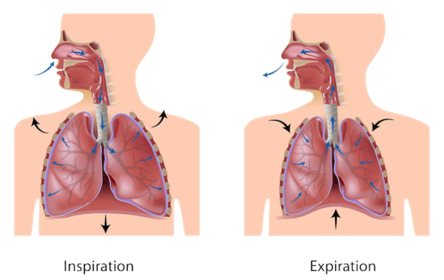
Bronchioles + Alveoli - 10What is ventilation?The movement of air into and out of your lungs.
- 11Fill in the missing words: When you breathe in, your ribcage moves __ and ____ and your diaphragm ________. When you breathe out, your ribcage moves __ and ____ and your diaphragm moves ____.Up, Out and Flattens
In, Down and Up. - 12What are the tiny holes on the leaves of plants called?Stomata
- 13What is transpiration?The movement of water through a plant.
- 14What does your circulatory system consist of?Your Heart, your Blood Vessels and your Blood.
- 15What does Oxygenated blood provide?Glucose and Oxygen to cells.
- 16What does Deoxygenated Blood take away?Waste Products (including Carbon Dioxide)
- 17When does blood pass through the Heart? (The TWO occasions)1. To carry blood from your heart to your lungs and then back to your heart.
2. The carry blood from your heart to all other organs then back to your heart. - 18What are the four chambers in your heart?Left Atria = Deoxygenated blood in from vena cava
Right Atria = Oxygenated blood in from pulmonary vein
Left Ventricle = Oxygenated blood out to aorta
Right Ventricle = Deoxygenated blood out to pulmonary artery - 19What makes sure that blood flows in the right direction?Valves
- 20Arteries - What do they do? - FeaturesTake blood from your heart to your organs.
Have thick walls made from muscle and elastic fibres.
Stents can be inserted if they become too narrow. - 21Veins - What do they do? - FeaturesTake blood from your organs to your heart.
Have thinner walls and valves to prevent backflow. - 22Capillaries - What do they do? - FeaturesAllow substances needed by the cells to pass out of the blood.
Allow substances produced by the cells to pass into the blood.
Are narrow, thin-walled blood vessels. - 23Is Blood a tissue, organ or organ system?Tissue
- 24What are the four components of Blood?Plasma
Red Blood Cells
White Blood cells
Platelets - 25What is Plasma?A straw-coloured liquid that transports:
- CO2 from your organs to your lungs.
- The soluble products of digestion from the small intestine to your organs.
- Other waste products from your liver to your kidneys. - 26What are Red Blood Cells?- Transport oxygen from your lungs to the organs.
- Don't have a nucleus.
- Are packed full of the red pigment haemoglobin. - 27What are White Blood cells?- Have a nucleus
- Are suspended in the plasma
- Form part of your body's defence system against pathogens. - 28What are Platelets?- Small fragments of cells.
- Don't have a nucleus.
- Help Blood to clot if you have a wound. - 29What does Xylem tissue do?Transport water and mineral ions from roots to the stem and leaves.
- 30What does Phloem tissue do?Carry dissolved sugars from the leaves to the rest of the plant, including growing regions and the storage organs.
- 31What does Homeostatis mean?Keeping your internal environment constant.
It includes monitoring and controlling;
-Waste materials
- Body temperature
- Water and ion content
- Blood Glucose levels - 32What should your body temperature be kept to?37°C
- 33What does the thermoregulatory centre in your brain do?Monitor and control body temperature.
- 34What does the thermoregulatory centre in your brain have?Receptors that monitor the temperature of the blood flowing through the brain.
- 35What does the thermoregulatory centre in your brain receive?Information (impulses) from temperature receptors in your skin.
- 36What happens if your core body temperature is too high?- Blood vessels supplying skin capillaries dilate (widen) to increase blood flow and heat loss.
- Sweat glands release more sweat, which cools the skin as it evaporates. - 37What happens if your core body temperature gets too low?- Blood vessels supplying skin capillaries constrict (narrow) to reduce blood flow and heat loss.
- Muscles start to shiver, causing heat energy to be released by respiration in cells. - 38What do the kidneys maintain?The concentrations of dissolved substances in the blood
- 39What three processes occur when blood vessels carry blood through the kidneys?Ultra filtration
Selective reabsorbtion
Excretion of waste - 40Explain what happens as blood flows through a dialysis machine (The 3 steps)1. The blood is separated from the dialysis fluid by partially permeable membranes.
2. The membranes allow urea, and any excess substances, to pass from the blood into the dialysis fluid.
3. Concentrations of dissolved substances in the blood are restored to their normal levels. - 41What can you do to prevent the rejection of a transplanted kidney?1. A donor kidney with a 'tissue-type' similar to that of the recipient is used.
2. The recipient is treated with drugs that suppress the immune system. - 42What does the Pancreas: - Monitor and control? - Excrete?Blood sugar levels
The hormone Insulin - 43What does insulin convert glucose into?Glycogen
- 44What is used to convert PREVIOUS ANSWER back into glucose?Glucagon
- 45Explain what is meant by: 'Carbon dioxide can be sequestered in oceans, lakes and ponds'It is taken from the atmosphere and stored in the water.
- 46What has been the effect of deforestation?- Increased levels of CO2 in atmosphere
- Reduced the rate at which carbon dioxide is removed from the atmosphere by photosynthesis
- Increased the amount of methane in the atmosphere - 47How is Biogas produced?Anaerobic Respiration/Fermentation
- 48What does biogas largely consist of?Methane
- 49The distances that food travels from where it is grown to where it is bought are called...Food Miles
- 50What is Mycoprotein?A protein-rich food suitable for vegetarians made bu using Fusarium, a type of fungus.
- 51How does the fungus grow?- In a fermenter.
- On glucose syrup.
- In anaerobic conditions. - 52Fill in the missing words: Urea is made in the _________, by the breakdown of ____________________. Urea is temporarily stored in the __________.Liver
Amino Acids
Bladder - 53What may happen if the pancreas doesn't produce enough insulin? What is this condition called?A person's blood sugar levels may rise to a high level.
This is called 'Type 1 Diabetes'. - 54Where is glycogen stored?In the liver.
- 55Where is glucagon made?In the pancreas.
- 56Describe what there is (and what happens in) an industrial fermenter (which is used to produce mycoprotein)...The nutrient medium (glucose syrup) and microorganisms (fungus) are passed into the fermenter.
There is a stirrer to keep the microorganisms in suspension and maintain an even temperature.
There is also a water-cooled jacket to remove heat produced by the respiring microorganisms.
On top of this, there is a temperature and pH probe, as well as an air supply, to provide oxygen for the microorganisms to respire.
Finally, there is an outlet tap, to collect the products. - 57List four reasons why there is less land available for plants and animals...- Farming
- Quarrying
- Building
- Dumping waste
Información
- Descripción
- The Time of the Biologist - Orbiting a quiet backwater planet, the massed forces of the universe's deadliest species gather, drawn to a mysterious message that echoes out to the stars - among them, the Biologist. Rescuing Blara from a family Biololimas dinner, the Science Lord and his companion must learn what this enigmatic signal means for his own fate and that of the universe.
- Creado por
- James Jolliffe
- Visitas
- 565
- Etiquetas
- Valoración