
Fichas
ATTACHMENT
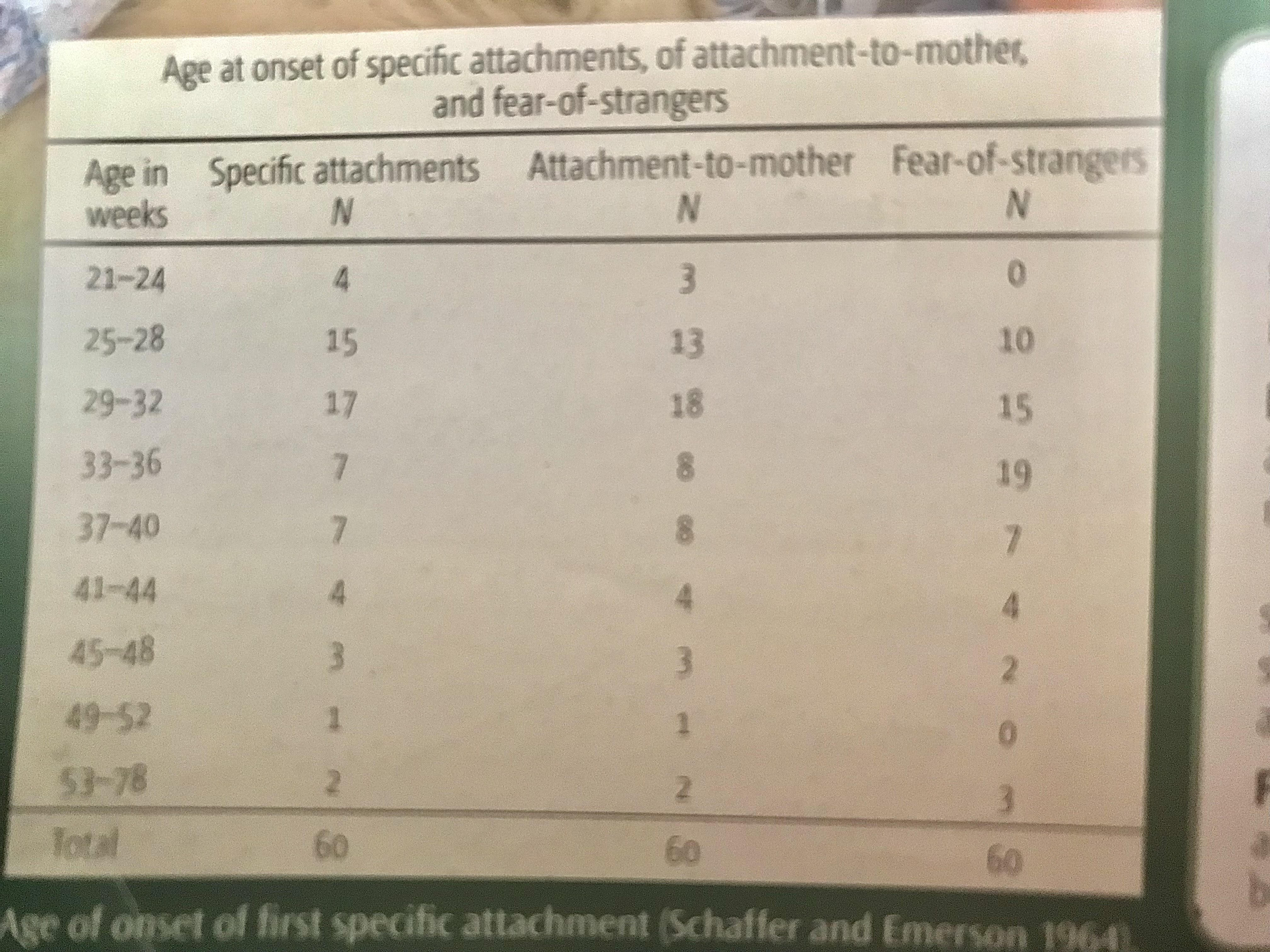
Fichas del conjunto (69)
- 1RECIPROCITYWhen both caregiver and baby respond to each others signals which elicit a responce, facial expression or verbal signals. Develops from around 3 months. It influences development and basic of trust is learned.
e.g smiling back at someon - 2ALERT PHASESWhen babies signal eg eye contact that they are ready to interact, mother responds to this 2/3 times but varies according to skill of the mother + stress
- 3INTERACTIONAL SYNCHRONYCaregiver and baby reflect actions and emotions of the other in a synchronised way
- 4carer-infant interactions: interactional synchrony research pt 1Meltzoff and Moore observed beginnings of IS in babies as early as 2 weeks adult displayed 1 of 3 facial expressions or distinctive gestures childs response was filmed and identified by independent observers an association was found between the expression or gesture and the actions of the babies
- 5carer-infant interactions: interactional synchrony research pt 2Isabella
observed 30 mothers and infants together
assessed the degree of synchrony and the quality of the mother-infant attachment
found high levels of synchrony were associated with better quality attachments - 6ATTACHMENT FIGURESSchaffer and Emerson
found majority of babies did become attached to their mother first
formed secondary attachments to other people in the family after a few weeks or months 75% of infants had attached to father by 18 months - 7SCHAFFER AMD EMERSON-60 babies from a working class families in glasgow, observed them every month for a year and then again at 18 months. asked mothers the baby's reaction to different types of separation to measure the baby's attachment by assesing separation anxiety and stranger anxiety
- 8SCHAFFER + EMERSON TABLE OF RESULTSmother.
- 9HOW ATTACHMENTS WERE MEASUREDSeparation anxiety- How distressed the infant was when separated from main care giver. This suggests that an attachment has been formed
Stranger Anxiety- How distressed the infant was when left in a room with an unfamilar person. This suggests that an infant can recognise familar and unfamilar faces. - 10SCHAFFER + EMERSON FINDINGS50% showed separation anxiety to a particular adult at 25-32 weeks
attachment tended to be to the caregiver who was most interactive and sensitive to the signals and facial expressions
80% had a specific attachment and almost 30% had multiple attachments at 40 weeks - 11STAGE 1: ASOCIAL STAGE- 0-2 months
- recognising and forming bonds with its carers
- preference towards familar adults.
- Babies behaviour towards humans and non humans is quite similar. - 12STAGE 2: INDISCRIMINATE ATTACHMENT- 2 to 7 months
- shows a preference to people rather than non human objects
-recognise and prefer familar adults
- accept cuddles from any adults
- no stranger anxiety or separation anxiety
- described as indiscriminate because it is not different towards any one person - 13STAGE 3: SPECIFIC ATTACHMENT-7-11 months
after 7 months the infant displays attachment to one care giver usally the mother. This is called primary attatchment figure. Attaches to who interacts the most and responds to signals.
- Child displays stranger anxiety and separation anxiety, is the mother 65% of the time - 14STAGE 4: MULTIPLE ATTACHMENTSAfter the infant has made a primary attachment, the infant goes on to make secondary attachments, then multiple attachments.
29% of children formed attachments within a month of the primary attachment, at 1 yr old, majority of babies have formed multiple attchments - 15GROSSMAN FATHER LONGITUDUNAL STUDYlooking at parents' behaviour + relationship with the quality of the children attachments into their teens. Found that the quality of the infant-mother attachment was related to children's attachments in teen years but NOT the infant-father attachment suggests father attachment is less important
- 16DIFFERENCE BETWEEN FATHER AND MOTHER ATTCHMENTSQuality of the father's play with the baby was related to quality of adolencent attachments suggesting the father's role is different to the mother's as it is more for play and stimulation rather than emotional development
- 17FATHERS AS PRIMARY CAREGIVERSField filmed 4 month old babies in face to face interaction with primary caregiver mothers and fathers, and secondary caregiver fathers. Primary caregivers spent more time smiling, imitating and holding infants these behaviours seem to be more important in building an attachment with the infant
- 18FATHERS AS PRIMARY ATTCHMENTS FINDINGSFathers can be the more nurturing attachment figure, the key the attachment relationship is the level of reciprocity, interactional synchrony not the gender of the parent but this may only happen when they are the primary caregiver
- 19ROLE OF THE FATHERFathers are less likely to be primary attachments eg in S+E study, 3% of cases, the father was the primary caregiver and in 27% cases was the joint fist attachment w/ mother, 75% formed an attachment w/ father at 18 months
- 20LORENZ'S IMPRINTING RESEARCHLorenz divided a group of goose eggs, with the mother or Lorenz as the first moving object, they followed him and the control group followed the mother, even when mixed up they followed who they imprinted on. A critical period in imprinting is the first few hours of the gooses' lives, if not imprinted, no attachement to anyone
- 21SECKUSAL IMPRINTINGGoose who imprinted on humans would display courtship to humans, Lorenz described a peacock who was reared next to tortoises and they would drect courtship to only tortoises, the peacock had undergone sexual impriniting
- 22HARLOW'S RESEARCHNewborn rhesus monkeys usually died when kept alone in a bare cage but survived when given a soft cloth, which serves the same function as a mother. One study he reared 16 baby monkeys with two wire "mothers". In one condition, a plain wire monkey dispensed milkand in the second condition, a cloth covered "monke" dispensed milk
- 23HARLOW'S FINDINGSThe baby monkeys prefered the cloth covered mother, even soughing comfort when frightened by loud noises, regardless of who dispensed milk. Shows "contact comfort" was more important to monkeys than food when it came to attachment behaviour.
- 24MATERNALLY DEPRIVED MONKEYS IN ADULTHOODFollowed deprived monkeys to see if maternal deprivation had an effect in adulthood, there were severe consequences. Monkeys reared with plain wire mothers were the most dysfunctional, even cloth covered reared monkeys did not develop normal social behaviour.
- 25DEPRIVED MONKEY FINDINGSThe deprived monkeys were aggressive + less socialable and bred less and were unskilled at mating . When the deprived mokeys became mothers, they attacked and neglected their children, even killing them in some cases. Harlow concluded there was a critical period for attachments to form within 90 days for monkeys
- 26CLASSICAL CONDITIONING IN ATTACHMENTA caregiver is a neutral stimulas, as they serve food over time, the unconditional stimulas which gives pleasure, they become associated with food, the neutral stimulas is the conditioned stimulas now. Once conditioning has taken place, the sight of the caregiver produces a conditioned responce of pleasure and an attachment is formed
- 27OPERANT CONDITIONING IN ATTACHMENTOC can explain why babies cry for comfort, important in building attachement. Crying leads to responce eg feeding, when the caregiver provides the correct responce, crying is reinforced. It is a two way process, the caregiver recieves negative reinforcement
- 28ATTACHMENT AS A SECONDARY DRIVELearning theory draws on the concept of drive reduction, hunger can be a primary drive, it's innate and biological, we are motivated to eat to reduce the hunger drive. Sears suggested as caregivers provide food, primary drive of hunger becomes generalised to them, and attachment is a secondary drive learned via association
- 29BOWLBYBowlby rejected learning theory as an explanation for attachment, he looked at the animal studies and proposed an evolutionary explanation, attachment is an innate system which gives survival advantages
- 30MONOTROPYHe placed great emphasis on a childs attachment to one particular caregiver
this was the 'mother' - primary attachment figure, he believed this attachment is different and more important than the others
more time spent with the baby = better. - 31LAW OF CONTINUITYMore constant and predictable the care = better quality of attachment
- 32LAW OF ACCUMULATED SEPARATIONThe effects of every separation adds up, should be a "zero dose" aka no separation
- 33SOCIAL RELEASERSInnate behaviours aka
cute behaviours like smiling and cooing
they encourage attention from adults
purpose is to activate the adult attachment system. It's a reciprocal process and both mother and baby are "hard wired" to become attached - 34CRITICAL PERIODAround when the baby is 6mo old, infant attachment system is active, a sensitive period which can last up to 2 yrs of age. If attachement isn't formed in this time, the child will find it hard to make future attachments
- 35INTERNAL WORKING MODELChild forms a mental representation of their relationship with their primary caregiver
this serves as a model for what relationships are like.
Affects the childs ability to be a parent themselves - 36STRANGE SITUATIONAinsworth and Bell aimed to observe key attachment behaviours to assess the quality of the attachment to the caregiver. It's a controlled observation, takes place in a lab w/ a two way mirror and/or cameras
- 37BEHAVIOURS USED TO JUDGE ATTACHMENTProxemity seeking- stays close to caregiver
Exploration + secure base behaviour- good attachment enables baby to feel comfortable to explore + the caregiver is the secure base
Stranger + separation anxiety
Responce to reunion- caregiver's return provides pleasure and they seek comfort - 38STRANGE SITUATION PROCEDURE
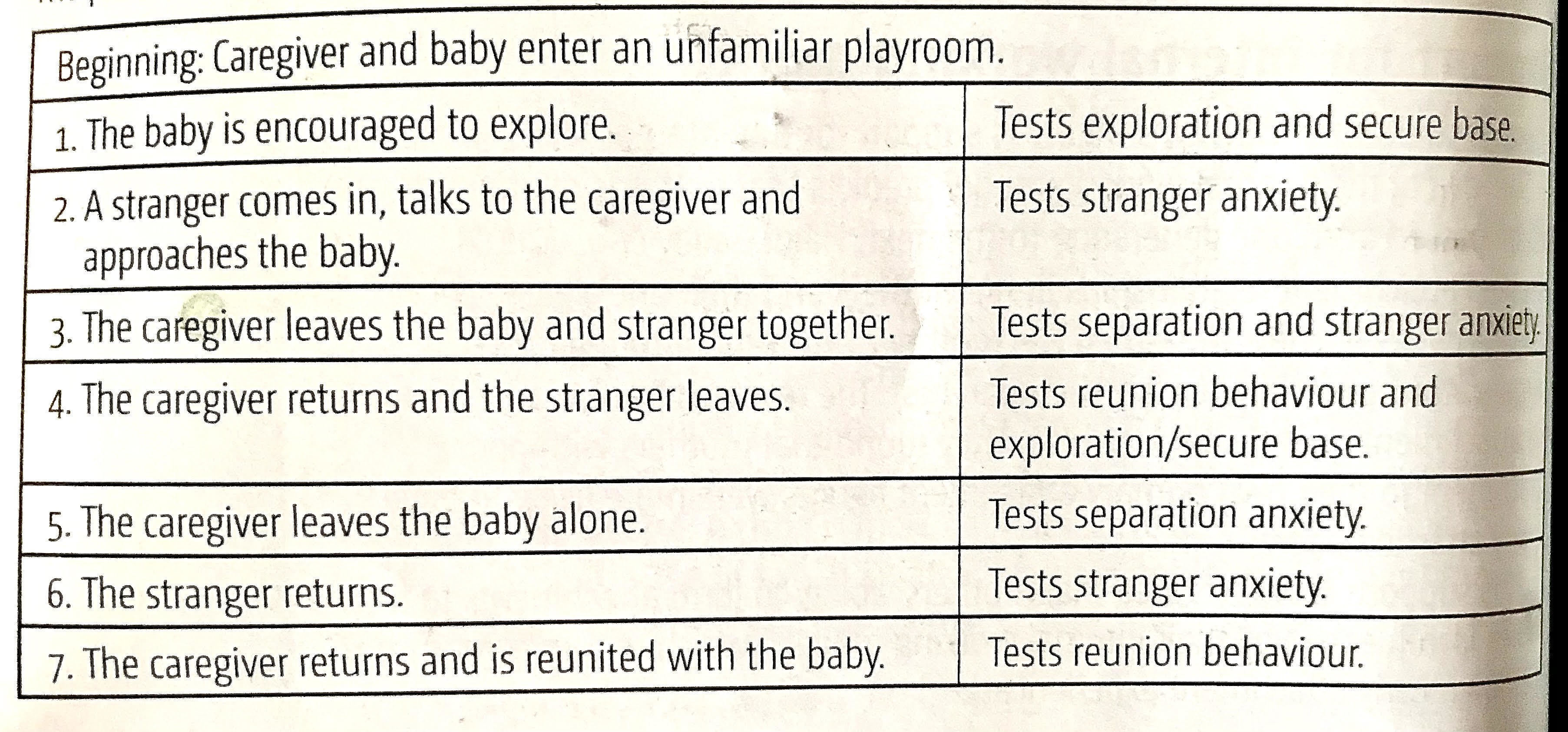
- 39STRANGE SITUATION FINDINGSThey concluded there were 3 main types of attachment: Secure attachment, insecure-avoidant attachment and nsecure-resistant attachment
- 40SECURE ATTACHMENT (TYPE B)Explore happily but regularly go back to caregiver
(proximity seeking and secure base behaviour)
moderate separation and stranger anxiety
require and accept comfort in reunion stage
60-75% british toddlers - 41INSECURE-AVOIDANT ATTACHMENT (TYPE A)Explore freely but not proximity seeking or secure base behaviour
show little or no separation anxiety and response to reunion
little stranger anxiety
20-25% british toddlers - 42INSECURE-RESISTANT ATTACHMENT (TYPE C)Children seek greater proximity than others and explore less
show huger stranger and separation anxiety
resist comfort at reunion
3% british toddlers - 43VAN IJZENDOORN + KROONENBERGTo investigate the type of attachments across cultures and to see how the 3 main attachments styled applied to assess cultural variation, also looking for variations within the same country to understand variation within a culture
- 44CULTURAL VARIATION PROCEDURE32 studies were conducted in 8 countries over 1990 children were assessed. The data was meta-analysed. The countries were USA, GB Sweden, Netherlands, Germany, Israel, Japan and China
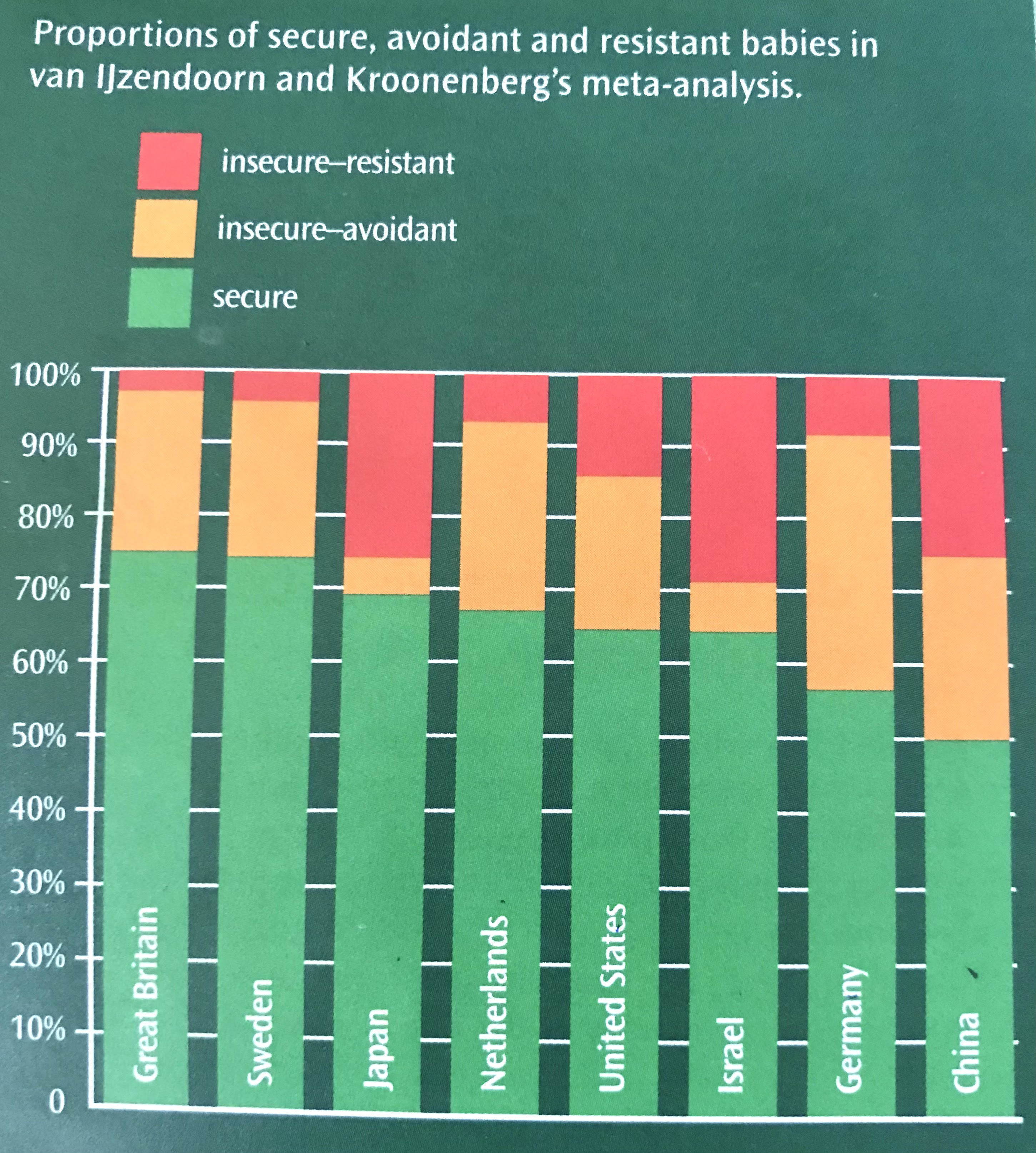
- 45STRANGE SITUATION CULTURAL VARIATION FINDINGS 1- lowest % of secure attachment was shown in China (50%)
- Highest % of secure attachment was shown in UK (75%)
- In individualistic cultures, insecure-resistant attachment was all under 14%
- collectivist cultures, e.g china and Japan insecure-resistant attachment was above 25% - 46STRANGE SITUATION CULTURAL VARIATION FINDINGS 2Variations between results of studies within the same country were 150% greater than those between different countries
- 47STRANGE SITUATION CULTURAL VARIATION GRAPH
- 48ITALIAN STRANGE SITUATIONSimonelli italian study - strange situation
76 babies aged 12 months.
50% secure, 36% insecure avoiding
= lower number of secure
because increasing number of mothers work long hours and use childcare, attachment types vary due to cultural change - 49KOREAN STRANGE SITUATIONJin Korean study - strange situation
87 children
overall proportions the same between secure and insecure in most countries, most were secure, however only 1 insecure avoidant.
Similar to Japanese distribution - they have similar child rearing practices - 50STRANGE SITUATUION'S CONCLUSIONSecure attachment is the norm in most countries and cultures, supporting Bowlby's theory that attachment is innate, however it also shows cultural practices have an influence on attachment type
- 51MATERNAL DEPRIVATION THEORYBowlby. The continuous presence of a mother figure is essential for normal psychological development both emotionally and intellectually
- 52MATERNAL DEPRIVATIONThe emotional and intellectual consequences of separation between a child and mother. Continuous care from the mother is essential for normal pyschological development.
- 53MATERNAL DEPRIVATION VS SEPARATIONSeparation = child not being in the presence of primary attachment
deprivation = extended separations where the infant looses an element of care - 54EFFECTS ON INTELLECTUAL DEVELOPMENTIntellectual suffering from mental retardation - abnormally low IQ
Goldfarb found lower IQ in children who had remained in institutions as a opposed to fostered children - 55EMOTIONAL DEVELOPMENTEmotional affectionless psychopathy - inability to experience guilt or strong emotions for others
prevents the person from developing normal relationships and is associated with criminality - 56BOWLBY'S 44 THEIVES RESEARCH44 stealing criminal teenagers - interviewed for signs of affectionless psychopathy families also interviewed to see if they had prolonged early separation.
compared against control group of non-criminal emotionally disturbed teenagers - 57BOWLBY 44 THIEVES FINDINGS14/44 of thieves = affectionless psychopaths, 12/14 had experience prolonged separation, 5 out of rest of thieves had experienced separation. control: 2/44 experienced long separations
concluded: prolonged early separation = affectionless psychopathy - 58ROMANIAN ORPHANSIn the 1990s, Romanian president ordered women to have 5 children, but many parents couldn't afford to keep all of them, so there were packed orphanages in very poor conditions but many were adopted my British families
- 59RUTTER ORPHAN PROCEDUREEnglish and romanian adoptee study: 165 Romanian orphans + 52 British orphans were the control group. All adopted in Britain
physical, cognitive and emotional development assessed at ages 4, 6, 11, 15. Aim was to see what extent good care can can make up for poor early experiences - 60RUTTER ORPHAN FINDINGSfirst arrival: signs of mental retardation, severely undernourished
Age 11: differential rates of recovery related to age of adoption - 61MEAN IQS AFTER ADOPTIONmean IQ:
adoption before 6 months = 102
adoption 6 months - 2 years = 86
adoption after 2 years = 77
Differences remained at age 16, ADHD was common in 15 + 22-25 yr olds - 62ATTACHMENT IN ORPHANSDifference in attachment related to whether sdoption took place before or after 6 months. After 6 mo showed disinhibited attachment- attention seeking, clingyness + social behaviour was directed indiscriminately, but before 6 mo it was the opposite
- 63ZEANAH BUCHAREST RESEARCH95 children that had spent 90% of their lives in institutional care, aged 12-31
control group - 50 children who had never lived in institutional care
attachment type measured using strange situation and carers were asked about unusual behaviour - 64ZEANAH FINDINGS74% of control group was securely attached, but 19% of research group was securely attached. Less than 20% of control group had disinhibited atachment but the research group was 44%
- 65DISINHIBITED ATTACHMENTTypical effect of spending time in an insitution, indiscrimiate friendliness and affection, highly unusual due to no stranger anxiety. It is an adaptation to having multiple caregivers during the sensitive period, many carers but none of them spend enough time with children individually to form primary, secure attachment
- 66RELATIONSHIPS IN CHILDHOODAttachment type is associated with the quality of peer relationships in childhood
secure - form best quality childhood friendships
insecure - have friendship difficulties
bullying - 67WILSON AND SMITH RESEARCHWilson and Smith
questionnaire - 196 children aged 7-11
secure - unlikely to be involved in bullying
insecure - avoidant - most likely to be victims
insecure - resistant - most likely to be bullies - 68MCCARTHY RESEARCH40 adult women who had been assessed as infants
securely attached = best romantic and friendships
insecure resistant = struggled with intimacy in romantic relationships - 69RELATIONSHIPS IN ADULTHOODEffects two major adult experiences: romantic and parental relationships, parenting style is based on their IWM so attachment types will be the same in the generations
Información
- Descripción
- Fichas sobre ATTACHMENT, creado por Sayar KHUDIYEVA el 31/08/2021.
- Creado por
- Sayar KHUDIYEVA
- Visitas
- 2
- Valoración