
Fichas
OCR AS Biology
Fichas del conjunto (68)
- 1This organelle functions in cellular respirationmitochondrion
- 2The organelle functions to package and deliver protiensGolgi Apperatus
- 3Cell organelles are located within the (__________) of the cellCytoplasm
- 4The Endoplasmic reticulum functions toTransport materials
- 5Genetic material is contained within the (___________) of the cellNucleus
- 6This organelle is responsible for destroying worn-out cell partsLysosomes
- 7The (__________) controls what enters and leaves the cellCell Membrane
- 8The rough endoplasmic reticulum has (__________) located on itRibosomes
- 9Located within the nucleus, it is responsible for producing ribosomesNucleolus
- 10Which structure is directly responsible for the formation of proteins within a cell?Ribosomes
- 11What part of the cell is responsible for the breaking down and digesting of thingsLysosomes
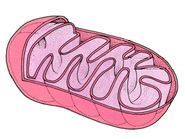
- 12Identify the organelle picturedMitochondria
- 13What part of the cell serves as an intracellular highway?Endoplasmic reticulum
- 14Which of the following would you NOT find in a bacterial cell? A)DNA B)Cell Membrane C)Golgi apperatus D)RibosomesC)Golgi apperatus
- 15Which of the following is found in plant cells but not animal cells? A)Cell wall B)Vacuole C)Mitochondria D)Endoplasmic reticulumA)Cell Wall
- 16The jellylike interior of the cell is called theCytoplasm
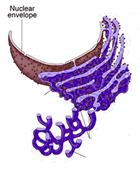
- 17Identify the organelleEndoplasmic reticulum
- 18What part of the cell makes protiensRibosomes
- 19Where are the ribosomes usually located in animal or plant cells?On the Endoplasmic reticulum
- 20What part of the cell serves to process, package and export protiens?Golgi apperatus
- 21What is cell signalling?A method of communication between cells
- 22The function of a glycolipid isto act as a binding site
- 23What do channel proteins allow?the movement of charged substances
- 24What do phospholipids do?form a barrier to the movement of polar molecules
- 25What does cholesterol do in the membrane?Stabilises the membrane structure
- 26Glycoproteins are...a membrane bound receptor
- 27How does a protein enter the cellEndocytosis
- 28How does a sodium ion enter the cell?facilitated diffusion
- 29How does water enter a cell?Osmosis
- 30How does oxygen enter the cell?Diffusion
- 31How does alcohol enter the cell?Diffusion
- 32The molecule that a signal molecule binds to is _________A receoptor
- 33The membrane contains binding sites which areGlycoproteins
- 34The signal molecule has a shape that isSpecific
- 35The shape of the binding site and the shape of the signal molecule areComplementary
- 36Cell signalling occurs when signal molecules bind to molecules on theCell Surface Membrane
- 37An example of a cell signalling molecule isa hormone
- 38Modern drugs often act by mimicking the action ofHormones
- 39How does heating affect cell membranes?Increased diffusion due to more kinetic energy
Membrane becomes more fluid
Membrane begins to melt
Proteins denature - 40What happens in anaphase?Sister chromotids move to opposite ends of the cell
- 41What happens is metaphase?Chromosomes move to the equator of the cell
- 42ProphaseChromosomes coil to become shorter and thicker
- 43What happens in Telophase?Nuclear envelope reforms around chromatids (now called chromosomes)
- 44The elastic fibres function is toRecoil and return the alveolus to its original shape
- 45The function of blood is toTransport gasses
- 46The function of cartilage during inhilation is toHold the airways open
- 47The function of a goblet cell isto secrete and release mucus
- 48The function of smooth muscle is toconstrict or narrow the airway
- 49The function of squamous epithelium is toTo provide a short diffusion pathway
- 50The function of ciliated epithelium is tomove the mucus up the throat
- 51Single-celled organisms have a _______ surface area to volume ratioLarge
- 52In large animals the surface area to volume ratio isSmall
- 53Active organisms need a lot ofoxygen
- 54Do single-celled organisms need a 'pump'?No
- 55Large organisms have a large surface area but a very large...volume
- 56True or false: Ventilation helps to increase the concentration of oxygen in the aveoliTrue
- 57True or false: A low concentration of oxygen in the blood facilitates diffusionTrue
- 58True or false: Carbon dioxide leaves the blood by osmosisFalse
- 59True or false: The alveoli have ciliated epitheliumFalse
- 60True or false: Elastic fibres contract to reduce the size of the alveoliFalse
- 61True or false: Elastic fibres help to expel air from the alveoliTrue
- 62True or false: During inhilation, the intercostal muscles contractTrue
- 63True or false: The alveoli contain smooth muscle fibresFalse
- 64True or false: The alveoli are stretched as more air enters the lungsTrue
- 65True or false: A short diffusion pathway helps to create a steep concentration gradientTrue
- 66True or false: A short diffusion pathway helps to maintain a steep concentration gradientFalse
- 67True or false: Cartilage keeps the airways rigidFalse
- 68True or false: Tidal volume must be measured at restFalse
Información
- Descripción
- Fichas sobre OCR AS Biology, creado por joshbrown3397 el 15/01/2015.
- Creado por
- joshbrown3397
- Visitas
- 1.347
- Etiquetas
- Valoración