
Fichas
AQA GCSE Biology unit 3

Fichas del conjunto (77)
- 1How do dissolved substances move?By diffusion or active transport
- 2What is Osmosis?The diffusion of water from a dilute to a more concentrated solution through a partially permeable membrane that allows the passage of water molecules
- 3What do soft drinks contain?-Water
-Sugar
-Ions - 4What do sports drinks contain? Why?-sugars to replace the sugar used in energy release during
the activity
-Water to replace the water
lost in sweating
-Ions to replace the ions lost
in sweating - 5What happens if water and ions are not replaced?The ion/water balance inside the body is disturbed so cells don't function as effectively (diffusion and osmosis affected as concentration gradients are different)
- 6What is active transport?-When substances are absorbed against the concentration gradient
-Requires energy from respiration - 7Why is active transport useful?Sometimes cells need to absorb ions against the concentration gradient
- 8How are organ systems specialised to exchange materials?The exchange surfaces have:
-a large surface area
-are thin (short diffusion path)
-an efficient blood supply
-are well ventilated (for
gaseous exchange) - 9What exchange surfaces are are adapted to maximise effectivenessGas and solute exchange surfaces (in humans and animals)
- 10How are human lungs adapted?The surface area is increased through alveoli
- 11How are small intestines adapted?-Large surface area due to villi
-Large network of capillaries (short diffusion path) takes the digested food away (high concentration gradient)
-Absorbs products of digestion through active transport and diffusion - 12Label this Diagram
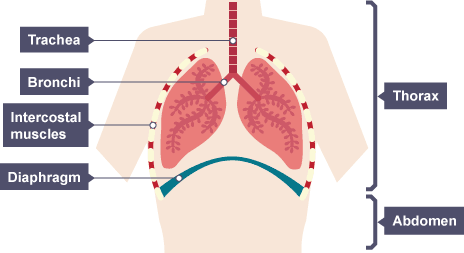
- 13Describe this diagramThe lungs are in the upper part of the body (thorax), protected by the ribcage and separated from the abdomen by the diaphragm

- 14What does the breathing system do?Takes air into and out of the body so that oxygen from the air can diffuse from air into bloodstream and carbon dioxide diffuses from bloodstream into the air
- 15What happens when we inhale?-Ribcage moves up and out
-Diaphragm becomes flatter
-Causes pressure to decrease, making air flow into our lungs - 16What happens when we exhale?-Ribcage moves back
-Diaphragm moves back
-Pressure increases, making air move out of lungs - 17What is ventialtion?The movement of air into and out of the lungs
- 18What exchanges occur in plants?-Carbon dioxide enters leaves
by diffusion
-Water and mineral ions are absorbed by the roots - 19How are these exchange surfaces adapted?-Roots have a large surface area due to root hairs
-Leaves have a large surface area due to flat shape and internal
air spaces - 20What do Stomata do?-obtain carbon dioxide from
the atmosphere
-Remove oxygen that is produced by photosynthesis
-Found at the bottom of leaves - 21Where does the majority of water loss in a plant occur?Water vapour escapes through the stomata
- 22What affects plant water loss?-Evaporation occurs faster in dry, windy and hot conditions
-If plants lose water faster than the roots can replace it stomata can close to prevent wilting - 23What controls the stomata?The stomata is controlled by guard cells that surround it
- 24What does the circulatory system do?Transports substances around the body
- 25What is the heart? What is it made of?The heart is an organ that pumps blood around te body. Majority of the wall of the heart is made of muscle
- 26List the parts of the heart
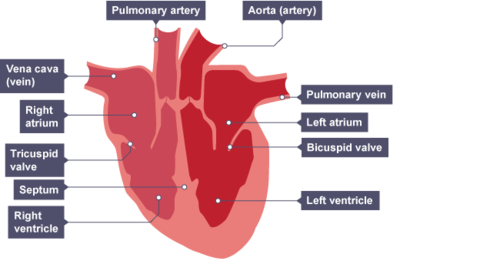
- 27Describe how blood flows through the heartVena cave -> Right atrium -> right ventricle -> pulmonary artery -> lungs -> pulmonary vein -> left atrium -> left ventricle -> aorta -> body
- 28What are artery walls made of?Arteries have very thick walls
made of muscle and elastic fibre - 29What are Veins made of?Veins have thinner walls and often have valves to prevent the backflow of blood
- 30What does blood do in the organs?-Flows through thin-walled capillaries
-Substances needed by cells in the body tissue passes out of the blood
-Substances produced by the cells pass into the blood (through capillary walls) - 31What is blood made of?Blood is a tissue made of:
-Mainly plasma
-Suspended red blood cells
-Suspended white blood cells
-Suspended platletes - 32What does blood plasma transport?-CO2 (from organs to lungs)
-Soluble products of digestion (from small intestine to organs)
-Urea (from liver to kidney) - 33What do red blood cells do?Transport oxygen from the lungs to organs
- 34How are red blood cells adapted for this job?They have no nucleus so that they can be packed with more of the red pigment hemoglobin
- 35How does haemoglobin work?-Haemoglobin combines with oxygen in the lungs to form oxyhaemoglobin
-In the organs oxyhaemoglobin splits into haemoglobin and oxygen again - 36What are white blood cells?-Part of the body's defence system against microorganisms
-They have nucleus's - 37What are platelets?-Small fragments of cells
-Have no nucleus
-Help to clot the blood at the site of a wound - 38What are the transport systems in plants?-Xylem tissue transports water and mineral ions from the roots to the stem and leaves
-Phloem tissue carries dissolved sugars from the leaves to the rest of the plant, including growing and storage systems
-Movement of water from the roots through the xylem and out of the leaves is called the transpiration stream - 39What are the types of breathing aids?-Negative pressure where the patient is put in an airtight machine from neck down. Pressure in the machine is alternated to cause ventilation
-Positive pressure is forcing air through a pipe into the trachea - 40Advantages and disadvantages of negative pressure-Has effectively treated polio patients
-Patient is confined to a machine
-Can cause pooling of blood around the abdomen - 41Advantages and disadvantages of positive pressure-Useful during operations when the surgeon has to access the whole body
-Effective at ventilating the lungs
-Long term ventilation requires the tube to be surgically inserted to the trachea through the neck - 42What waste needs to be removed from the body?-Carbon dioxide produced by respiration and removed via the lungs when we breathe out
-Urea, produced in the liver by the breakdown of amino acids and removed by the kidneys in the urine, temporarily stored in the bladder - 43Water and Ion content balance-Water and ions enter the body when we eat or drink
-Leave the body through sweating and urine
-If the water or ion content of the body is wrong, too much water may move into or out of the cells and damage them - 44How does a kidney produce urine?-First filters the blood
-Reabsorbs all of the sugar
-Reabsorbs all of the dissolved ions needed by the body
-Reabsorbs as much water as the body needs
-Releases urea and excess water and ions - 45How can you treat kidney failure?-Kidney dialysis
-Kidney transplant - 46Dialysis treatment-Restores the concentration of dissolved substances in the blood to normal levels
-Has to be carried out at regular intervals
-In a dialysis machine the persons blood flows through partially permeable membranes
-Dialysis liquid has the same concentration of useful substances as the blood to ensure glucose and mineral ions aren't lost
-Urea passes from the blood into the dialysis fluid - 47Kidney transplants-Diseased kidney is replaced with a healthy one from a donor
-The donor kidney could be rejected by the immune system without precautions
-Antigens are proteins on the surface of cells
-Recipients antibodies may attack the antigens on the door's kidney as they don't recognise the organ as they're own
-To prevent rejection the recipient is treated with drugs that suppress the immune system
-And a donor kidney with a tissue-type similar to the recipient is chosen - 48Advantages and disadvantages of dialysis-Availabe for all kidney patients
-No need for immune suppressing drugs
-Must limit salt and protein intake
-Expensive for NHS
-Regular dialysis treatment affects patients lifestyle - 49Advantages and disadvantages of kidney transplants-Overall cheaper for the NHS
-Can lead a normal life without a special diet
-Immune suppressant drugs increase chances of infection
-Operation has risks
-Kidney only lasts 8-9 years
-Shortage of kidneys - 50Sweating-Cools down the body by evaporation
-More water is lost, so more water must be taken as drink or food to balance this - 51How is body temperature monitored and controlled?-Thermoregulatory center in the brain
-Has receptors sensitive to temperature of blood flowing through the brain
-Temperature receptors in the skin send impulses to the thermoregularity centre - 52If core body temperature is too high...-Blood vessels supplying capillaries dilate so more blood flows through the capillaries so more heat is lost
-Sweat glands release more sweat which cools the body as it evaporates - 53If core body temperature is too low...-Blood vessels supplying the skin capillaries constrict to reduce the flow of blood through the capillaries thereby reducing heat loss
-Muscles 'shiver', the contraction needs respiration which releases some energy to warm the body - 54Pancreas' role in sugar level control-Pancreas monitors and controls the blood glucose concentration
-Produces the hormone insulin which allows glucose to move from the blood into the cells
-Produces glucagon when blood glucose levels fall
-Glucagon causes glycogen to be converted into glucose and released into the blood - 55Type 1 diabetes-Disorder where a persons blood glucose concentration may rise to a high level because the pancreas does not produce enough insulin
-Controlled by careful attention to diet, exercise and injecting insulin - 56Why is the amount of waste we produce increasing?-Rapid growth of the human population
-Increase in standard of living
-If this waste isn't handled properly pollution occurs - 57Waste can pollute...-Water with sewage, fertiliser and toxic chemicals
-Air with smoke and gases such as sulphur dioxide
-Land, with toxic chemicals like pesticides and herbicides, these can be washed from the land into waterways - 58Human use of landReduces land available for other species by:
-Building
-Quarrying
-Farming
-Dumping waste - 59Why does deforestation occur?-For timber
-Crops can be grown for biofuel (e.g. crops that can make ethanol)
-Increase in cattle and rice fields for food
-These organisms produce methane, increasing the amount of methane in the atmosphee - 60How does deforestation affect the environment?-Increased levels of CO2 release as wood is burned or microorganisms decay it
-Reduced rate at which carbon dioxide is removed from the atmosphere and locked up for many years as wood
Leads to a decrease in biodiversity - 61Peat bogs-Form in areas where plants grow in waterlogged conditions
-When they die they don't fully decompose
-Carbon is 'locked up' in peat bogs
-Peat can be used as compost in agriculture to increase the nutrient content of soil
-So peat bogs are being destroyed
-This releases CO2 so peat free compost is important - 62Global warming-CO2 and Methane levels in the atmosphere are rising
-This contributes to global warming
-An increase of only a few degrees Celsius can have a significant impact - 63Effects of global warming-May cause big changes in climate
-May cause a rise in sea levels
-May reduce biodiversity
-May Cause changes to migration patterns
-May result in a change in the distribution of species - 64Sequestering of carbon dioxide-CO2 sequesters in oceans, lakes and ponds
-Important factor in removing CO2 from the atmosphere
-However, the solubility of CO2 in water decreases at higher temperatures - 65Measuring concentrations of Co2-Carbon dioxide concentrations naturally change
-To measure atmospheric CO2 concentrations before this, scientists can measure bubbles of air trapped in polar ice caps
-Some data indicates that there has been a large increase of CO2 since the industrial revolution - 66Production of biofuels-Can be made from natural processes like fermentation
-Biogas, mainly methane, can be made from anaerobic fermentation of a wide range of plant products or waste material containing carbohydrates
-On a large scale Waste from sugar factories and sewage works can be used
-On a small scale plant waste from crops and animal faeces and urine can be used - 67Advantaged of biofuels-Useful way of recycling waste material
-initial set up cost expensive but raw materials are cheap
-Fuel is readily available
-Useful in developing countries
-Waste products can be used as fertiliser
-Reduces use of fossil fuels - 68Advantages and disadvantages of small biogas generators-Fewer metal parts so less expensive and doesn't rust
-Cheaper to set up, useful for small communities
-Gas pressure fluctuates
-Less straightforward to control
-Gas leakage is more likely methane production is low - 69Advantages and disadvantages of larger biogas generators-Stabilises gas pressure
-Gas production can be monitored more easily
-Can be used on a larger scale
-Expensive to set up and maintain
-Rusts easily
-Requires more management - 70Loss of biomass in the food chain-At each stage of the food chain, less material and energy are contained in the biomass of the organisms
-Efficiency of food production can be improved by reducing the number of stages in food chains
-This may require more people to convert to a vegetarian diet - 71Increasing efficiency of food productionRestricting the energy lost from animals by:
-Limiting their movement
-Regulating their temperature
This has ethical concerns though:
-Animals movement is limited
-Suffer pain and discomfort
-Don't live in their natural environment
-Antibiotics used to treat against disease - 72Food Miles-The distance food has been transported from producer to consumer
-Food transport adds millions of tonnes of CO2 to the atmosphere every year
=Reducing food miles can significantly reduce CO2 emissions - 73Sustainable developmentABout how we should ensure that we:
-Conserve natural resources
-Reduce the damage to the environment
-Maintain biodiversity
This will be a compromise between competeing priorities - 74Dealing with overfishing-Fish stocks in the oceans are declining
-Need to maintain fish stocks at a level where breeding continues or certain species can die out
-Net sizes mean only mature fish can be caught
-Fishing quotas limit the amount of fish caught, but drive fish prices up and reduce a fishermans income - 75Fusarium-Fungus Fusarium is useful for producing mycoprotein, a protein-rich substance for vegetarians
-Grown on glucose syrup
-Aerobic conditions
-Biomass is harvested and purified
-May become more important when land availability for farms becomes restrictive - 76Providing food-Various organisations provide emergency food assistance after natural disasters
-Countries who struggle with food production are advised to grow staple crops like cereals, their seeds are high in protein and can be stored year round
-GM crops have been developed, but use is banned in many countries - 77Providing water-Many people in less developed countries have no access to clean water
-Contaminated water can carry harmful bacteria
-Some charitable agencies provide pumps, pipes and education
-Demand for water is often greater than supply from rivers, lakes and underground aquifers
-People need to reduce water use, especially for irrigation
-Hose pipe bans enforced to reduce residential water use
Información
- Descripción
- All information you need for the 2014 specification for B3. Good luck =)
- Creado por
- Natalia Cliff
- Visitas
- 94
- Etiquetas
- Valoración