
Mapa mental
Interpersonal Attraction
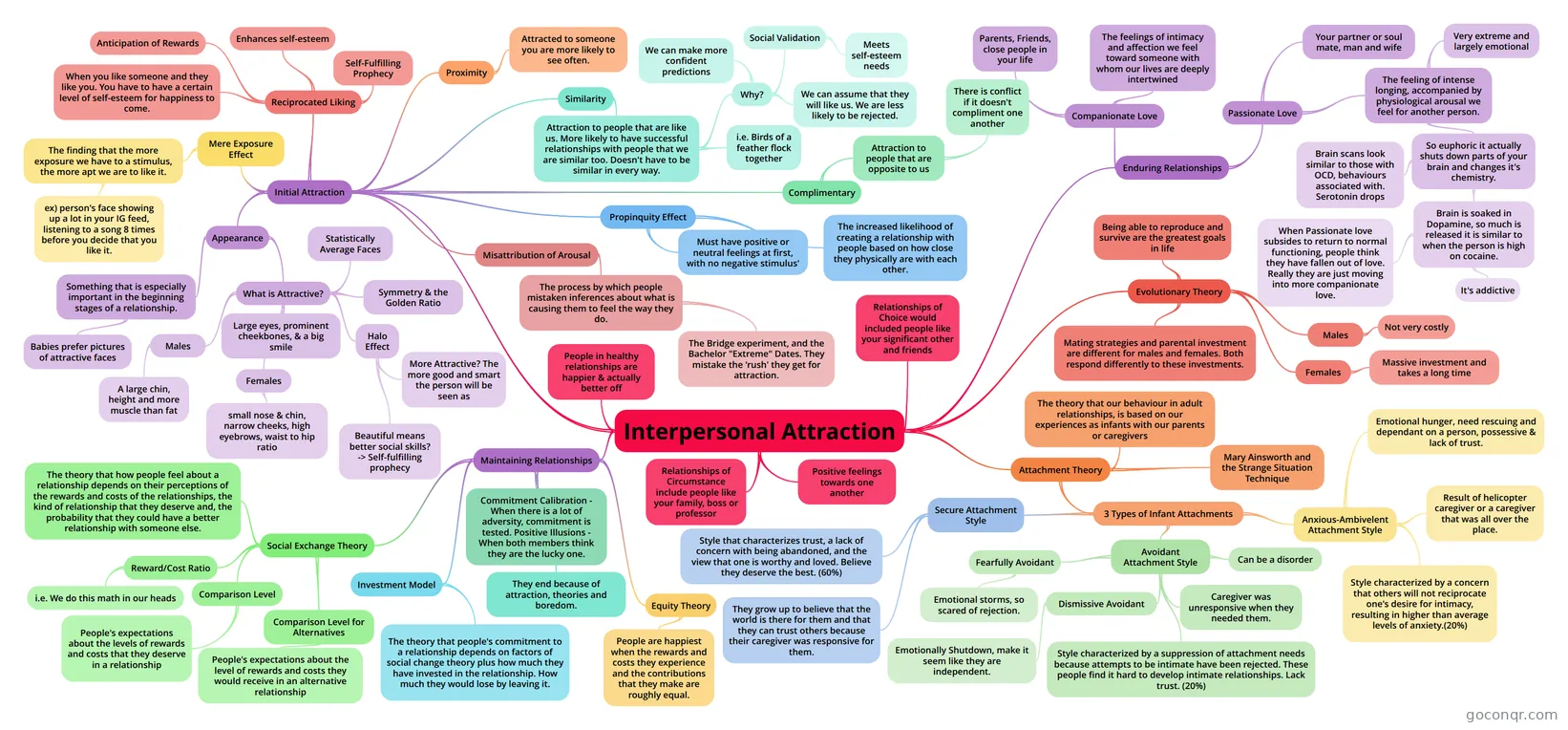
Mind map: Interpersonal attraction
Contenido del mapa
Interpersonal Attraction
Positive feelings towards one another
People in healthy relationships are happier & actually better off
Relationships of Choice would included people like your significant other and friends
Relationships of Circumstance include people like your family, boss or professor
Initial Attraction
- Appearance
- Something that is especially important in the beginning stages of a relationship.
- Babies prefer pictures of attractive faces
- What is Attractive?
- Large eyes, prominent cheekbones, & a big smile
- Males
- A large chin, height and more muscle than fat
- Females
- small nose & chin, narrow cheeks, high eyebrows, waist to hip ratio
- Statistically Average Faces
- Symmetry & the Golden Ratio
- Halo Effect
- More Attractive? The more good and smart the person will be seen as
- Beautiful means better social skills? -> Self-fulfilling prophecy
- Something that is especially important in the beginning stages of a relationship.
- Misattribution of Arousal
- The process by which people mistaken inferences about what is causing them to feel the way they do.
- The Bridge experiment, and the Bachelor "Extreme" Dates. They mistake the 'rush' they get for attraction.
- The process by which people mistaken inferences about what is causing them to feel the way they do.
- Proximity
- Attracted to someone you are more likely to see often.
- Propinquity Effect
- The increased likelihood of creating a relationship with people based on how close they physically are with each other.
- Must have positive or neutral feelings at first, with no negative stimulus'
- Mere Exposure Effect
- The finding that the more exposure we have to a stimulus, the more apt we are to like it.
- ex) person's face showing up a lot in your IG feed, listening to a song 8 times before you decide that you like it.
- The finding that the more exposure we have to a stimulus, the more apt we are to like it.
- Similarity
- Attraction to people that are like us. More likely to have successful relationships with people that we are similar too. Doesn't have to be similar in every way.
- i.e. Birds of a feather flock together
- Why?
- Social Validation
- Meets self-esteem needs
- We can make more confident predictions
- We can assume that they will like us. We are less likely to be rejected.
- Social Validation
- Attraction to people that are like us. More likely to have successful relationships with people that we are similar too. Doesn't have to be similar in every way.
- Complimentary
- Attraction to people that are opposite to us
- There is conflict if it doesn't compliment one another
- Attraction to people that are opposite to us
- Reciprocated Liking
- When you like someone and they like you. You have to have a certain level of self-esteem for happiness to come.
- Enhances self-esteem
- Anticipation of Rewards
- Self-Fulfilling Prophecy
- Appearance
Enduring Relationships
- Companionate Love
- The feelings of intimacy and affection we feel toward someone with whom our lives are deeply intertwined
- Parents, Friends, close people in your life
- Passionate Love
- The feeling of intense longing, accompanied by physiological arousal we feel for another person.
- Very extreme and largely emotional
- So euphoric it actually shuts down parts of your brain and changes it's chemistry.
- Brain scans look similar to those with OCD, behaviours associated with. Serotonin drops
- Brain is soaked in Dopamine, so much is released it is similar to when the person is high on cocaine.
- It's addictive
- When Passionate love subsides to return to normal functioning, people think they have fallen out of love. Really they are just moving into more companionate love.
- Your partner or soul mate, man and wife
- The feeling of intense longing, accompanied by physiological arousal we feel for another person.
- Companionate Love
Evolutionary Theory
- Mating strategies and parental investment are different for males and females. Both respond differently to these investments.
- Males
- Not very costly
- Females
- Massive investment and takes a long time
- Being able to reproduce and survive are the greatest goals in life
Attachment Theory
- The theory that our behaviour in adult relationships, is based on our experiences as infants with our parents or caregivers
- Mary Ainsworth and the Strange Situation Technique
- 3 Types of Infant Attachments
- Secure Attachment Style
- Style that characterizes trust, a lack of concern with being abandoned, and the view that one is worthy and loved. Believe they deserve the best. (60%)
- They grow up to believe that the world is there for them and that they can trust others because their caregiver was responsive for them.
- Avoidant Attachment Style
- Style characterized by a suppression of attachment needs because attempts to be intimate have been rejected. These people find it hard to develop intimate relationships. Lack trust. (20%)
- Fearfully Avoidant
- Emotional storms, so scared of rejection.
- Dismissive Avoidant
- Emotionally Shutdown, make it seem like they are independent.
- Can be a disorder
- Caregiver was unresponsive when they needed them.
- Anxious-Ambivelent Attachment Style
- Style characterized by a concern that others will not reciprocate one's desire for intimacy, resulting in higher than average levels of anxiety.(20%)
- Emotional hunger, need rescuing and dependant on a person, possessive & lack of trust.
- Result of helicopter caregiver or a caregiver that was all over the place.
- Secure Attachment Style
Maintaining Relationships
- Social Exchange Theory
- The theory that how people feel about a relationship depends on their perceptions of the rewards and costs of the relationships, the kind of relationship that they deserve and, the probability that they could have a better relationship with someone else.
- Reward/Cost Ratio
- i.e. We do this math in our heads
- Comparison Level
- People's expectations about the levels of rewards and costs that they deserve in a relationship
- Comparison Level for Alternatives
- People's expectations about the level of rewards and costs they would receive in an alternative relationship
- Investment Model
- The theory that people's commitment to a relationship depends on factors of social change theory plus how much they have invested in the relationship. How much they would lose by leaving it.
- Equity Theory
- People are happiest when the rewards and costs they experience and the contributions that they make are roughly equal.
- Commitment Calibration - When there is a lot of adversity, commitment is tested. Positive Illusions - When both members think they are the lucky one.
- They end because of attraction, theories and boredom.
- Social Exchange Theory
Información
- Descripción
- Second Year (Social Psyc) Psychology Mapa Mental sobre Interpersonal Attraction, creado por Paige Jaras el 14/11/2017.
- Creado por
- Paige Jaras
- Visitas
- 0
- Valoración
Más sobre Relationship formation and attraction