
Mapa mental
The Developing Mind
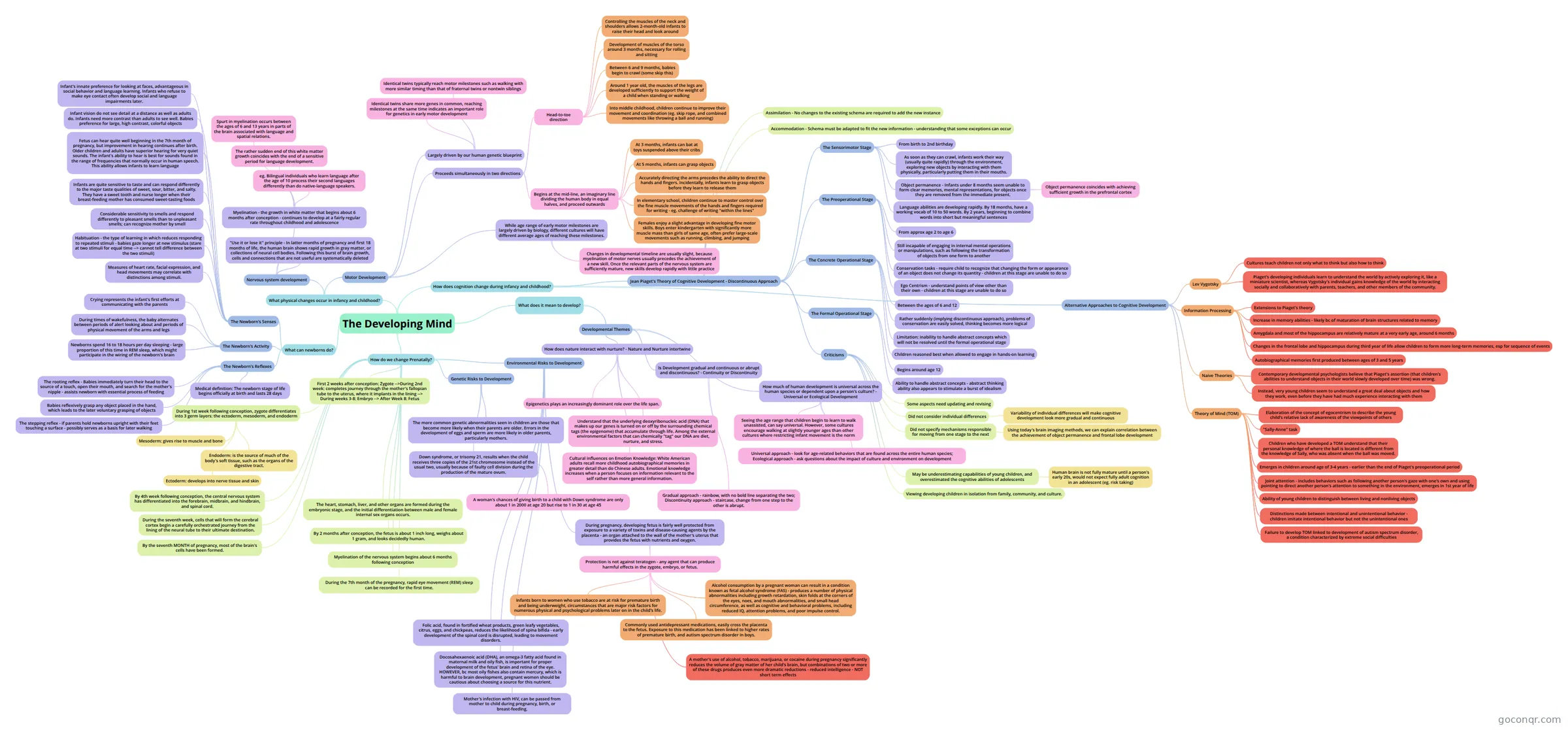
Mind map: The Developing Mind
Contenido del mapa
The Developing Mind
What does it mean to develop?
- Developmental Themes
- How does nature interact with nurture? - Nature and Nurture intertwine
- Cultural influences on Emotion Knowledge: White American adults recall more childhood autobiographical memories in greater detail than do Chinese adults. Emotional knowledge increases when a person focuses on information relevant to the self rather than more general information.
- Understand that the underlying deoxyribonucleic acid (DNA) that makes up our genes is turned on or off by the surrounding chemical tags (the epigenome) that accumulate through life. Among the external environmental factors that can chemically "tag" our DNA are diet, nurture, and stress.
- Epigenetics plays an increasingly dominant role over the life span.
- Is Development gradual and continuous or abrupt and discontinuous? - Continuity or Discontinuity
- Gradual approach - rainbow, with no bold line separating the two; Discontinuity approach - staircase, change from one step to the other is abrupt.
- How much of human development is universal across the human species or dependent upon a person's culture? - Universal or Ecological Development
- Universal approach - look for age-related behaviors that are found across the entire human species; Ecological approach - ask questions about the impact of culture and environment on development
- Seeing the age range that children begin to learn to walk unassisted, can say universal. However, some cultures encourage walking at slightly younger ages than other cultures where restricting infant movement is the norm
- How does nature interact with nurture? - Nature and Nurture intertwine
- Developmental Themes
How do we change Prenatally?
- First 2 weeks after conception: Zygote -->During 2nd week: completes journey through the mother's fallopian tube to the uterus, where it implants in the lining --> During weeks 3-8: Embryo --> After Week 8: Fetus
- During 1st week following conception, zygote differentiates into 3 germ layers: the ectoderm, mesoderm, and endoderm
- Ectoderm: develops into nerve tissue and skin
- Mesoderm: gives rise to muscle and bone
- Endoderm: is the source of much of the body's soft tissue, such as the organs of the digestive tract.
- By 4th week following conception, the central nervous system has differentiated into the forebrain, midbrain, and hindbrain, and spinal cord.
- During the seventh week, cells that will form the cerebral cortex begin a carefully orchestrated journey from the lining of the neural tube to their ultimate destination.
- By the seventh MONTH of pregnancy, most of the brain's cells have been formed.
- The heart, stomach, liver, and other organs are formed during the embryonic stage, and the initial differentiation between male and female internal sex organs occurs.
- By 2 months after conception, the fetus is about 1 inch long, weighs about 1 gram, and looks decidedly human.
- Myelination of the nervous system begins about 6 months following conception
- During the 7th month of the pregnancy, rapid eye movement (REM) sleep can be recorded for the first time.
- Genetic Risks to Development
- The more common genetic abnormalities seen in children are those that become more likely when their parents are older. Errors in the development of eggs and sperm are more likely in older parents, particularly mothers.
- Down syndrome, or trisomy 21, results when the child receives three copies of the 21st chromosome instead of the usual two, usually because of faulty cell division during the production of the mature ovum.
- A woman's chances of giving birth to a child with Down syndrome are only about 1 in 2000 at age 20 but rise to 1 in 30 at age 45
- Environmental Risks to Development
- During pregnancy, developing fetus is fairly well protected from exposure to a variety of toxins and disease-causing agents by the placenta - an organ attached to the wall of the mother's uterus that provides the fetus with nutrients and oxygen.
- Protection is not against teratogen - any agent that can produce harmful effects in the zygote, embryo, or fetus.
- Commonly used antidepressant medications, easily cross the placenta to the fetus. Exposure to this medication has been linked to higher rates of premature birth, and autism spectrum disorder in boys.
- Infants born to women who use tobacco are at risk for premature birth and being underweight, circumstances that are major risk factors for numerous physical and psychological problems later on in the child's life.
- Alcohol consumption by a pregnant woman can result in a condition known as fetal alcohol syndrome (FAS) - produces a number of physical abnormalities including growth retardation, skin folds at the corners of the eyes, noes, and mouth abnormalities, and small head circumference, as well as cognitive and behavioral problems, including reduced IQ, attention problems, and poor impulse control.
- A mother's use of alcohol, tobacco, marijuana, or cocaine during pregnancy significantly reduces the volume of gray matter of her child's brain, but combinations of two or more of these drugs produces even more dramatic reductions - reduced intelligence - NOT short term effects
- Protection is not against teratogen - any agent that can produce harmful effects in the zygote, embryo, or fetus.
- Folic acid, found in fortified wheat products, green leafy vegetables, citrus, eggs, and chickpeas, reduces the likelihood of spina bifida - early development of the spinal cord is disrupted, leading to movement disorders.
- Docosahexaenoic acid (DHA), an omega-3 fatty acid found in maternal milk and oily fish, is important for proper development of the fetus' brain and retina of the eye. HOWEVER, bc most oily fishes also contain mercury, which is harmful to brain development, pregnant women should be cautious about choosing a source for this nutrient.
- Mother's infection with HIV, can be passed from mother to child during pregnancy, birth, or breast-feeding.
- During pregnancy, developing fetus is fairly well protected from exposure to a variety of toxins and disease-causing agents by the placenta - an organ attached to the wall of the mother's uterus that provides the fetus with nutrients and oxygen.
What can newborns do?
- The Newborn's Reflexes
- Medical definition: The newborn stage of life begins officially at birth and lasts 28 days
- The rooting reflex - Babies immediately turn their head to the source of a touch, open their mouth, and search for the mother's nipple - assists newborn with essential process of feeding
- Babies reflexively grasp any object placed in the hand, which leads to the later voluntary grasping of objects
- The stepping reflex - if parents hold newborns upright with their feet touching a surface - possibly serves as a basis for later walking
- The Newborn's Activity
- Newborns spend 16 to 18 hours per day sleeping - large proportion of this time in REM sleep, which might participate in the wiring of the newborn's brain
- During times of wakefulness, the baby alternates between periods of alert looking about and periods of physical movement of the arms and legs
- Crying represents the infant's first efforts at communicating with the parents
- The Newborn's Senses
- Measures of heart rate, facial expression, and head movements may correlate with distinctions among stimuli.
- Habituation - the type of learning in which reduces responding to repeated stimuli - babies gaze longer at new stimulus (stare at two stimuli for equal time --> cannot tell difference between the two stimuli)
- Considerable sensitivity to smells and respond differently to pleasant smells than to unpleasant smells; can recognize mother by smell
- Infants are quite sensitive to taste and can respond differently to the major taste qualities of sweet, sour, bitter, and salty. They have a sweet tooth and nurse longer when their breast-feeding mother has consumed sweet-tasting foods
- Fetus can hear quite well beginning in the 7th month of pregnancy, but improvement in hearing continues after birth. Older children and adults have superior hearing for very quiet sounds. The infant's ability to hear is best for sounds found in the range of frequencies that normally occur in human speech. This ability allows infants to learn language
- Infant vision do not see detail at a distance as well as adults do. Infants need more contrast than adults to see well. Babies preference for large, high contrast, colorful objects
- Infant's innate preference for looking at faces, advantageous in social behavior and language learning. Infants who refuse to make eye contact often develop social and language impairments later.
- The Newborn's Reflexes
What physical changes occur in infancy and childhood?
- Nervous system development
- "Use it or lose it" principle - In latter months of pregnancy and first 18 months of life, the human brain shows rapid growth in gray matter, or collections of neural cell bodies. Following this burst of brain growth, cells and connections that are not useful are systematically deleted
- Myelination - the growth in white matter that begins about 6 months after conception - continues to develop at a fairly regular rate throughout childhood and adolescence
- Spurt in myelination occurs between the ages of 6 and 13 years in parts of the brain associated with language and spatial relations.
- The rather sudden end of this white matter growth coincides with the end of a sensitive period for language development.
- eg. Bilingual individuals who learn language after the age of 10 process their second languages differently than do native-language speakers.
- Motor Development
- Largely driven by our human genetic blueprint
- Identical twins typically reach motor milestones such as walking with more similar timing than that of fraternal twins or nontwin siblings
- Identical twins share more genes in common, reaching milestones at the same time indicates an important role for genetics in early motor development
- Proceeds simultaneously in two directions
- Head-to-toe direction
- Controlling the muscles of the neck and shoulders allows 2-month-old infants to raise their head and look around
- Development of muscles of the torso around 3 months, necessary for rolling and sitting
- Between 6 and 9 months, babies begin to crawl (some skip this)
- Around 1 year old, the muscles of the legs are developed sufficiently to support the weight of a child when standing or walking
- Into middle childhood, children continue to improve their movement and coordination (eg. skip rope, and combined movements like throwing a ball and running)
- Begins at the mid-line, an imaginary line dividing the human body in equal halves, and proceed outwards
- At 3 months, infants can bat at toys suspended above their cribs
- At 5 months, infants can grasp objects
- Accurately directing the arms precedes the ability to direct the hands and fingers. Incidentally, infants learn to grasp objects before they learn to release them
- In elementary school, children continue to master control over the fine muscle movements of the hands and fingers required for writing - eg. challenge of writing "within the lines"
- Females enjoy a slight advantage in developing fine motor skills. Boys enter kindergarten with significantly more muscle mass than girls of same age, often prefer large-scale movements such as running, climbing, and jumping
- Head-to-toe direction
- While age range of early motor milestones are largely driven by biology, different cultures will have different average ages of reaching these milestones.
- Changes in developmental timeline are usually slight, because myelination of motor nerves usually precedes the achievement of a new skill. Once the relevant parts of the nervous system are sufficiently mature, new skills develop rapidly with little practice
- Largely driven by our human genetic blueprint
- Nervous system development
How does cognition change during infancy and childhood?
- Jean Piaget's Theory of Cognitive Development - Discontinuous Approach
- Assimilation - No changes to the existing schema are required to add the new instance
- Accommodation - Schema must be adapted to fit the new information - understanding that some exceptions can occur
- The Sensorimotor Stage
- From birth to 2nd birthday
- As soon as they can crawl, infants work their way (usually quite rapidly) through the environment, exploring new objects by interacting with them physically, particularly putting them in their mouths.
- Object permanence - Infants under 8 months seem unable to form clear memories, mental representations, for objects once they are removed from the immediate present.
- Object permanence coincides with achieving sufficient growth in the prefrontal cortex
- Language abilities are developing rapidly. By 18 months, have a working vocab of 10 to 50 words. By 2 years, beginning to combine words into short but meaningful sentences
- The Preoperational Stage
- From approx age 2 to age 6
- Still incapable of engaging in internal mental operations or manipulations, such as following the transformation of objects from one form to another
- Conservation tasks - require child to recognize that changing the form or appearance of an object does not change its quantity - children at this stage are unable to do so
- Ego Centrism - understand points of view other than their own - children at this stage are unable to do so
- The Concrete Operational Stage
- Between the ages of 6 and 12
- Rather suddenly (implying discontinuous approach), problems of conservation are easily solved, thinking becomes more logical
- Limitation: inability to handle abstract concepts which will not be resolved until the formal operational stage
- Children reasoned best when allowed to engage in hands-on learning
- The Formal Operational Stage
- Begins around age 12
- Ability to handle abstract concepts - abstract thinking ability also appears to stimulate a burst of idealism
- Criticisms
- Some aspects need updating and revising
- Did not consider individual differences
- Variability of individual differences will make cognitive development look more gradual and continuous
- Did not specify mechanisms responsible for moving from one stage to the next
- Using today's brain imaging methods, we can explain correlation between the achievement of object permanence and frontal lobe development
- May be underestimating capabilities of young children, and overestimated the cognitive abilities of adolescents
- Human brain is not fully mature until a person's early 20s, would not expect fully adult cognition in an adolescent (eg. risk taking)
- Viewing developing children in isolation from family, community, and culture.
- Alternative Approaches to Cognitive Development
- Lev Vygotsky
- Cultures teach children not only what to think but also how to think
- Piaget's developing individuals learn to understand the world by actively exploring it, like a miniature scientist, whereas Vygotsky's individual gains knowledge of the world by interacting socially and collaboratively with parents, teachers, and other members of the community.
- Information Processing
- Extensions to Piaget's theory
- Increase in memory abilities - likely bc of maturation of brain structures related to memory
- Amygdala and most of the hippocampus are relatively mature at a very early age, around 6 months
- Changes in the frontal lobe and hippocampus during third year of life allow children to form more long-term memories, esp for sequence of events
- Autobiographical memories first produced between ages of 3 and 5 years
- Naive Theories
- Contemporary developmental psychologists believe that Piaget's assertion (that children's abilities to understand objects in their world slowly developed over time) was wrong.
- Instead, very young children seem to understand a great deal about objects and how they work, even before they have had much experience interacting with them
- Theory of Mind (TOM)
- Elaboration of the concept of egocentrism to describe the young child's relative lack of awareness of the viewpoints of others
- "Sally-Anne" task
- Children who have developed a TOM understand that their personal knowledge of where the ball is located is different from the knowledge of Sally, who was absent when the ball was moved.
- Emerges in children around age of 3-4 years - earlier than the end of Piaget's preoperational period
- Joint attention - includes behaviors such as following another person's gaze with one's own and using pointing to direct another person's attention to something in the environment, emerges in 1st year of life
- Ability of young children to distinguish between living and nonliving objects
- Distinctions made between intentional and unintentional behavior - children imitate intentional behavior but not the unintentional ones
- Failure to develop TOM linked to development of autism spectrum disorder, a condition characterized by extreme social difficulties
- Lev Vygotsky
- Jean Piaget's Theory of Cognitive Development - Discontinuous Approach
Información
- Descripción
- Psychology Mapa Mental sobre The Developing Mind, creado por Hong Yi Ning el 17/04/2019.
- Creado por
- Hong Yi Ning
- Visitas
- 1
- Valoración