
Mapa mental
Psychology
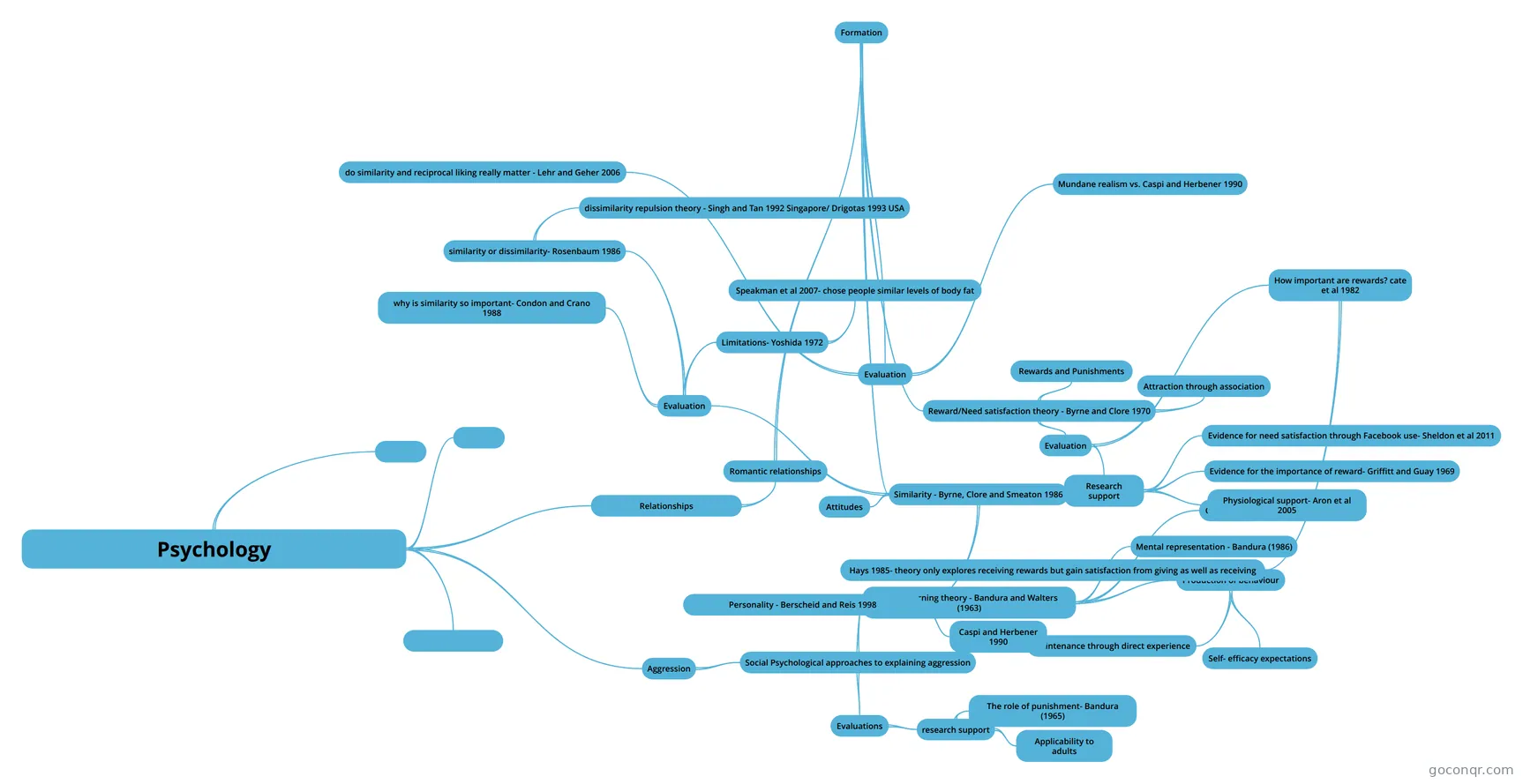
Mind map: Psychology: Relationships and Aggression
Contenido del mapa
Psychology
Relationships
- Romantic relationships
- Formation
- social psychologists scientific study shown initial stages little do shared emotions and more to do with self-interest
- Reward/Need satisfaction theory - Byrne and Clore 1970
- attracted people find satisfying/gratifying to be with motivated seek rewarding stimuli and avoid punishing stimuli rewarding=reflect unmet needs mutual attraction= partner meets needs
- Rewards and Punishments
- operant condition principles= enter relationship presence individual directly associated reinforcement= more attractive
- Attraction through association
- like people associated positive events/mood association- classical conditioning balance +/- crucial relationship formation . more + relationship succeed
- Evaluation
- Research support
- Evidence for the importance of reward- Griffitt and Guay 1969
- pps evaluated creative task, experimenter asked rate how much liked experimenter, rating highest when experimenter positively evaluated (rewarded) pps performance on the task
- Evidence for need satisfaction through Facebook use- Sheldon et al 2011
- greater fb use +correlated both + feeling 'connectedness' and - indicators relationship satisfaction feelings'disconnectedness' relationally connected ppl socialability motivates fb use and satisfies relational need to reach out to others disconnected ppl lack need satisfaction through face-to-face relationships ise fb coping strategy
- Physiological support- Aron et al 2005
- pps measured very high self-report questionnaire romantic love strong activity brain- ventral tegmental area early stage intense love associated elevated levels activity subcortical reward regions brain, rich dopamine
- Evidence for the importance of reward- Griffitt and Guay 1969
- How important are rewards? cate et al 1982
- 337 individuals assess current relationships terms reward level and satisfaction results- reward level superior other factors determining satisfaction
- Hays 1985- theory only explores receiving rewards but gain satisfaction from giving as well as receiving
- Research support
- Similarity - Byrne, Clore and Smeaton 1986
- 2 stages formation 1. sort by dissimilarity 2. remaining choose someone similar
- Personality - Berscheid and Reis 1998
- attracted more similar personality traits than those dissimilar/complementary
- Caspi and Herbener 1990
- married couples similar personalities more happier than those couples that aren't
- Attitudes
- attitude alignment- patners modify attitudes to be more similar relationship develop
- Evaluation
- similarity or dissimilarity- Rosenbaum 1986
- dissimilarity more important dissimilarity-repulsion hypothesis tested number different cultures
- dissimilarity repulsion theory - Singh and Tan 1992 Singapore/ Drigotas 1993 USA
- pps 1st attracted similarity of attitudes know better discover more dissimilarities discontinue
- Limitations- Yoshida 1972
- research just fiocused on similarity and personality. represents very narrow view factors important formation. factors - self-concept, economic level and physical conditiion
- Speakman et al 2007- chose people similar levels of body fat
- why is similarity so important- Condon and Crano 1988
- similarity important 1. assume similar people likely to like back- less chance rejection 2. other people share attitudes and beliefs validate them= rewarding. reward/need satisfaction theory
- similarity or dissimilarity- Rosenbaum 1986
- Evaluation
- Mundane realism vs. Caspi and Herbener 1990
- most lab studies not necessarily show principles need satisfaction and similary apply real life- lack mundane realism though study by caspi and herbener 1990 real life applicability
- do similarity and reciprocal liking really matter - Lehr and Geher 2006
- lab experiment , 24 male and 32 female students aim: importance similarity and reciprocal attraction in liking knowing someone likes you, rewarding lead mutual liking pps given description stranger varying degrees similarity attitude to pps dependent variable: measures liking bogus stranger ( degree liking and likelihood dating) found sig effects attitude similarity (similar ppl liked more) and liking (more likely to be reciprocated inserted each description statement stranger either liked or didn't dependent variables
- Mundane realism vs. Caspi and Herbener 1990
- Formation
- Romantic relationships
Aggression
- Social Psychological approaches to explaining aggression
- social psychological theories cause aggressive behaviour arising from interactions with others in social world
- Social learning theory - Bandura and Walters (1963)
- learn by observing others learn specifics of aggressive behaviour - form taken, how often enacted and situations which produce it and who targeted persons biological make-up creates potential for aggression and actual expression aggression learnt.
- Observation
- observing role model(identify with)then imitating. opposite skinner's operant conditioning learning occurs through direct reinforcement. observe and learn consequences aggressive behaviour others reinforced/punishment = vicarious reinforcement learn considered appropriate(and effective) learn behaviours and if they're worth repeating
- Mental representation - Bandura (1986)
- slt take place child form mental representation events in their social environment also represent possible rewards and punishments terms expectancies of future outcomes expectation reward greater than expectation punishment - behaviour displayed
- Production of behaviour
- Maintenance through direct experience
- child rewarded likely repeat behaviour in similar situations. e.g. successful bully will attach value to aggression
- Self- efficacy expectations
- develop confidence ability carry out necessary aggressive actions e.g. not successful past, lower self-efficacy and not use aggression to resolve conflicts but other means
- Maintenance through direct experience
- Evaluations
- research support
- The role of punishment- Bandura (1965)
- Bandura
- Applicability to adults
- The role of punishment- Bandura (1965)
- research support
- Social Psychological approaches to explaining aggression
Información
- Descripción
- Mapa Mental sobre Psychology, creado por 28249 el 22/04/2015.
- Creado por
- 28249
- Visitas
- 0
- Valoración