
Mapa mental
Relationships
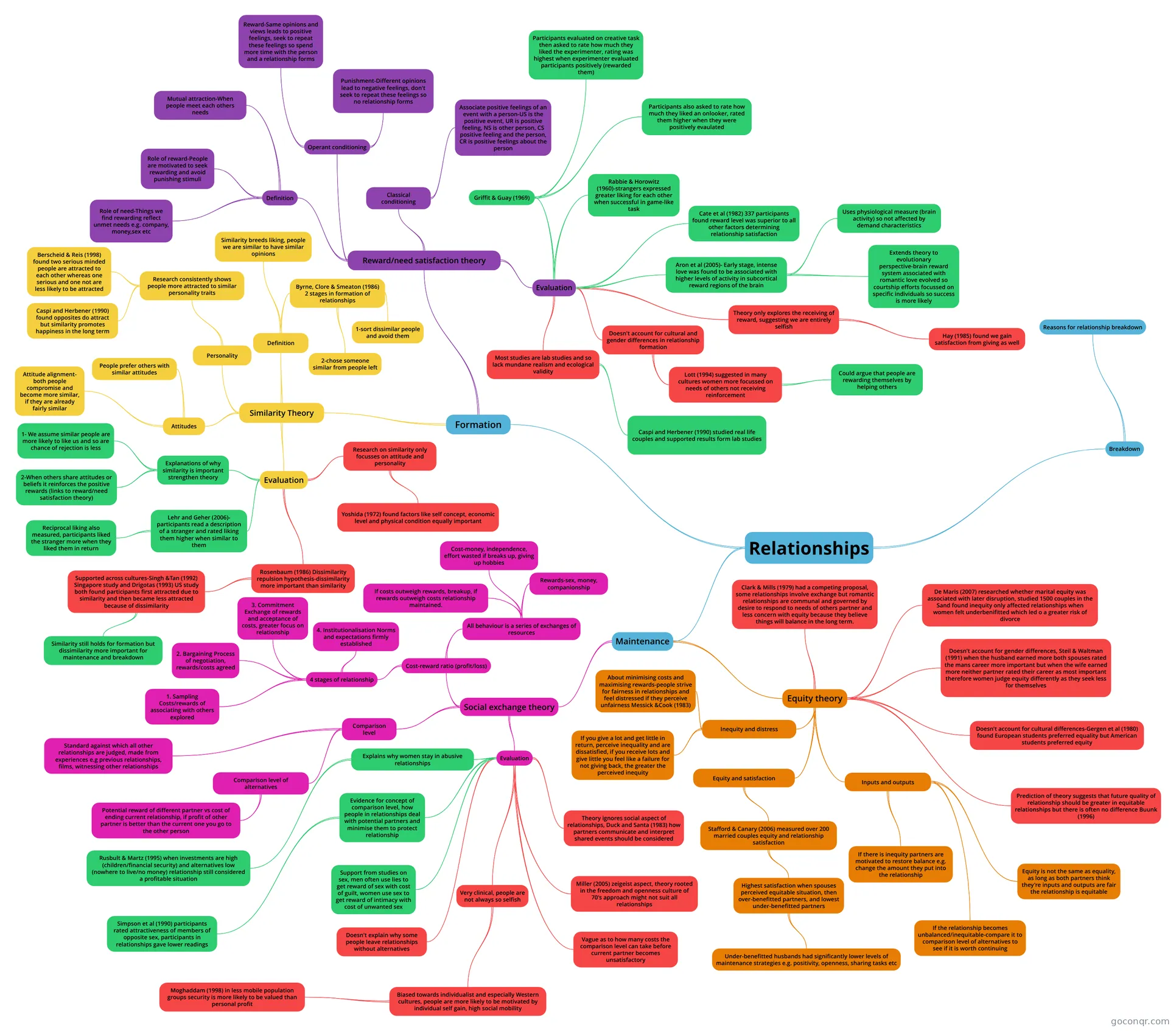
Mind map: Relationships
Contenido del mapa
Relationships
Formation
- Reward/need satisfaction theory
- Definition
- Role of reward-People are motivated to seek rewarding and avoid punishing stimuli
- Role of need-Things we find rewarding reflect unmet needs e.g. company, money,sex etc
- Mutual attraction-When people meet each others needs
- Operant conditioning
- Reward-Same opinions and views leads to positive feelings, seek to repeat these feelings so spend more time with the person and a relationship forms
- Punishment-Different opinions lead to negative feelings, don't seek to repeat these feelings so no relationship forms
- Classical conditioning
- Associate positive feelings of an event with a person-US is the positive event, UR is positive feeling, NS is other person, CS positive feeling and the person, CR is positive feelings about the person
- Evaluation
- Griffit & Guay (1969)
- Participants evaluated on creative task then asked to rate how much they liked the experimenter, rating was highest when experimenter evaluated participants positively (rewarded them)
- Participants also asked to rate how much they liked an onlooker, rated them higher when they were positively evaulated
- Rabbie & Horowitz (1960)-strangers expressed greater liking for each other when successful in game-like task
- Cate et al (1982) 337 participants found reward level was superior to all other factors determining relationship satisfaction
- Aron et al (2005)- Early stage, intense love was found to be associated with higher levels of activity in subcortical reward regions of the brain
- Uses physiological measure (brain activity) so not affected by demand characteristics
- Extends theory to evolutionary perspective-brain reward system associated with romantic love evolved so courtship efforts focussed on specific individuals so success is more likely
- Theory only explores the receiving of reward, suggesting we are entirely selfish
- Hay (1985) found we gain satisfaction from giving as well
- Doesn't account for cultural and gender differences in relationship formation
- Lott (1994) suggested in many cultures women more focussed on needs of others not receiving reinforcement
- Could argue that people are rewarding themselves by helping others
- Lott (1994) suggested in many cultures women more focussed on needs of others not receiving reinforcement
- Most studies are lab studies and so lack mundane realism and ecological validity
- Caspi and Herbener (1990) studied real life couples and supported results form lab studies
- Griffit & Guay (1969)
- Definition
- Similarity Theory
- Definition
- Similarity breeds liking, people we are similar to have similar opinions
- Byrne, Clore & Smeaton (1986) 2 stages in formation of relationships
- 1-sort dissimilar people and avoid them
- 2-chose someone similar from people left
- Personality
- Research consistently shows people more attracted to similar personality traits
- Berscheid & Reis (1998) found two serious minded people are attracted to each other whereas one serious and one not are less likely to be attracted
- Caspi and Herbener (1990) found opposites do attract but similarity promotes happiness in the long term
- Research consistently shows people more attracted to similar personality traits
- Attitudes
- People prefer others with similar attitudes
- Attitude alignment- both people compromise and become more similar, if they are already fairly similar
- Evaluation
- Explanations of why similarity is important strengthen theory
- 1- We assume similar people are more likely to like us and so are chance of rejection is less
- 2-When others share attitudes or beliefs it reinforces the positive rewards (links to reward/need satisfaction theory)
- Lehr and Geher (2006)- participants read a description of a stranger and rated liking them higher when similar to them
- Reciprocal liking also measured, participants liked the stranger more when they liked them in return
- Rosenbaum (1986) Dissimilarity repulsion hypothesis-dissimilarity more important than similarity
- Supported across cultures-Singh &Tan (1992) Singapore study and Drigotas (1993) US study both found participants first attracted due to similarity and then became less attracted because of dissimilarity
- Similarity still holds for formation but dissimilarity more important for maintenance and breakdown
- Supported across cultures-Singh &Tan (1992) Singapore study and Drigotas (1993) US study both found participants first attracted due to similarity and then became less attracted because of dissimilarity
- Research on similarity only focusses on attitude and personality
- Yoshida (1972) found factors like self concept, economic level and physical condition equally important
- Explanations of why similarity is important strengthen theory
- Definition
- Reward/need satisfaction theory
Maintenance
- Social exchange theory
- Cost-reward ratio (profit/loss)
- All behaviour is a series of exchanges of resources
- Cost-money, independence, effort wasted if breaks up, giving up hobbies
- Rewards-sex, money, companionship
- If costs outweigh rewards, breakup, if rewards outweigh costs relationship maintained.
- 4 stages of relationship
- 1. Sampling Costs/rewards of associating with others explored
- 2. Bargaining Process of negotiation, rewards/costs agreed
- 3. Commitment Exchange of rewards and acceptance of costs, greater focus on relationship
- 4. Institutionalisation Norms and expectations firmly established
- All behaviour is a series of exchanges of resources
- Comparison level
- Standard against which all other relationships are judged, made from experiences e.g previous relationships, films, witnessing other relationships
- Comparison level of alternatives
- Potential reward of different partner vs cost of ending current relationship, if profit of other partner is better than the current one you go to the other person
- Evaluation
- Explains why women stay in abusive relationships
- Rusbult & Martz (1995) when investments are high (children/financial security) and alternatives low (nowhere to live/no money) relationship still considered a profitable situation
- Evidence for concept of comparison level, how people in relationships deal with potential partners and minimise them to protect relationship
- Simpson et al (1990) participants rated attractiveness of members of opposite sex, participants in relationships gave lower readings
- Support from studies on sex, men often use lies to get reward of sex with cost of guilt, women use sex to get reward of intimacy with cost of unwanted sex
- Doesn't explain why some people leave relationships without alternatives
- Vague as to how many costs the comparison level can take before current partner becomes unsatisfactory
- Very clinical, people are not always so selfish
- Biased towards individualist and especially Western cultures, people are more likely to be motivated by individual self gain, high social mobility
- Moghaddam (1998) in less mobile population groups security is more likely to be valued than personal profit
- Biased towards individualist and especially Western cultures, people are more likely to be motivated by individual self gain, high social mobility
- Miller (2005) zeigeist aspect, theory rooted in the freedom and openness culture of 70's approach might not suit all relationships
- Theory ignores social aspect of relationships, Duck and Santa (1983) how partners communicate and interpret shared events should be considered
- Explains why women stay in abusive relationships
- Cost-reward ratio (profit/loss)
- Equity theory
- Inequity and distress
- About minimising costs and maximising rewards-people strive for fairness in relationships and feel distressed if they perceive unfairness Messick &Cook (1983)
- If you give a lot and get little in return, perceive inequality and are dissatisfied, if you receive lots and give little you feel like a failure for not giving back, the greater the perceived inequity
- Inputs and outputs
- If the relationship becomes unbalanced/inequitable-compare it to comparison level of alternatives to see if it is worth continuing
- If there is inequity partners are motivated to restore balance e.g. change the amount they put into the relationship
- Equity is not the same as equality, as long as both partners think they're inputs and outputs are fair the relationship is equitable
- Equity and satisfaction
- Stafford & Canary (2006) measured over 200 married couples equity and relationship satisfaction
- Highest satisfaction when spouses perceived equitable situation, then over-benefitted partners, and lowest under-benefitted partners
- Under-benefitted husbands had significantly lower levels of maintenance strategies e.g. positivity, openness, sharing tasks etc
- Highest satisfaction when spouses perceived equitable situation, then over-benefitted partners, and lowest under-benefitted partners
- Stafford & Canary (2006) measured over 200 married couples equity and relationship satisfaction
- Clark & Mills (1979) had a competing proposal, some relationships involve exchange but romantic relationships are communal and governed by desire to respond to needs of others partner and less concern with equity because they believe things will balance in the long term.
- De Maris (2007) researched whether marital equity was associated with later disruption, studied 1500 couples in the Sand found inequity only affected relationships when women felt underbenifitted which led o a greater risk of divorce
- Doesn't account for gender differences, Steil & Waltman (1991) when the husband earned more both spouses rated the mans career more important but when the wife earned more neither partner rated their career as most important therefore women judge equity differently as they seek less for themselves
- Doesn't account for cultural differences-Gergen et al (1980) found European students preferred equality but American students preferred equity
- Prediction of theory suggests that future quality of relationship should be greater in equitable relationships but there is often no difference Buunk (1996)
- Inequity and distress
- Social exchange theory
Breakdown
- Reasons for relationship breakdown
Información
- Descripción
- Mapa Mental sobre Relationships, creado por ocean el 01/05/2015.
- Creado por
- ocean
- Visitas
- 3
- Valoración
Más sobre Relationship formation and attraction