
Mapa mental
Relationships
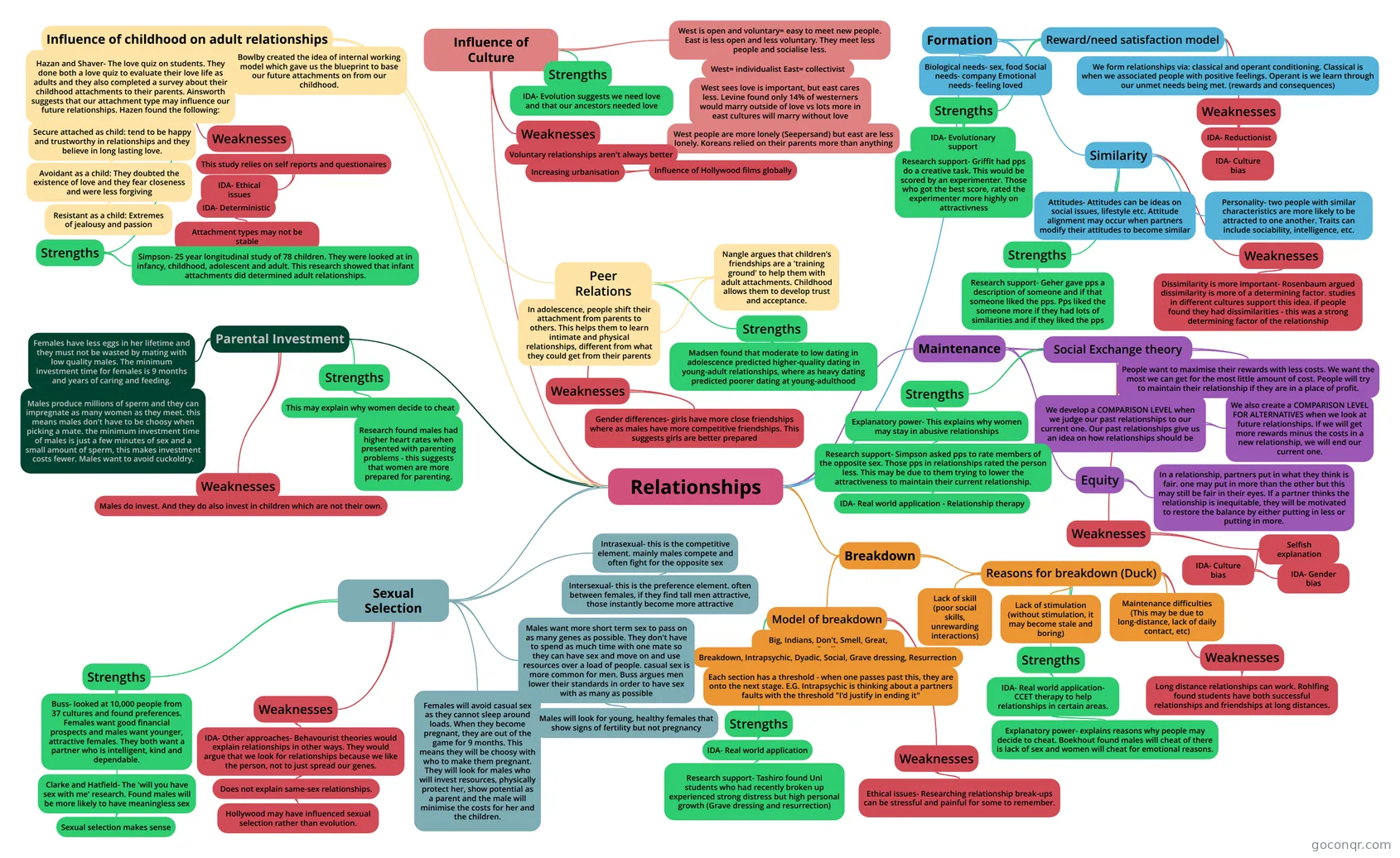
Mind map: Relationships
Contenido del mapa
Relationships
Formation
- Reward/need satisfaction model
- We form relationships via: classical and operant conditioning. Classical is when we associated people with positive feelings. Operant is we learn through our unmet needs being met. (rewards and consequences)
- Strengths
- IDA- Evolutionary support
- Research support- Griffit had pps do a creative task. This would be scored by an experimenter. Those who got the best score, rated the experimenter more highly on attractivness
- Weaknesses
- IDA- Reductionist
- IDA- Culture bias
- Biological needs- sex, food Social needs- company Emotional needs- feeling loved
- Similarity
- Personality- two people with similar characteristics are more likely to be attracted to one another. Traits can include sociability, intelligence, etc.
- Attitudes- Attitudes can be ideas on social issues, lifestyle etc. Attitude alignment may occur when partners modify their attitudes to become similar
- Strengths
- Research support- Geher gave pps a description of someone and if that someone liked the pps. Pps liked the someone more if they had lots of similarities and if they liked the pps
- Weaknesses
- Dissimilarity is more important- Rosenbaum argued dissimilarity is more of a determining factor. studies in different cultures support this idea. if people found they had dissimilarities - this was a strong determining factor of the relationship
- Reward/need satisfaction model
Maintenance
- Social Exchange theory
- People want to maximise their rewards with less costs. We want the most we can get for the most little amount of cost. People will try to maintain their relationship if they are in a place of profit.
- We develop a COMPARISON LEVEL when we judge our past relationships to our current one. Our past relationships give us an idea on how relationships should be
- We also create a COMPARISON LEVEL FOR ALTERNATIVES when we look at future relationships. If we will get more rewards minus the costs in a new relationship, we will end our current one.
- Strengths
- Explanatory power- This explains why women may stay in abusive relationships
- Research support- Simpson asked pps to rate members of the opposite sex. Those pps in relationships rated the person less. This may be due to them trying to lower the attractiveness to maintain their current relationship.
- IDA- Real world application - Relationship therapy
- Research support- Simpson asked pps to rate members of the opposite sex. Those pps in relationships rated the person less. This may be due to them trying to lower the attractiveness to maintain their current relationship.
- Explanatory power- This explains why women may stay in abusive relationships
- Weaknesses
- Selfish explanation
- IDA- Culture bias
- IDA- Gender bias
- IDA- Culture bias
- Selfish explanation
- Equity
- In a relationship, partners put in what they think is fair. one may put in more than the other but this may still be fair in their eyes. If a partner thinks the relationship is inequitable, they will be motivated to restore the balance by either putting in less or putting in more.
- Social Exchange theory
Breakdown
- Reasons for breakdown (Duck)
- Lack of skill (poor social skills, unrewarding interactions)
- Lack of stimulation (without stimulation, it may become stale and boring)
- Maintenance difficulties (This may be due to long-distance, lack of daily contact, etc)
- Strengths
- IDA- Real world application- CCET therapy to help relationships in certain areas.
- Explanatory power- explains reasons why people may decide to cheat. Boekhout found males will cheat of there is lack of sex and women will cheat for emotional reasons.
- IDA- Real world application- CCET therapy to help relationships in certain areas.
- Weaknesses
- Long distance relationships can work. Rohlfing found students have both successful relationships and friendships at long distances.
- Model of breakdown
- Big, Indians, Don't, Smell, Great, Really
- Breakdown, Intrapsychic, Dyadic, Social, Grave dressing, Resurrection
- Each section has a threshold - when one passes past this, they are onto the next stage. E.G. Intrapsychic is thinking about a partners faults with the threshold "I'd justify in ending it"
- Strengths
- IDA- Real world application
- Research support- Tashiro found Uni students who had recently broken up experienced strong distress but high personal growth (Grave dressing and resurrection)
- IDA- Real world application
- Weaknesses
- Ethical issues- Researching relationship break-ups can be stressful and painful for some to remember.
- Reasons for breakdown (Duck)
Sexual Selection
- Intrasexual- this is the competitive element. mainly males compete and often fight for the opposite sex
- Intersexual- this is the preference element. often between females, if they find tall men attractive, those instantly become more attractive
- Males want more short term sex to pass on as many genes as possible. They don't have to spend as much time with one mate so they can have sex and move on and use resources over a load of people. casual sex is more common for men. Buss argues men lower their standards in order to have sex with as many as possible
- Males will look for young, healthy females that show signs of fertility but not pregnancy
- Females will avoid casual sex as they cannot sleep around loads. When they become pregnant, they are out of the game for 9 months. This means they will be choosy with who to make them pregnant. They will look for males who will invest resources, physically protect her, show potential as a parent and the male will minimise the costs for her and the children.
- Strengths
- Buss- looked at 10,000 people from 37 cultures and found preferences. Females want good financial prospects and males want younger, attractive females. They both want a partner who is intelligent, kind and dependable.
- Clarke and Hatfield- The 'will you have sex with me' research. Found males will be more likely to have meaningless sex
- Sexual selection makes sense
- Weaknesses
- IDA- Other approaches- Behavourist theories would explain relationships in other ways. They would argue that we look for relationships because we like the person, not to just spread our genes.
- Does not explain same-sex relationships.
- Hollywood may have influenced sexual selection rather than evolution.
- Does not explain same-sex relationships.
- IDA- Other approaches- Behavourist theories would explain relationships in other ways. They would argue that we look for relationships because we like the person, not to just spread our genes.
- Intrasexual- this is the competitive element. mainly males compete and often fight for the opposite sex
Influence of childhood on adult relationships
- Bowlby created the idea of internal working model which gave us the blueprint to base our future attachments on from our childhood.
- Hazan and Shaver- The love quiz on students. They done both a love quiz to evaluate their love life as adults and they also completed a survey about their childhood attachments to their parents. Ainsworth suggests that our attachment type may influence our future relationships. Hazen found the following:
- Secure attached as child: tend to be happy and trustworthy in relationships and they believe in long lasting love.
- Avoidant as a child: They doubted the existence of love and they fear closeness and were less forgiving
- Resistant as a child: Extremes of jealousy and passion
- Avoidant as a child: They doubted the existence of love and they fear closeness and were less forgiving
- Secure attached as child: tend to be happy and trustworthy in relationships and they believe in long lasting love.
- Weaknesses
- This study relies on self reports and questionaires
- IDA- Ethical issues
- IDA- Deterministic
- Attachment types may not be stable
- IDA- Deterministic
- IDA- Ethical issues
- This study relies on self reports and questionaires
- Strengths
- Simpson- 25 year longitudinal study of 78 children. They were looked at in infancy, childhood, adolescent and adult. This research showed that infant attachments did determined adult relationships.
- Peer Relations
- Nangle argues that children's friendships are a 'training ground' to help them with adult attachments. Childhood allows them to develop trust and acceptance.
- In adolescence, people shift their attachment from parents to others. This helps them to learn intimate and physical relationships, different from what they could get from their parents
- Strengths
- Madsen found that moderate to low dating in adolescence predicted higher-quality dating in young-adult relationships, where as heavy dating predicted poorer dating at young-adulthood
- Weaknesses
- Gender differences- girls have more close friendships where as males have more competitive friendships. This suggests girls are better prepared
- Nangle argues that children's friendships are a 'training ground' to help them with adult attachments. Childhood allows them to develop trust and acceptance.
Influence of Culture
- West is open and voluntary= easy to meet new people. East is less open and less voluntary. They meet less people and socialise less.
- West= individualist East= collectivist
- West sees love is important, but east cares less. Levine found only 14% of westerners would marry outside of love vs lots more in east cultures will marry without love
- West people are more lonely (Seepersand) but east are less lonely. Koreans relied on their parents more than anything
- West sees love is important, but east cares less. Levine found only 14% of westerners would marry outside of love vs lots more in east cultures will marry without love
- West= individualist East= collectivist
- Strengths
- IDA- Evolution suggests we need love and that our ancestors needed love
- Weaknesses
- Voluntary relationships aren't always better
- Increasing urbanisation
- Influence of Hollywood films globally
- Increasing urbanisation
- Voluntary relationships aren't always better
- West is open and voluntary= easy to meet new people. East is less open and less voluntary. They meet less people and socialise less.
Parental Investment
- Females have less eggs in her lifetime and they must not be wasted by mating with low quality males. The minimum investment time for females is 9 months and years of caring and feeding.
- Males produce millions of sperm and they can impregnate as many women as they meet. this means males don't have to be choosy when picking a mate. the minimum investment time of males is just a few minutes of sex and a small amount of sperm, this makes investment costs fewer. Males want to avoid cuckoldry.
- Strengths
- This may explain why women decide to cheat
- Research found males had higher heart rates when presented with parenting problems - this suggests that women are more prepared for parenting.
- This may explain why women decide to cheat
- Weaknesses
- Males do invest. And they do also invest in children which are not their own.
- Females have less eggs in her lifetime and they must not be wasted by mating with low quality males. The minimum investment time for females is 9 months and years of caring and feeding.
Información
- Descripción
- Mapa Mental sobre Relationships, creado por Oli Brown el 04/06/2015.
- Creado por
- Oli Brown
- Visitas
- 1
- Valoración