
Mapa mental
Reinforcement Affect - Formation
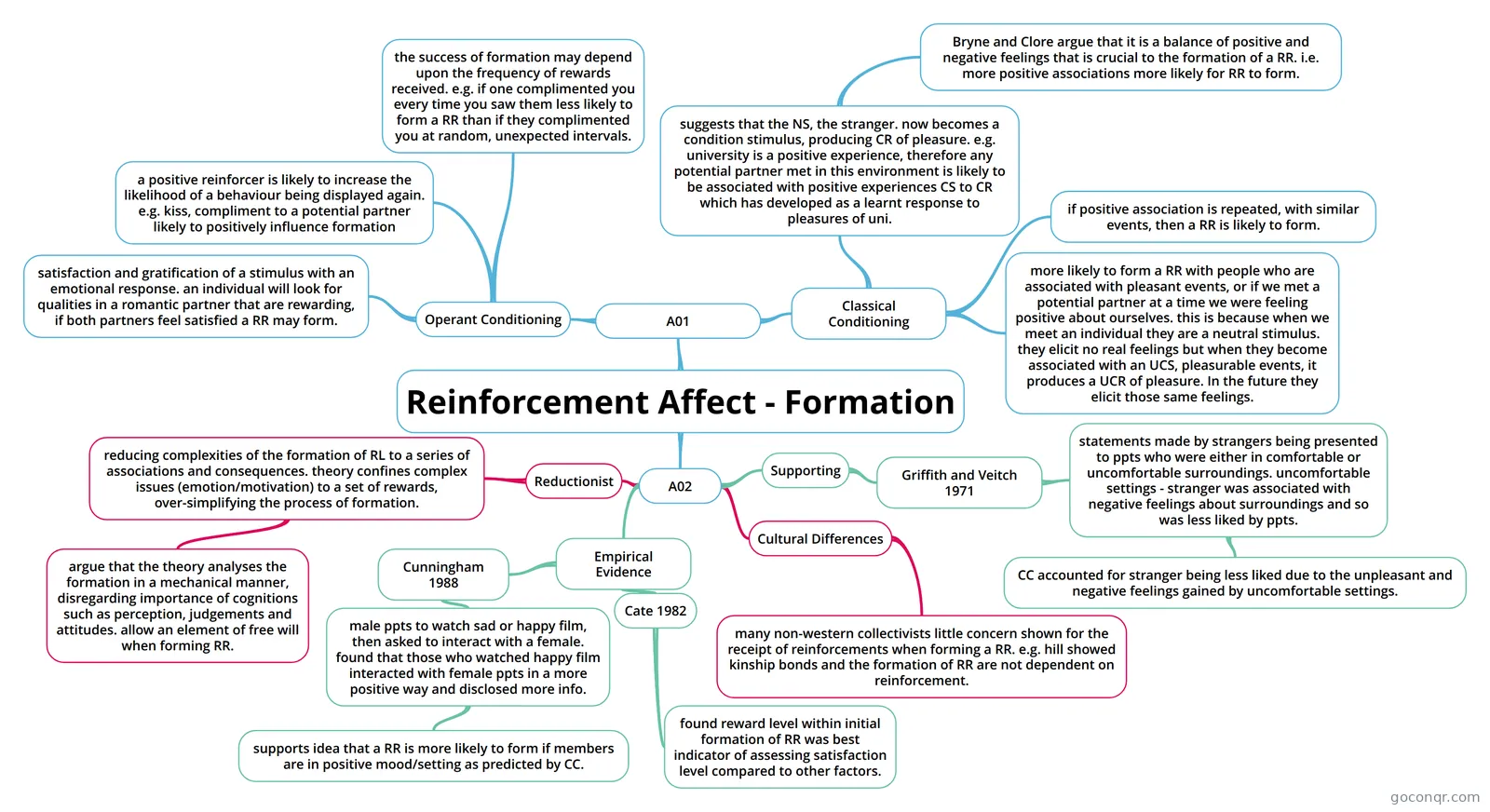
Mind map: Reinforcement affect formation
Contenido del mapa
Reinforcement Affect - Formation
A01
- Classical Conditioning
- more likely to form a RR with people who are associated with pleasant events, or if we met a potential partner at a time we were feeling positive about ourselves. this is because when we meet an individual they are a neutral stimulus. they elicit no real feelings but when they become associated with an UCS, pleasurable events, it produces a UCR of pleasure. In the future they elicit those same feelings.
- if positive association is repeated, with similar events, then a RR is likely to form.
- suggests that the NS, the stranger. now becomes a condition stimulus, producing CR of pleasure. e.g. university is a positive experience, therefore any potential partner met in this environment is likely to be associated with positive experiences CS to CR which has developed as a learnt response to pleasures of uni.
- Bryne and Clore argue that it is a balance of positive and negative feelings that is crucial to the formation of a RR. i.e. more positive associations more likely for RR to form.
- Operant Conditioning
- satisfaction and gratification of a stimulus with an emotional response. an individual will look for qualities in a romantic partner that are rewarding, if both partners feel satisfied a RR may form.
- a positive reinforcer is likely to increase the likelihood of a behaviour being displayed again. e.g. kiss, compliment to a potential partner likely to positively influence formation
- the success of formation may depend upon the frequency of rewards received. e.g. if one complimented you every time you saw them less likely to form a RR than if they complimented you at random, unexpected intervals.
- Classical Conditioning
A02
- Supporting
- Griffith and Veitch 1971
- statements made by strangers being presented to ppts who were either in comfortable or uncomfortable surroundings. uncomfortable settings - stranger was associated with negative feelings about surroundings and so was less liked by ppts.
- CC accounted for stranger being less liked due to the unpleasant and negative feelings gained by uncomfortable settings.
- statements made by strangers being presented to ppts who were either in comfortable or uncomfortable surroundings. uncomfortable settings - stranger was associated with negative feelings about surroundings and so was less liked by ppts.
- Griffith and Veitch 1971
- Empirical Evidence
- Cunningham 1988
- male ppts to watch sad or happy film, then asked to interact with a female. found that those who watched happy film interacted with female ppts in a more positive way and disclosed more info.
- supports idea that a RR is more likely to form if members are in positive mood/setting as predicted by CC.
- male ppts to watch sad or happy film, then asked to interact with a female. found that those who watched happy film interacted with female ppts in a more positive way and disclosed more info.
- Cate 1982
- found reward level within initial formation of RR was best indicator of assessing satisfaction level compared to other factors.
- Cunningham 1988
- Reductionist
- reducing complexities of the formation of RL to a series of associations and consequences. theory confines complex issues (emotion/motivation) to a set of rewards, over-simplifying the process of formation.
- argue that the theory analyses the formation in a mechanical manner, disregarding importance of cognitions such as perception, judgements and attitudes. allow an element of free will when forming RR.
- reducing complexities of the formation of RL to a series of associations and consequences. theory confines complex issues (emotion/motivation) to a set of rewards, over-simplifying the process of formation.
- Cultural Differences
- many non-western collectivists little concern shown for the receipt of reinforcements when forming a RR. e.g. hill showed kinship bonds and the formation of RR are not dependent on reinforcement.
- Supporting
Información
- Descripción
- A-Level (Printed) Psychology Mapa Mental sobre Reinforcement Affect - Formation, creado por Sophie Edroff el 16/12/2015.
- Creado por
- Sophie Edroff
- Visitas
- 0
- Valoración