
Mapa mental
Formation, maintenance and breakdown
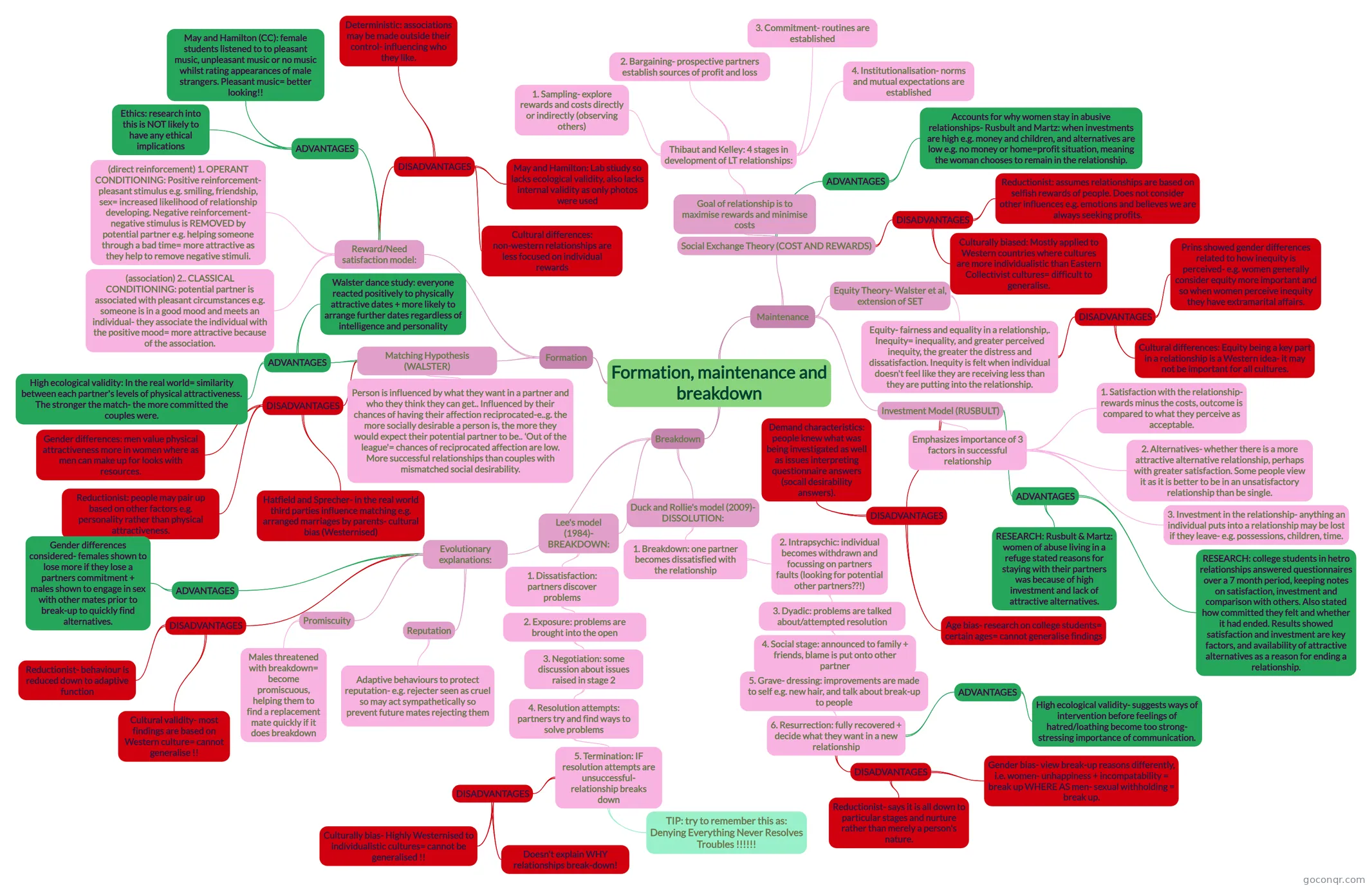
Mind map: relationships formation maintenance and breakdown
Contenido del mapa
Formation, maintenance and breakdown
Formation
- Reward/Need satisfaction model:
- (direct reinforcement) 1. OPERANT CONDITIONING: Positive reinforcement- pleasant stimulus e.g. smiling, friendship, sex= increased likelihood of relationship developing. Negative reinforcement- negative stimulus is REMOVED by potential partner e.g. helping someone through a bad time= more attractive as they help to remove negative stimuli.
- (association) 2.. CLASSICAL CONDITIONING: potential partner is associated with pleasant circumstances e.g. someone is in a good mood and meets an individual- they associate the individual with the positive mood= more attractive because of the association.
- ADVANTAGES
- Ethics: research into this is NOT likely to have any ethical implications
- May and Hamilton (CC): female students listened to to pleasant music, unpleasant music or no music whilst rating appearances of male strangers. Pleasant music= better looking!!
- DISADVANTAGES
- Cultural differences: non-western relationships are less focused on individual rewards
- Deterministic: associations may be made outside their control- influencing who they like.
- May and Hamilton: Lab stiudy so lacks ecological validity, also lacks internal validity as only photos were used
- Matching Hypothesis (WALSTER)
- Person is influenced by what they want in a partner and who they think they can get.. Influenced by their chances of having their affection reciprocated-e..g. the more socially desirable a person is, the more they would expect their potential partner to be.. 'Out of the league'= chances of reciprocated affection are low. More successful relationships than couples with mismatched social desirability.
- ADVANTAGES
- Walster dance study: everyone reacted positively to physically attractive dates + more likely to arrange further dates regardless of intelligence and personality
- High ecological validity: In the real world= similarity between each partner's levels of physical attractiveness. The stronger the match- the more committed the couples were.
- DISADVANTAGES
- Reductionist: people may pair up based on other factors e.g. personality rather than physical attractiveness.
- Gender differences: men value physical attractiveness more in women where as men can make up for looks with resources.
- Hatfield and Sprecher- in the real world third parties influence matching e.g. arranged marriages by parents- cultural bias (Westernised)
- Reward/Need satisfaction model:
Maintenance
- Social Exchange Theory (COST AND REWARDS)
- Goal of relationship is to maximise rewards and minimise costs
- Thibaut and Kelley: 4 stages in development of LT relationships:
- 1. Sampling- explore rewards and costs directly or indirectly (observing others)
- 2. Bargaining- prospective partners establish sources of profit and loss
- 3. Commitment- routines are established
- 4. Institutionalisation- norms and mutual expectations are established
- Thibaut and Kelley: 4 stages in development of LT relationships:
- ADVANTAGES
- Accounts for why women stay in abusive relationships- Rusbult and Martz: when investments are high e.g. money and children, and alternatives are low e.g. no money or home=profit situation, meaning the woman chooses to remain in the relationship.
- DISADVANTAGES
- Reductionist: assumes relationships are based on selfish rewards of people. Does not consider other influences e.g. emotions and believes we are always seeking profits.
- Culturally biased: Mostly applied to Western countries where cultures are more individualistic than Eastern Collectivist cultures= difficult to generalise.
- Goal of relationship is to maximise rewards and minimise costs
- Equity Theory- Walster et al, extension of SET
- Equity- fairness and equality in a relationship,. Inequity= inequality, and greater perceived inequity, the greater the distress and dissatisfaction. Inequity is felt when individual doesn't feel like they are receiving less than they are putting into the relationship.
- DISADVANTAGES
- Prins showed gender differences related to how inequity is perceived- e.g. women generally consider equity more important and so when women perceive inequity they have extramarital affairs.
- Cultural differences: Equity being a key part in a relationship is a Western idea- it may not be important for all cultures.
- DISADVANTAGES
- Equity- fairness and equality in a relationship,. Inequity= inequality, and greater perceived inequity, the greater the distress and dissatisfaction. Inequity is felt when individual doesn't feel like they are receiving less than they are putting into the relationship.
- Investment Model (RUSBULT)
- Emphasizes importance of 3 factors in successful relationship
- 1. Satisfaction with the relationship- rewards minus the costs, outcome is compared to what they perceive as acceptable.
- 2. Alternatives- whether there is a more attractive alternative relationship, perhaps with greater satisfaction. Some people view it as it is better to be in an unsatisfactory relationship than be single.
- 3. Investment in the relationship- anything an individual puts into a relationship may be lost if they leave- e.g. possessions, children, time.
- ADVANTAGES
- RESEARCH: college students in hetro relationships answered questionnaires over a 7 month period, keeping notes on satisfaction, investment and comparison with others. Also stated how committed they felt and whether it had ended. Results showed satisfaction and investment are key factors, and availability of attractive alternatives as a reason for ending a relationship.
- RESEARCH: Rusbult & Martz: women of abuse living in a refuge stated reasons for staying with their partners was because of high investment and lack of attractive alternatives.
- DISADVANTAGES
- Age bias- research on college students= certain ages= cannot generalise findings
- Demand characteristics: people knew what was being investigated as well as issues interpreting questionnaire answers (socail desirability answers).
- Emphasizes importance of 3 factors in successful relationship
- Social Exchange Theory (COST AND REWARDS)
Breakdown
- Duck and Rollie's model (2009)- DISSOLUTION:
- 1. Breakdown: one partner becomes dissatisfied with the relationship
- 2. Intrapsychic: individual becomes withdrawn and focussing on partners faults (looking for potential other partners??!)
- 3. Dyadic: problems are talked about/attempted resolution
- 4. Social stage: announced to family + friends, blame is put onto other partner
- 5. Grave- dressing: improvements are made to self e.g. new hair, and talk about break-up to people
- 6. Resurrection: fully recovered + decide what they want in a new relationship
- ADVANTAGES
- High ecological validity- suggests ways of intervention before feelings of hatred/loathing become too strong- stressing importance of communication.
- DISADVANTAGES
- Gender bias- view break-up reasons differently, i.e. women- unhappiness + incompatability = break up WHERE AS men- sexual withholding = break up.
- Reductionist- says it is all down to particular stages and nurture rather than merely a person's nature.
- ADVANTAGES
- 6. Resurrection: fully recovered + decide what they want in a new relationship
- 5. Grave- dressing: improvements are made to self e.g. new hair, and talk about break-up to people
- 4. Social stage: announced to family + friends, blame is put onto other partner
- 3. Dyadic: problems are talked about/attempted resolution
- 2. Intrapsychic: individual becomes withdrawn and focussing on partners faults (looking for potential other partners??!)
- 1. Breakdown: one partner becomes dissatisfied with the relationship
- Lee's model (1984)- BREAKDOWN:
- 1. Dissatisfaction: partners discover problems
- 2. Exposure: problems are brought into the open
- 3. Negotiation: some discussion about issues raised in stage 2
- 4. Resolution attempts: partners try and find ways to solve problems
- 5. Termination: IF resolution attempts are unsuccessful- relationship breaks down
- TIP: try to remember this as: Denying Everything Never Resolves Troubles !!!!!!
- DISADVANTAGES
- Doesn't explain WHY relationships break-down!
- Culturally bias- Highly Westernised to individualistic cultures= cannot be generalised !!
- 5. Termination: IF resolution attempts are unsuccessful- relationship breaks down
- 4. Resolution attempts: partners try and find ways to solve problems
- 3. Negotiation: some discussion about issues raised in stage 2
- 2. Exposure: problems are brought into the open
- 1. Dissatisfaction: partners discover problems
- Evolutionary explanations:
- Promiscuity
- Males threatened with breakdown= become promiscuous, helping them to find a replacement mate quickly if it does breakdown
- Reputation
- Adaptive behaviours to protect reputation- e.g. rejecter seen as cruel so may act sympathetically so prevent future mates rejecting them
- ADVANTAGES
- Gender differences considered- females shown to lose more if they lose a partners commitment + males shown to engage in sex with other mates prior to break-up to quickly find alternatives.
- DISADVANTAGES
- Reductionist- behaviour is reduced down to adaptive function
- Cultural validity- most findings are based on Western culture= cannot generalise !!
- Promiscuity
- Duck and Rollie's model (2009)- DISSOLUTION:
Información
- Descripción
- A-Level Psychology Mapa Mental sobre Formation, maintenance and breakdown, creado por beth.ransford el 17/02/2016.
- Creado por
- beth.ransford
- Visitas
- 4
- Valoración