
Mapa mental
Relationships; Formation, Maintenance, Breakdown
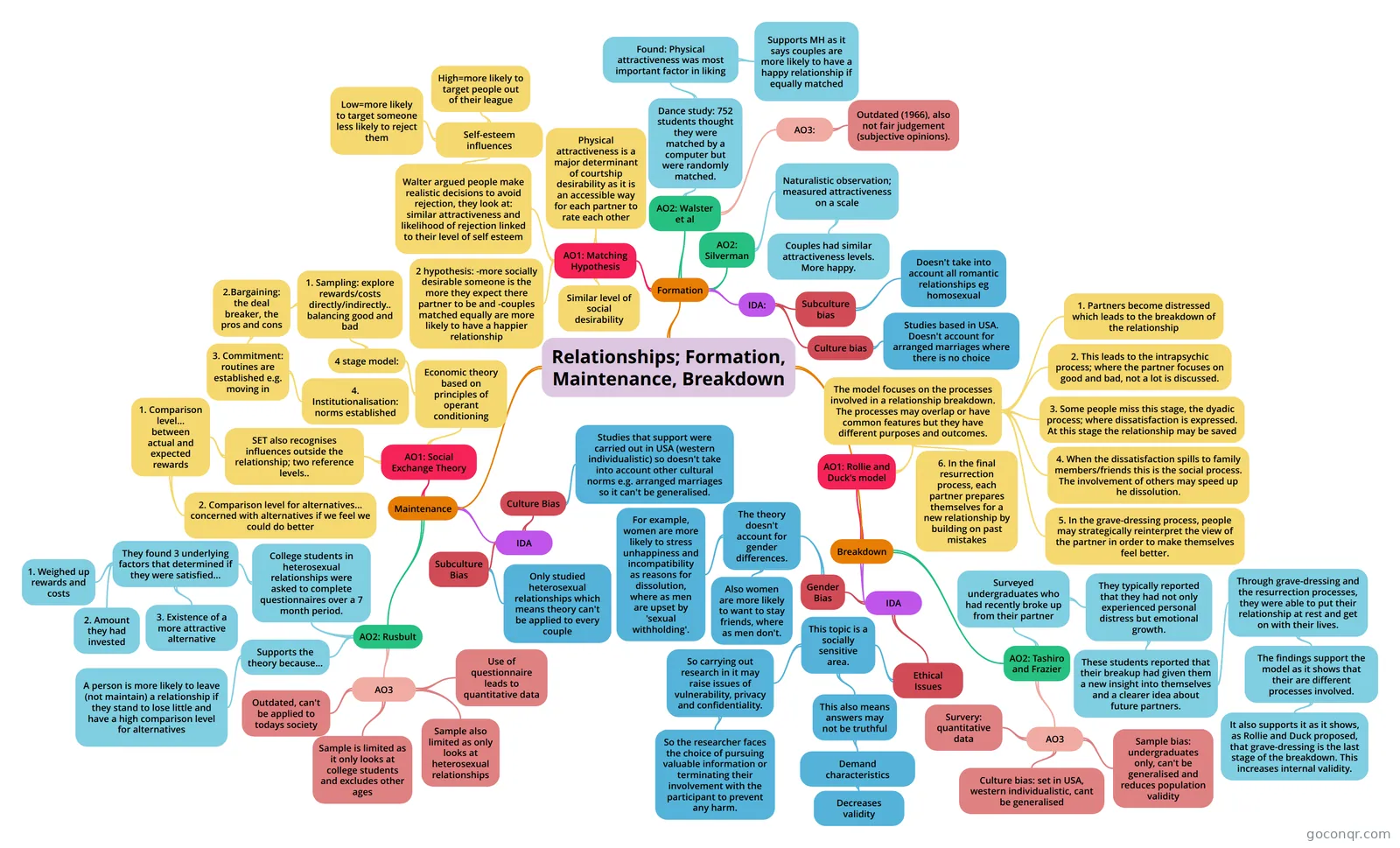
Mind map: Relationships: formation, maintenance and breakdown
Contenido del mapa
Relationships; Formation, Maintenance, Breakdown
Formation
- AO1: Matching Hypothesis
- Similar level of social desirability
- 2 hypothesis: -more socially desirable someone is the more they expect there partner to be and -couples matched equally are more likely to have a happier relationship
- Walter argued people make realistic decisions to avoid rejection, they look at: similar attractiveness and likelihood of rejection linked to their level of self esteem
- Self-esteem influences
- Low=more likely to target someone less likely to reject them
- High=more likely to target people out of their league
- Self-esteem influences
- Physical attractiveness is a major determinant of courtship desirability as it is an accessible way for each partner to rate each other
- IDA:
- Subculture bias
- Doesn't take into account all romantic relationships eg homosexual
- Culture bias
- Studies based in USA. Doesn't account for arranged marriages where there is no choice
- Subculture bias
- AO2: Walster et al
- Dance study: 752 students thought they were matched by a computer but were randomly matched.
- Found: Physical attractiveness was most important factor in liking
- Supports MH as it says couples are more likely to have a happy relationship if equally matched
- Found: Physical attractiveness was most important factor in liking
- AO3:
- Outdated (1966), also not fair judgement (subjective opinions).
- Dance study: 752 students thought they were matched by a computer but were randomly matched.
- AO2: Silverman
- Naturalistic observation; measured attractiveness on a scale
- Couples had similar attractiveness levels. More happy.
- Naturalistic observation; measured attractiveness on a scale
- AO1: Matching Hypothesis
Maintenance
- AO1: Social Exchange Theory
- Economic theory based on principles of operant conditioning
- 4 stage model:
- 1. Sampling: explore rewards/costs directly/indirectly.. balancing good and bad
- 2.Bargaining: the deal breaker, the pros and cons
- 3. Commitment: routines are established e.g. moving in
- 4. Institutionalisation: norms established
- 3. Commitment: routines are established e.g. moving in
- 2.Bargaining: the deal breaker, the pros and cons
- 1. Sampling: explore rewards/costs directly/indirectly.. balancing good and bad
- 4 stage model:
- SET also recognises influences outside the relationship; two reference levels..
- 1. Comparison level... between actual and expected rewards
- 2. Comparison level for alternatives... concerned with alternatives if we feel we could do better
- 1. Comparison level... between actual and expected rewards
- Economic theory based on principles of operant conditioning
- AO2: Rusbult
- College students in heterosexual relationships were asked to complete questionnaires over a 7 month period.
- They found 3 underlying factors that determined if they were satisfied...
- 1. Weighed up rewards and costs
- 2. Amount they had invested
- 3. Existence of a more attractive alternative
- They found 3 underlying factors that determined if they were satisfied...
- Supports the theory because...
- A person is more likely to leave (not maintain) a relationship if they stand to lose little and have a high comparison level for alternatives
- AO3
- Outdated, can't be applied to todays society
- Sample is limited as it only looks at college students and excludes other ages
- Sample also limited as only looks at heterosexual relationships
- Use of questionnaire leads to quantitative data
- College students in heterosexual relationships were asked to complete questionnaires over a 7 month period.
- IDA
- Subculture Bias
- Only studied heterosexual relationships which means theory can't be applied to every couple
- Culture Bias
- Studies that support were carried out in USA (western individualistic) so doesn't take into account other cultural norms e.g. arranged marriages so it can't be generalised.
- Subculture Bias
- AO1: Social Exchange Theory
Breakdown
- AO1: Rollie and Duck's model
- The model focuses on the processes involved in a relationship breakdown. The processes may overlap or have common features but they have different purposes and outcomes.
- 1. Partners become distressed which leads to the breakdown of the relationship
- 2. This leads to the intrapsychic process; where the partner focuses on good and bad, not a lot is discussed.
- 3. Some people miss this stage, the dyadic process; where dissatisfaction is expressed. At this stage the relationship may be saved
- 4. When the dissatisfaction spills to family members/friends this is the social process. The involvement of others may speed up he dissolution.
- 5. In the grave-dressing process, people may strategically reinterpret the view of the partner in order to make themselves feel better.
- 6. In the final resurrection process, each partner prepares themselves for a new relationship by building on past mistakes
- The model focuses on the processes involved in a relationship breakdown. The processes may overlap or have common features but they have different purposes and outcomes.
- IDA
- Gender Bias
- The theory doesn't account for gender differences.
- For example, women are more likely to stress unhappiness and incompatibility as reasons for dissolution, where as men are upset by 'sexual withholding'.
- Also women are more likely to want to stay friends, where as men don't.
- The theory doesn't account for gender differences.
- Ethical Issues
- This topic is a socially sensitive area.
- So carrying out research in it may raise issues of vulnerability, privacy and confidentiality.
- So the researcher faces the choice of pursuing valuable information or terminating their involvement with the participant to prevent any harm.
- This also means answers may not be truthful
- Demand characteristics
- Decreases validity
- Demand characteristics
- So carrying out research in it may raise issues of vulnerability, privacy and confidentiality.
- This topic is a socially sensitive area.
- Gender Bias
- AO2: Tashiro and Frazier
- Surveyed undergraduates who had recently broke up from their partner
- They typically reported that they had not only experienced personal distress but emotional growth.
- These students reported that their breakup had given them a new insight into themselves and a clearer idea about future partners.
- Through grave-dressing and the resurrection processes, they were able to put their relationship at rest and get on with their lives.
- The findings support the model as it shows that their are different processes involved.
- It also supports it as it shows, as Rollie and Duck proposed, that grave-dressing is the last stage of the breakdown. This increases internal validity.
- The findings support the model as it shows that their are different processes involved.
- Through grave-dressing and the resurrection processes, they were able to put their relationship at rest and get on with their lives.
- These students reported that their breakup had given them a new insight into themselves and a clearer idea about future partners.
- They typically reported that they had not only experienced personal distress but emotional growth.
- AO3
- Sample bias: undergraduates only, can't be generalised and reduces population validity
- Culture bias: set in USA, western individualistic, cant be generalised
- Survery: quantitative data
- Surveyed undergraduates who had recently broke up from their partner
- AO1: Rollie and Duck's model
Información
- Descripción
- A-Level Psychology Mapa Mental sobre Relationships; Formation, Maintenance, Breakdown, creado por Loren Ward el 29/05/2016.
- Creado por
- Loren Ward
- Visitas
- 0
- Valoración