
Mapa mental
Conflict
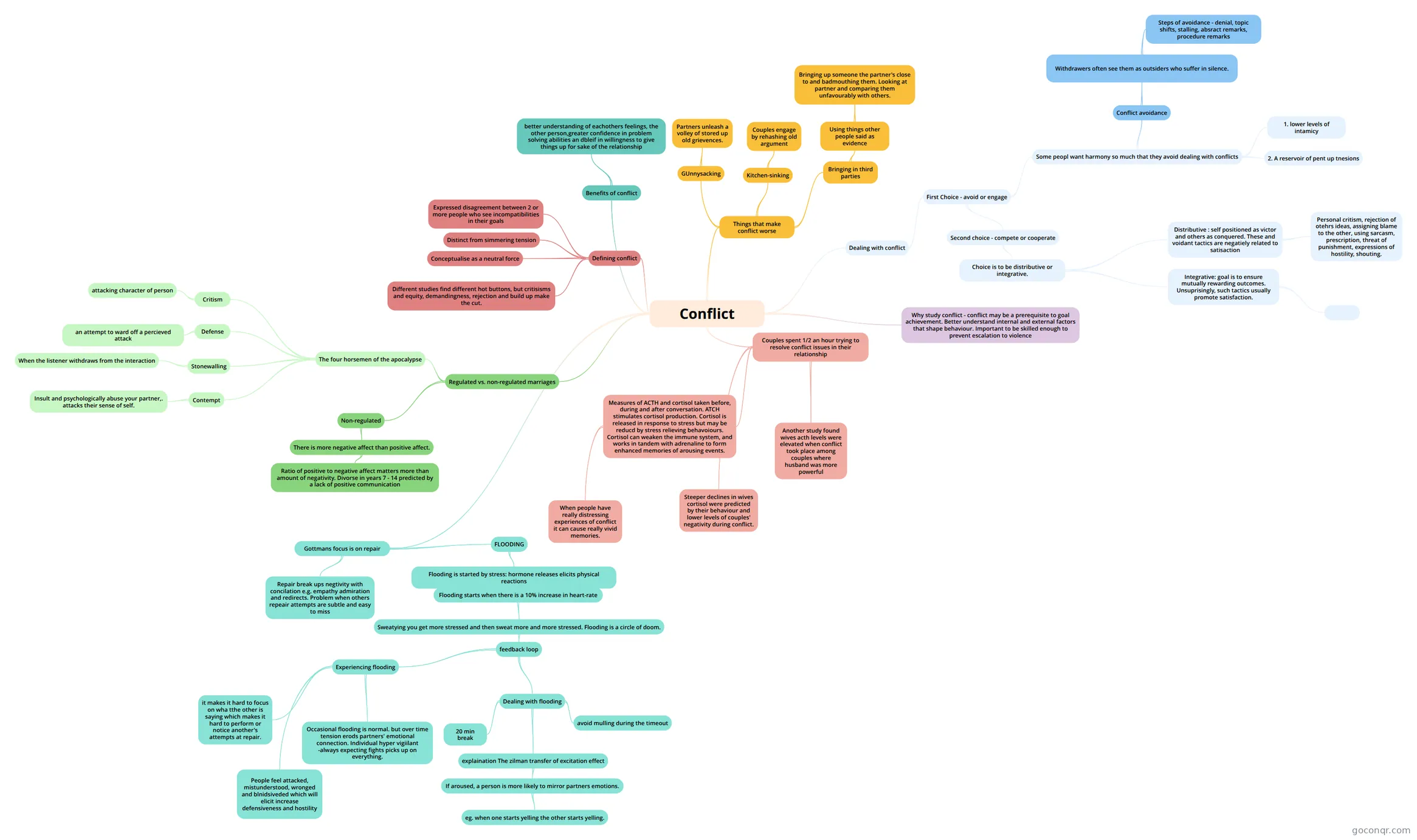
Mind map: Conflict in relationships
Contenido del mapa
Conflict
Defining conflict
- Expressed disagreement between 2 or more people who see incompatibilities in their goals
- Distinct from simmering tension
- Conceptualise as a neutral force
- Different studies find different hot buttons, but critisisms and equity, demandingness, rejection and build up make the cut.
Couples spent 1/2 an hour trying to resolve conflict issues in their relationship
- Measures of ACTH and cortisol taken before, during and after conversation. ATCH stimulates cortisol production. Cortisol is released in response to stress but may be reducd by stress relieving behavoiours. Cortisol can weaken the immune system, and works in tandem with adrenaline to form enhanced memories of arousing events.
- When people have really distressing experiences of conflict it can cause really vivid memories.
- Steeper declines in wives cortisol were predicted by their behaviour and lower levels of couples' negativity during conflict.
- Another study found wives acth levels were elevated when conflict took place among couples where husband was more powerful
- Measures of ACTH and cortisol taken before, during and after conversation. ATCH stimulates cortisol production. Cortisol is released in response to stress but may be reducd by stress relieving behavoiours. Cortisol can weaken the immune system, and works in tandem with adrenaline to form enhanced memories of arousing events.
Why study conflict - conflict may be a prerequisite to goal achievement. Better understand internal and external factors that shape behaviour. Important to be skilled enough to prevent escalation to violence
Dealing with conflict
- First Choice - avoid or engage
- Some peopl want harmony so much that they avoid dealing with conflicts
- 1. lower levels of intamicy
- 2. A reservoir of pent up tnesions
- Conflict avoidance
- Withdrawers often see them as outsiders who suffer in silence.
- Steps of avoidance - denial, topic shifts, stalling, absract remarks, procedure remarks
- Withdrawers often see them as outsiders who suffer in silence.
- Second choice - compete or cooperate
- Choice is to be distributive or integrative.
- Distributive : self positioned as victor and others as conquered. These and voidant tactics are negatiely related to satisaction
- Personal critism, rejection of otehrs ideas, assigning blame to the other, using sarcasm, prescription, threat of punishment, expressions of hostility, shouting.
- Integrative: goal is to ensure mutually rewarding outcomes. Unsuprisingly, such tactics usually promote satisfaction.
- Distributive : self positioned as victor and others as conquered. These and voidant tactics are negatiely related to satisaction
- Choice is to be distributive or integrative.
- Some peopl want harmony so much that they avoid dealing with conflicts
- First Choice - avoid or engage
Benefits of conflict
- better understanding of eachothers feelings, the other person,greater confidence in problem solving abilities an dbleif in willingness to give things up for sake of the relationship
Things that make conflict worse
- GUnnysacking
- Partners unleash a volley of stored up old grievences.
- Kitchen-sinking
- Couples engage by rehashing old argument
- Bringing in third parties
- Using things other people said as evidence
- Bringing up someone the partner's close to and badmouthing them. Looking at partner and comparing them unfavourably with others.
- Using things other people said as evidence
- GUnnysacking
Regulated vs. non-regulated marriages
- The four horsemen of the apocalypse
- Critism
- attacking character of person
- Defense
- an attempt to ward off a percieved attack
- Stonewalling
- When the listener withdraws from the interaction
- Contempt
- Insult and psychologically abuse your partner,. attacks their sense of self.
- Critism
- Non-regulated
- There is more negative affect than positive affect.
- Ratio of positive to negative affect matters more than amount of negativity. Divorse in years 7 - 14 predicted by a lack of positive communication
- There is more negative affect than positive affect.
- The four horsemen of the apocalypse
Gottmans focus is on repair
- Repair break ups negtivity with concilation e.g. empathy admiration and redirects. Problem when others repeair attempts are subtle and easy to miss
- FLOODING
- Flooding is started by stress: hormone releases elicits physical reactions
- Flooding starts when there is a 10% increase in heart-rate
- Sweatying you get more stressed and then sweat more and more stressed. Flooding is a circle of doom.
- feedback loop
- Experiencing flooding
- it makes it hard to focus on wha tthe other is saying which makes it hard to perform or notice another's attempts at repair.
- People feel attacked, mistunderstood, wronged and blnidsiveded which will elicit increase defensiveness and hostility
- Occasional flooding is normal. but over time tension erods partners' emotional connection. Individual hyper vigiilant -always expecting fights picks up on everything.
- Dealing with flooding
- 20 min break
- avoid mulling during the timeout
- explaination The zilman transfer of excitation effect
- If aroused, a person is more likely to mirror partners emotions.
- eg. when one starts yelling the other starts yelling.
- If aroused, a person is more likely to mirror partners emotions.
- Experiencing flooding
- feedback loop
- Sweatying you get more stressed and then sweat more and more stressed. Flooding is a circle of doom.
- Flooding starts when there is a 10% increase in heart-rate
- Flooding is started by stress: hormone releases elicits physical reactions
Información
- Descripción
- Mapa Mental sobre Conflict, creado por brooke hattie el 08/11/2016.
- Creado por
- brooke hattie
- Visitas
- 1
- Valoración