
Mapa mental
Child Language theorists
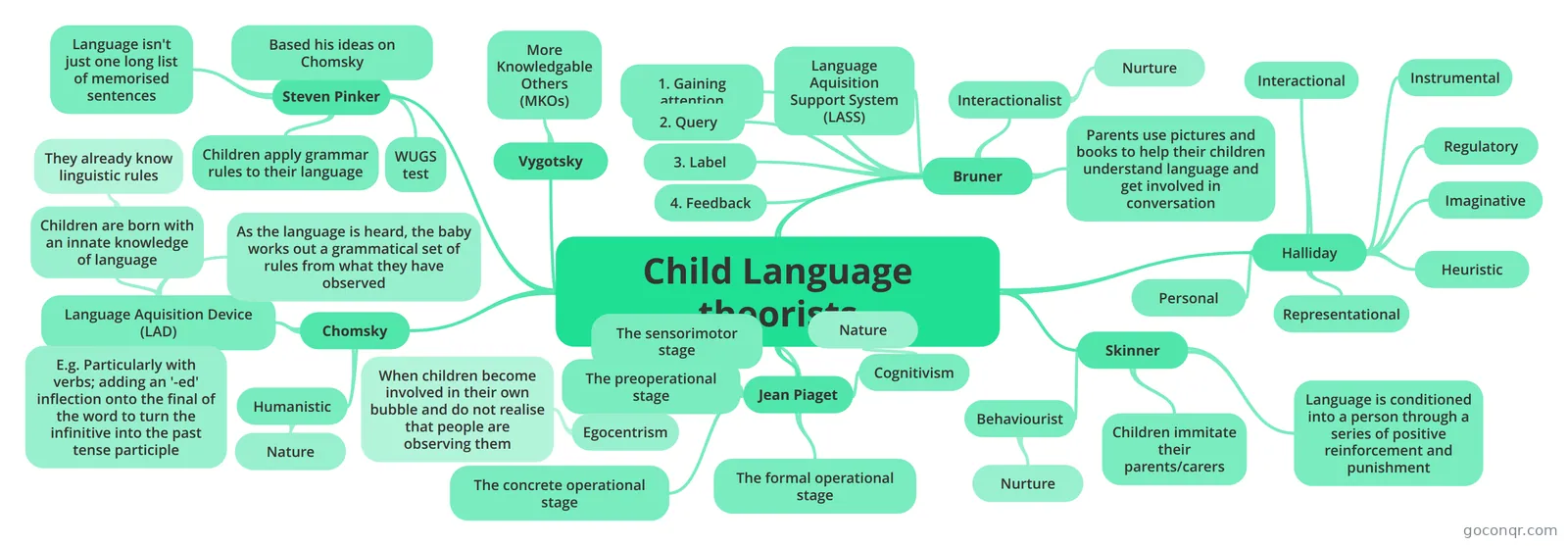
Mind map: Child Language theorists
Contenido del mapa
Child Language theorists
Steven Pinker
- Language isn't just one long list of memorised sentences
- Children apply grammar rules to their language
- Based his ideas on Chomsky
- WUGS test
Chomsky
- Language Aquisition Device (LAD)
- Children are born with an innate knowledge of language
- They already know linguistic rules
- E.g. Particularly with verbs; adding an '-ed' inflection onto the final of the word to turn the infinitive into the past tense participle
- As the language is heard, the baby works out a grammatical set of rules from what they have observed
- Children are born with an innate knowledge of language
- Humanistic
- Nature
- Language Aquisition Device (LAD)
Jean Piaget
- Cognitivism
- Nature
- The sensorimotor stage
- Lasts until 2 years old. Language skills, at this stage, are mainly physical, the baby experiments making sounds with their mouth. In the process, they imitate sounds that their parents have made and learn in which context they should be used.
- The preoperational stage
- 2-7 years. Child talks constantly but most of what they say does not need to be said out loud.
- Egocentrism
- When children become involved in their own bubble and do not realise that people are observing them
- The formal operational stage
- 12+ years. Can use language to express and debate abstract theoretical concepts
- The concrete operational stage
- 7-12 years. Child can only deal with concrete and specific facts through language instead of abstract concepts.
- Cognitivism
Bruner
- Interactionalist
- Nurture
- Language Aquisition Support System (LASS)
- Parents use pictures and books to help their children understand language and get involved in conversation
- 1. Gaining attention
- 2. Query
- 3. Label
- 4. Feedback
- Interactionalist
Skinner
- Behaviourist
- Nurture
- Children immitate their parents/carers
- Language is conditioned into a person through a series of positive reinforcement and punishment
- Behaviourist
Vygotsky
- More Knowledgable Others (MKOs)
Halliday
- Instrumental
- Language used to fulfill a need on the part of the speaker. Mostly related with food, drink and comfort.
- Regulatory
- Language used to influence the behaviour of others. Usually concerned with persuading/commanding/ requesting someone to do something you want
- Interactional
- Language used to develop social relationships and ease the process of interaction. Concerned withthe phatic dimension of talk.
- Imaginative
- Language used to explore the imagination. May also accompany play as children explore imaginary worlds.
- Heuristic
- Language used to learn and explore the environment. This may be quesitons and answers or the running commentary that accompanies children's play
- Personal
- Language used to express the personal preferences and identity of the speaker. Sometimes referred to as the "Here I am function" - children announcing themselves to the world.
- Representational
- Language used to exchange information
- Instrumental