
Mapa mental
Character & Aims Henry VIII
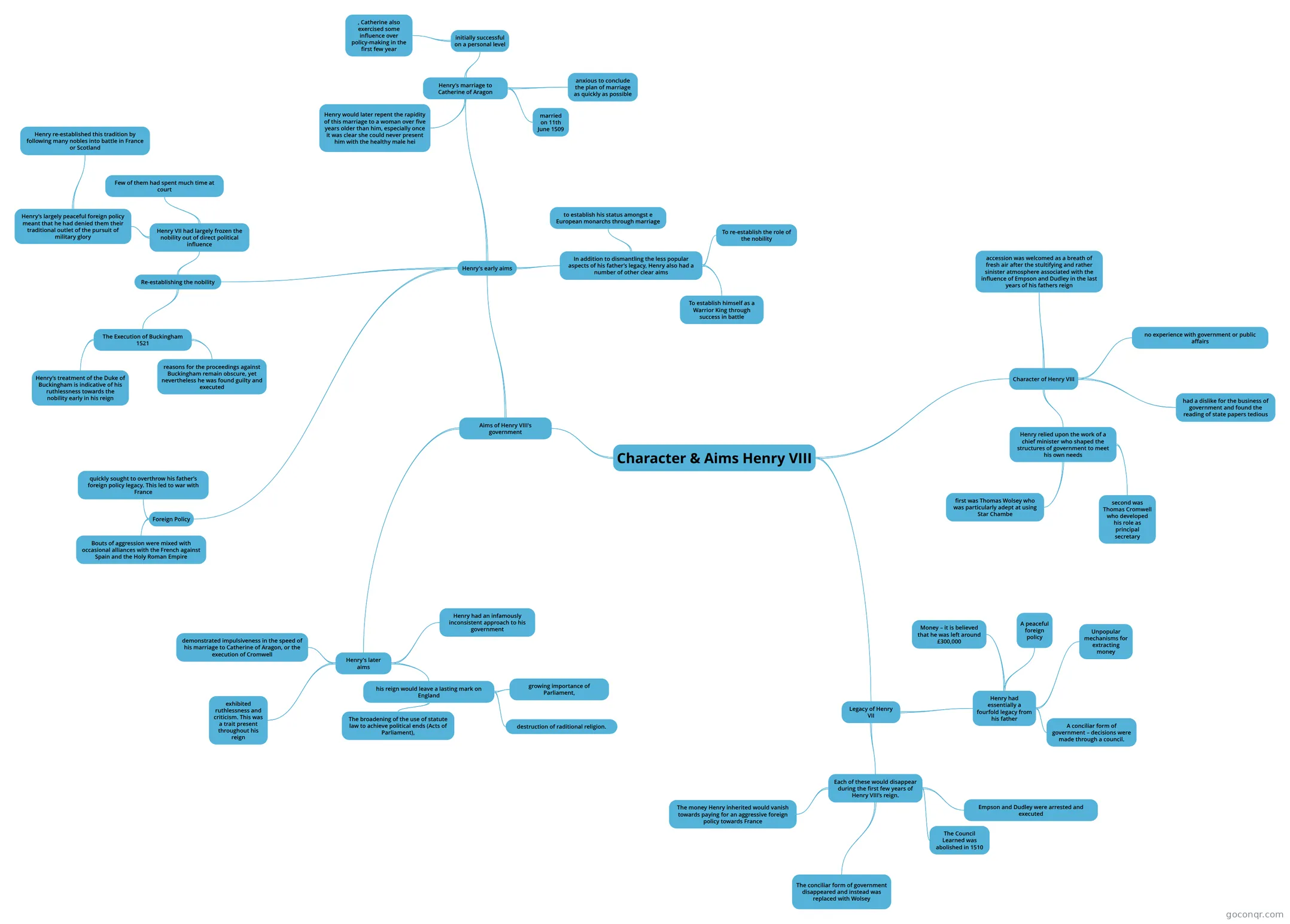
Mind map: Character and aims of Henry VIII
Contenido del mapa
Character & Aims Henry VIII
Character of Henry VIII
- no experience with government or public affairs
- accession was welcomed as a breath of fresh air after the stultifying and rather sinister atmosphere associated with the influence of Empson and Dudley in the last years of his fathers reign
- had a dislike for the business of government and found the reading of state papers tedious
- Henry relied upon the work of a chief minister who shaped the structures of government to meet his own needs
- first was Thomas Wolsey who was particularly adept at using Star Chambe
- second was Thomas Cromwell who developed his role as principal secretary
Legacy of Henry VII
- Henry had essentially a fourfold legacy from his father
- Money – it is believed that he was left around £300,000
- Unpopular mechanisms for extracting money
- A peaceful foreign policy
- A conciliar form of government – decisions were made through a council.
- Each of these would disappear during the first few years of Henry VIII’s reign.
- The money Henry inherited would vanish towards paying for an aggressive foreign policy towards France
- The conciliar form of government disappeared and instead was replaced with Wolsey
- The Council Learned was abolished in 1510
- Empson and Dudley were arrested and executed
- Henry had essentially a fourfold legacy from his father
Aims of Henry VIII's government
- Henry's early aims
- Re-establishing the nobility
- Henry VII had largely frozen the nobility out of direct political influence
- Few of them had spent much time at court
- Henry’s largely peaceful foreign policy meant that he had denied them their traditional outlet of the pursuit of military glory
- Henry re-established this tradition by following many nobles into battle in France or Scotland
- The Execution of Buckingham 1521
- Henry’s treatment of the Duke of Buckingham is indicative of his ruthlessness towards the nobility early in his reign
- reasons for the proceedings against Buckingham remain obscure, yet nevertheless he was found guilty and executed
- Henry VII had largely frozen the nobility out of direct political influence
- Henry’s marriage to Catherine of Aragon
- anxious to conclude the plan of marriage as quickly as possible
- married on 11th June 1509
- initially successful on a personal level
- , Catherine also exercised some influence over policy-making in the first few year
- Henry would later repent the rapidity of this marriage to a woman over five years older than him, especially once it was clear she could never present him with the healthy male hei
- Foreign Policy
- quickly sought to overthrow his father’s foreign policy legacy. This led to war with France
- Bouts of aggression were mixed with occasional alliances with the French against Spain and the Holy Roman Empire
- In addition to dismantling the less popular aspects of his father’s legacy, Henry also had a number of other clear aims
- to establish his status amongst e European monarchs through marriage
- To re-establish the role of the nobility
- To establish himself as a Warrior King through success in battle
- Re-establishing the nobility
- Henry's later aims
- Henry had an infamously inconsistent approach to his government
- his reign would leave a lasting mark on England
- The broadening of the use of statute law to achieve political ends (Acts of Parliament),
- growing importance of Parliament,
- destruction of raditional religion.
- exhibited ruthlessness and criticism. This was a trait present throughout his reign
- demonstrated impulsiveness in the speed of his marriage to Catherine of Aragon, or the execution of Cromwell
- Henry's early aims
Información
- Descripción
- A-Level (Henry VIII's Character and Aims ) Tudors Mapa Mental sobre Character & Aims Henry VIII, creado por Maya Khangura el 26/02/2017.
- Creado por
- Maya Khangura
- Visitas
- 14
- Valoración