
Mapa mental
Freud and Psychoanalysis
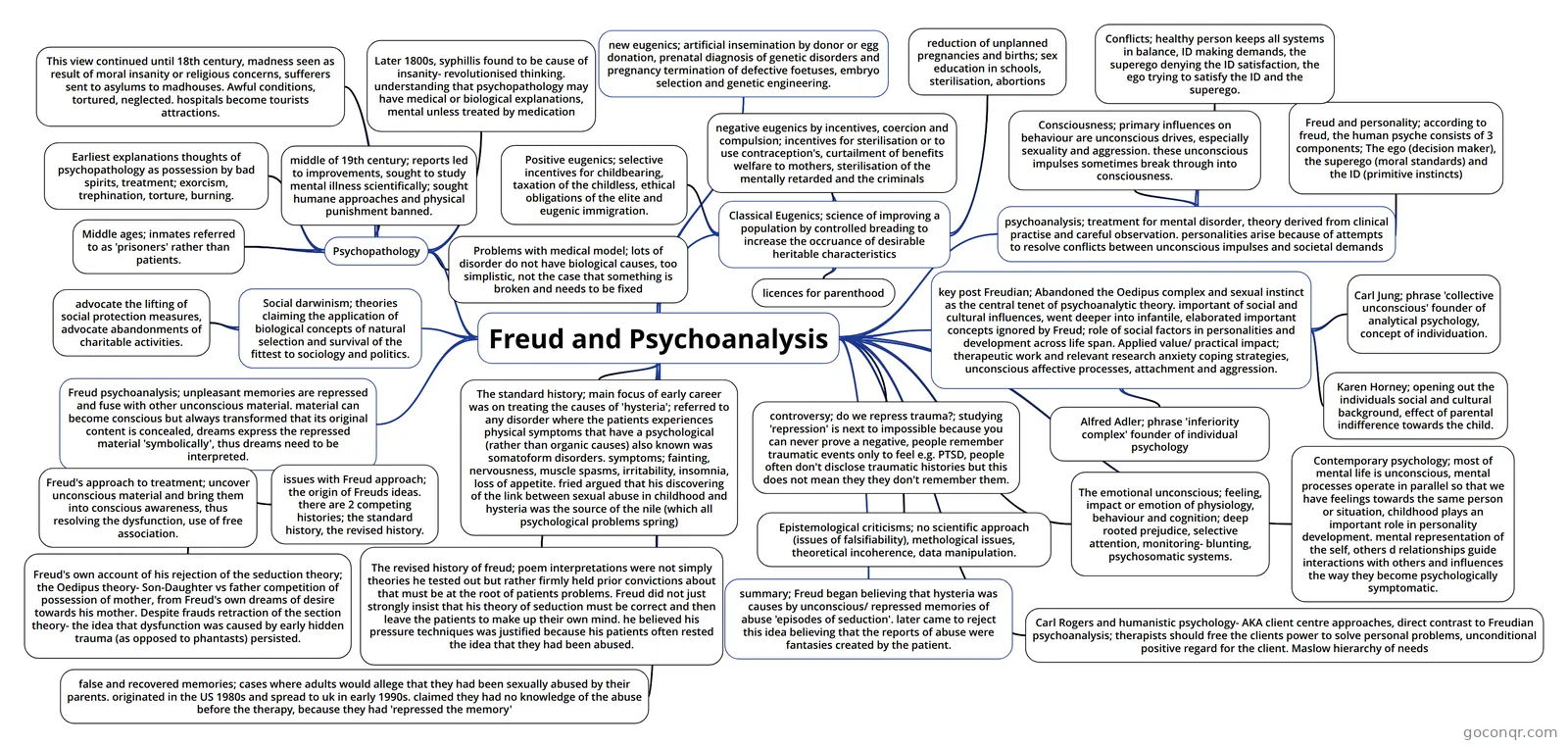
Mind map: Freud and psychoanalysis
Contenido del mapa
Freud and Psychoanalysis
Psychopathology
- Middle ages; inmates referred to as 'prisoners' rather than patients.
- Earliest explanations thoughts of psychopathology as possession by bad spirits, treatment; exorcism, trephination, torture, burning.
- This view continued until 18th century, madness seen as result of moral insanity or religious concerns, sufferers sent to asylums to madhouses. Awful conditions, tortured, neglected. hospitals become tourists attractions.
- middle of 19th century; reports led to improvements, sought to study mental illness scientifically; sought humane approaches and physical punishment banned.
- Later 1800s, syphillis found to be cause of insanity- revolutionised thinking. understanding that psychopathology may have medical or biological explanations, mental unless treated by medication
- Problems with medical model; lots of disorder do not have biological causes, too simplistic, not the case that something is broken and needs to be fixed
Social darwinism; theories claiming the application of biological concepts of natural selection and survival of the fittest to sociology and politics.
- advocate the lifting of social protection measures, advocate abandonments of charitable activities.
Classical Eugenics; science of improving a population by controlled breading to increase the occruance of desirable heritable characteristics
- reduction of unplanned pregnancies and births; sex education in schools, sterilisation, abortions
- negative eugenics by incentives, coercion and compulsion; incentives for sterilisation or to use contraception's, curtailment of benefits welfare to mothers, sterilisation of the mentally retarded and the criminals
- licences for parenthood
- Positive eugenics; selective incentives for childbearing, taxation of the childless, ethical obligations of the elite and eugenic immigration.
new eugenics; artificial insemination by donor or egg donation, prenatal diagnosis of genetic disorders and pregnancy termination of defective foetuses, embryo selection and genetic engineering.
psychoanalysis; treatment for mental disorder, theory derived from clinical practise and careful observation. personalities arise because of attempts to resolve conflicts between unconscious impulses and societal demands
- Consciousness; primary influences on behaviour are unconscious drives, especially sexuality and aggression. these unconscious impulses sometimes break through into consciousness.
- Freud and personality; according to freud, the human psyche consists of 3 components; The ego (decision maker), the superego (moral standards) and the ID (primitive instincts)
- Conflicts; healthy person keeps all systems in balance, ID making demands, the superego denying the ID satisfaction, the ego trying to satisfy the ID and the superego.
Freud psychoanalysis; unpleasant memories are repressed and fuse with other unconscious material. material can become conscious but always transformed that its original content is concealed, dreams express the repressed material 'symbolically', thus dreams need to be interpreted.
- Freud's approach to treatment; uncover unconscious material and bring them into conscious awareness, thus resolving the dysfunction, use of free association.
- issues with Freud approach; the origin of Freuds ideas. there are 2 competing histories; the standard history, the revised history.
- Freud's own account of his rejection of the seduction theory; the Oedipus theory- Son-Daughter vs father competition of possession of mother, from Freud's own dreams of desire towards his mother. Despite frauds retraction of the section theory- the idea that dysfunction was caused by early hidden trauma (as opposed to phantasts) persisted.
The standard history; main focus of early career was on treating the causes of 'hysteria'; referred to any disorder where the patients experiences physical symptoms that have a psychological (rather than organic causes) also known was somatoform disorders. symptoms; fainting, nervousness, muscle spasms, irritability, insomnia, loss of appetite. fried argued that his discovering of the link between sexual abuse in childhood and hysteria was the source of the nile (which all psychological problems spring)
The revised history of freud; poem interpretations were not simply theories he tested out but rather firmly held prior convictions about that must be at the root of patients problems. Freud did not just strongly insist that his theory of seduction must be correct and then leave the patients to make up their own mind. he believed his pressure techniques was justified because his patients often rested the idea that they had been abused.
false and recovered memories; cases where adults would allege that they had been sexually abused by their parents. originated in the US 1980s and spread to uk in early 1990s. claimed they had no knowledge of the abuse before the therapy, because they had 'repressed the memory'
controversy; do we repress trauma?; studying 'repression' is next to impossible because you can never prove a negative, people remember traumatic events only to feel e.g. PTSD, people often don't disclose traumatic histories but this does not mean they they don't remember them.
Epistemological criticisms; no scientific approach (issues of falsifiability), methological issues, theoretical incoherence, data manipulation.
summary; Freud began believing that hysteria was causes by unconscious/ repressed memories of abuse 'episodes of seduction'. later came to reject this idea believing that the reports of abuse were fantasies created by the patient.
key post Freudian; Abandoned the Oedipus complex and sexual instinct as the central tenet of psychoanalytic theory. important of social and cultural influences, went deeper into infantile, elaborated important concepts ignored by Freud; role of social factors in personalities and development across life span. Applied value/ practical impact; therapeutic work and relevant research anxiety coping strategies, unconscious affective processes, attachment and aggression.
- Carl Jung; phrase 'collective unconscious' founder of analytical psychology, concept of individuation.
- Alfred Adler; phrase 'inferiority complex' founder of individual psychology
- Karen Horney; opening out the individuals social and cultural background, effect of parental indifference towards the child.
The emotional unconscious; feeling, impact or emotion of physiology, behaviour and cognition; deep rooted prejudice, selective attention, monitoring- blunting, psychosomatic systems.
Contemporary psychology; most of mental life is unconscious, mental processes operate in parallel so that we have feelings towards the same person or situation, childhood plays an important role in personality development. mental representation of the self, others d relationships guide interactions with others and influences the way they become psychologically symptomatic.
Carl Rogers and humanistic psychology- AKA client centre approaches, direct contrast to Freudian psychoanalysis; therapists should free the clients power to solve personal problems, unconditional positive regard for the client. Maslow hierarchy of needs
Información
- Descripción
- Psychology Mapa Mental sobre Freud and Psychoanalysis, creado por Harriet Amber Dolan el 02/05/2017.
- Creado por
- Harriet Amber Dolan
- Visitas
- 1
- Valoración