
Mapa mental
Cranial nerves – visual disorders
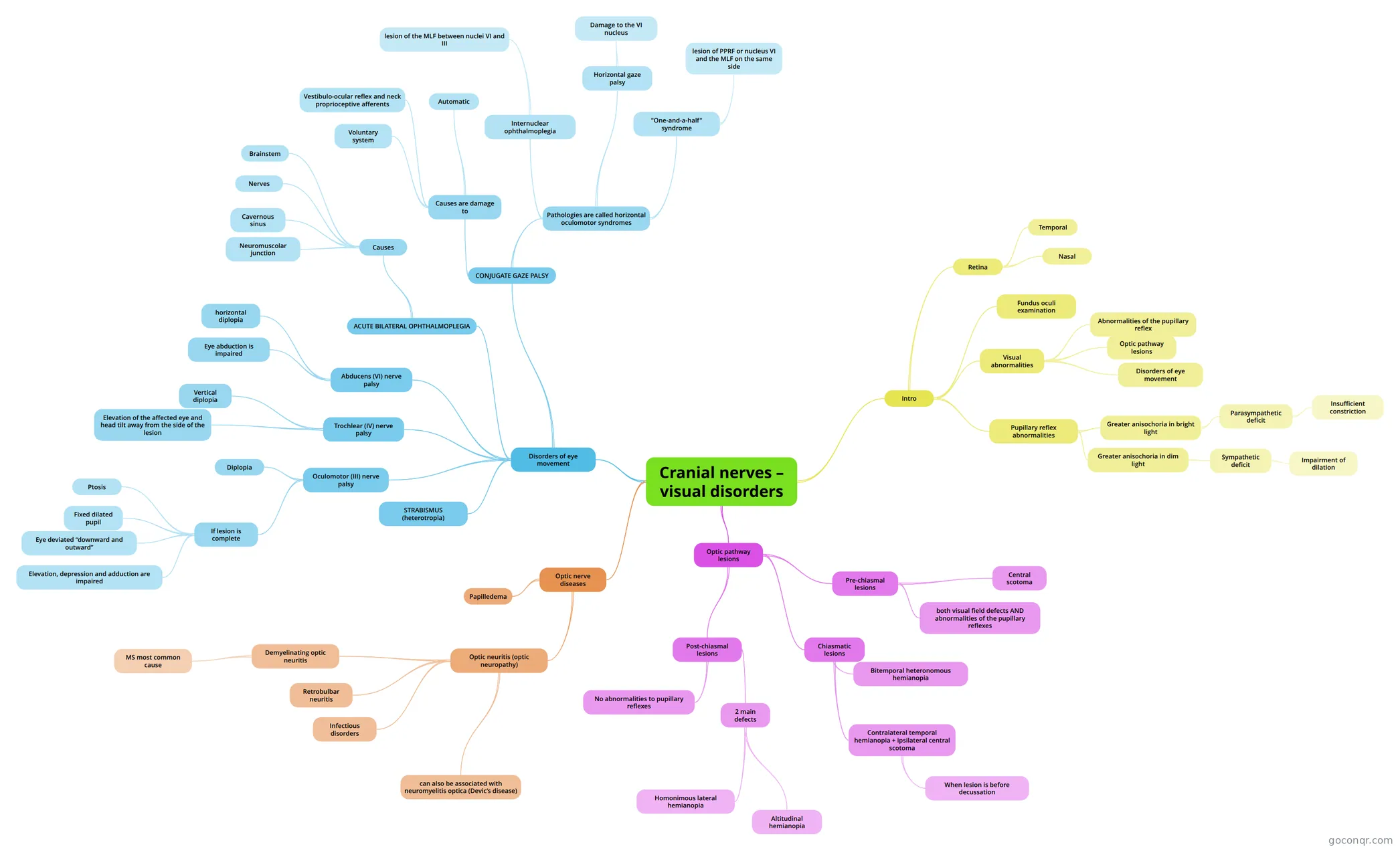
Mind map: Cranial nerves visual disorders
Contenido del mapa
Cranial nerves – visual disorders
Intro
- Pupillary reflex abnormalities
- Greater anisochoria in bright light
- Parasympathetic deficit
- Insufficient constriction
- Parasympathetic deficit
- Greater anisochoria in dim light
- Sympathetic deficit
- Impairment of dilation
- Sympathetic deficit
- Greater anisochoria in bright light
- Visual abnormalities
- Abnormalities of the pupillary reflex
- Optic pathway lesions
- Disorders of eye movement
- Fundus oculi examination
- Retina
- Nasal
- Temporal
- Pupillary reflex abnormalities
Optic pathway lesions
- Pre-chiasmal lesions
- both visual field defects AND abnormalities of the pupillary reflexes
- Central scotoma
- Chiasmatic lesions
- Bitemporal heteronomous hemianopia
- Contralateral temporal hemianopia + ipsilateral central scotoma
- When lesion is before decussation
- Post-chiasmal lesions
- No abnormalities to pupillary reflexes
- 2 main defects
- Homonimous lateral hemianopia
- Altitudinal hemianopia
- Pre-chiasmal lesions
Optic nerve diseases
- Optic neuritis (optic neuropathy)
- Infectious disorders
- Retrobulbar neuritis
- Demyelinating optic neuritis
- MS most common cause
- can also be associated with neuromyelitis optica (Devic’s disease)
- Papilledema
- Optic neuritis (optic neuropathy)
Disorders of eye movement
- STRABISMUS (heterotropia)
- Oculomotor (III) nerve palsy
- Diplopia
- If lesion is complete
- Ptosis
- Fixed dilated pupil
- Eye deviated “downward and outward”
- Elevation, depression and adduction are impaired
- Trochlear (IV) nerve palsy
- Vertical diplopia
- Elevation of the affected eye and head tilt away from the side of the lesion
- Abducens (VI) nerve palsy
- horizontal diplopia
- Eye abduction is impaired
- ACUTE BILATERAL OPHTHALMOPLEGIA
- Causes
- Brainstem
- Nerves
- Cavernous sinus
- Neuromuscolar junction
- Causes
- CONJUGATE GAZE PALSY
- Causes are damage to
- Voluntary system
- Vestibulo-ocular reflex and neck proprioceptive afferents
- Automatic
- Pathologies are called horizontal oculomotor syndromes
- Internuclear ophthalmoplegia
- lesion of the MLF between nuclei VI and III
- Horizontal gaze palsy
- Damage to the VI nucleus
- "One-and-a-half" syndrome
- lesion of PPRF or nucleus VI and the MLF on the same side
- Internuclear ophthalmoplegia
- Causes are damage to
Información
- Descripción
- Neurology Mapa Mental sobre Cranial nerves – visual disorders, creado por LewisLewis el 21/05/2014.
- Creado por
- LewisLewis
- Visitas
- 33
- Valoración