
Mapa mental
Sensory Ecology 2: Predation and Aggression
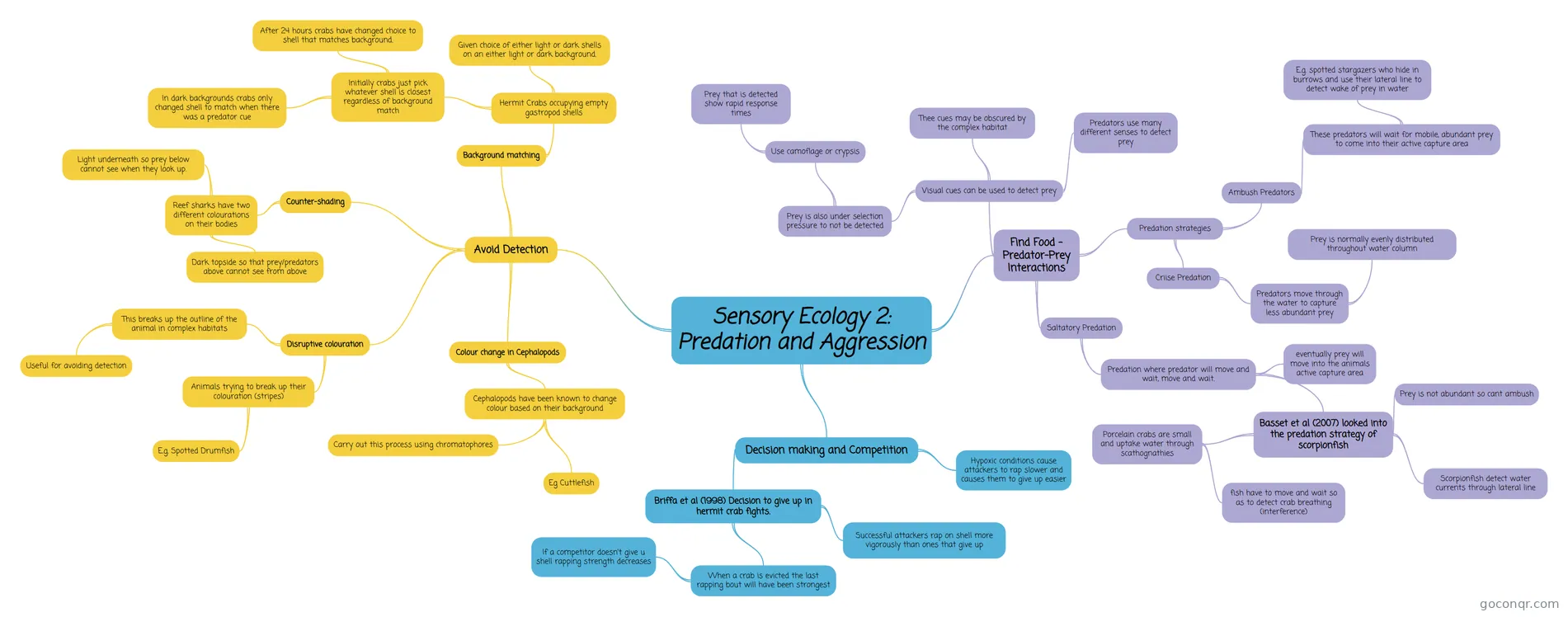
Mind map: sensory ecology predation and aggression
Contenido del mapa
Sensory Ecology 2: Predation and Aggression
Find Food - Predator-Prey Interactions
- Visual cues can be used to detect prey
- Thee cues may be obscured by the complex habitat
- Prey is also under selection pressure to not be detected
- Use camoflage or crypsis
- Prey that is detected show rapid response times
- Use camoflage or crypsis
- Predators use many different senses to detect prey
- Predation strategies
- Ambush Predators
- These predators will wait for mobile, abundant prey to come into their active capture area
- E.g. spotted stargazers who hide in burrows and use their lateral line to detect wake of prey in water
- These predators will wait for mobile, abundant prey to come into their active capture area
- Criise Predation
- Predators move through the water to capture less abundant prey
- Prey is normally evenly distributed throughout water column
- Predators move through the water to capture less abundant prey
- Ambush Predators
- Saltatory Predation
- Predation where predator will move and wait, move and wait.
- eventually prey will move into the animals active capture area
- Basset et al (2007) looked into the predation strategy of scorpionfish
- Porcelain crabs are small and uptake water through scathognathies
- fish have to move and wait so as to detect crab breathing (interference)
- Prey is not abundant so cant ambush
- Scorpionfish detect water currents through lateral line
- Porcelain crabs are small and uptake water through scathognathies
- Predation where predator will move and wait, move and wait.
- Visual cues can be used to detect prey
Avoid Detection
- Background matching
- Hermit Crabs occupying empty gastropod shells
- Given choice of either light or dark shells on an either light or dark background.
- Initially crabs just pick whatever shell is closest regardless of background match
- After 24 hours crabs have changed choice to shell that matches background.
- In dark backgrounds crabs only changed shell to match when there was a predator cue
- Hermit Crabs occupying empty gastropod shells
- Counter-shading
- Reef sharks have two different colourations on their bodies
- Light underneath so prey below cannot see when they look up.
- Dark topside so that prey/predators above cannot see from above
- Reef sharks have two different colourations on their bodies
- Disruptive colouration
- Animals trying to break up their colouration (stripes)
- E.g. Spotted Drumfish
- This breaks up the outline of the animal in complex habitats
- Useful for avoiding detection
- Animals trying to break up their colouration (stripes)
- Colour change in Cephalopods
- Cephalopods have been known to change colour based on their background
- Carry out this process using chromatophores
- Eg Cuttlefish
- Cephalopods have been known to change colour based on their background
- Background matching
Decision making and Competition
- Briffa et al (1998) Decision to give up in hermit crab fights.
- Successful attackers rap on shell more vigorously than ones that give up
- When a crab is evicted the last rapping bout will have been strongest
- If a competitor doesn't give u shell rapping strength decreases
- Hypoxic conditions cause attackers to rap slower and causes them to give up easier
- Briffa et al (1998) Decision to give up in hermit crab fights.
Información
- Descripción
- How organisms use the senses when they're faced with predation and aggression from other organisms.
- Creado por
- Connor Joesbury
- Visitas
- 41
- Etiquetas
- Valoración