
Mapa mental
Attatchment
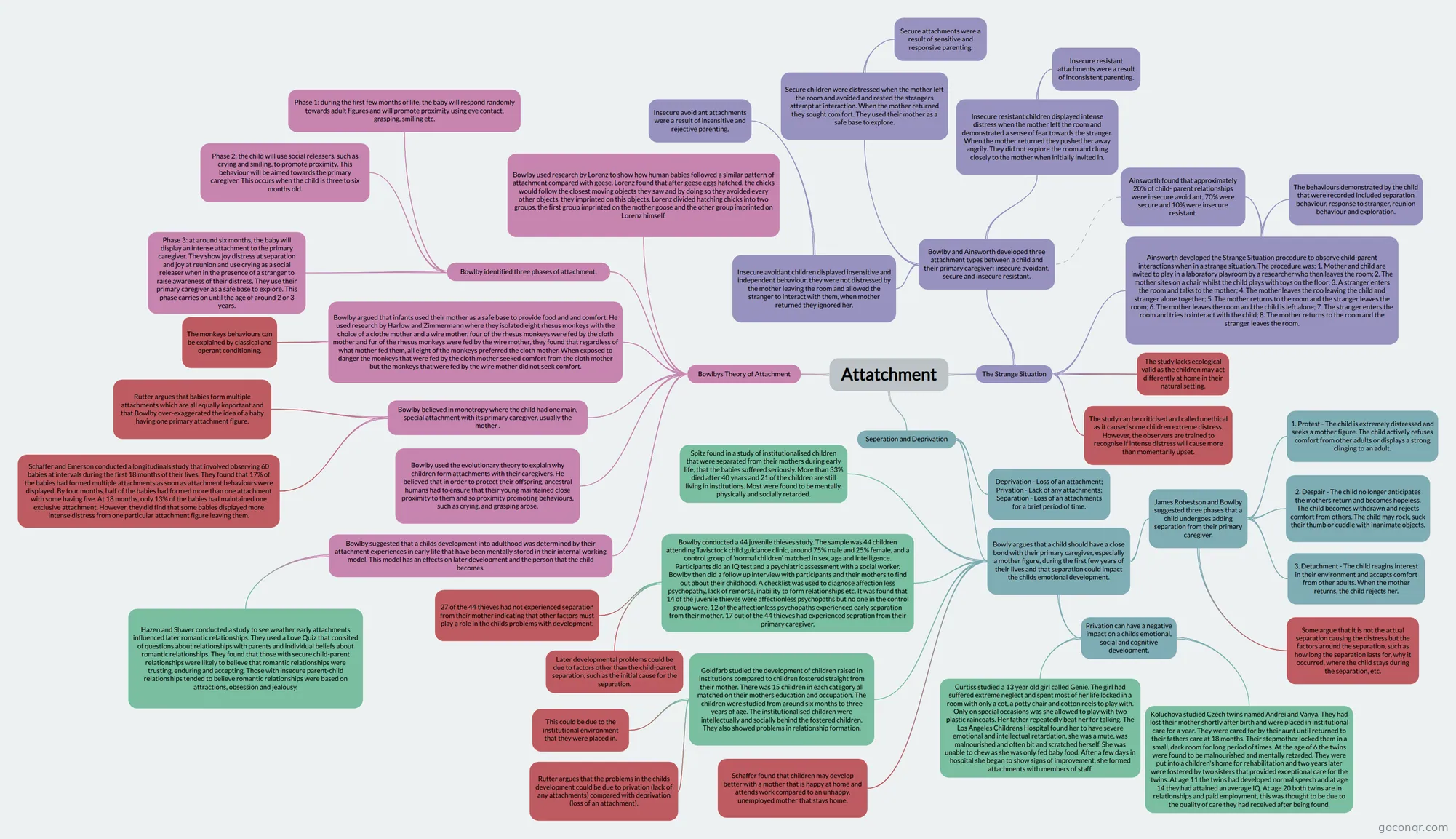
Mind map: Attachment
Contenido del mapa
Attatchment
Bowlbys Theory of Attachment
- Bowlby used the evolutionary theory to explain why children form attachments with their caregivers. He believed that in order to protect their offspring, ancestral humans had to ensure that their young maintained close proximity to them and so proximity promoting behaviours, such as crying, and grasping arose.
- Bowlby identified three phases of attachment:
- Phase 1: during the first few months of life, the baby will respond randomly towards adult figures and will promote proximity using eye contact, grasping, smiling etc.
- Phase 2: the child will use social releasers, such as crying and smiling, to promote proximity. This behaviour will be aimed towards the primary caregiver. This occurs when the child is three to six months old.
- Phase 3: at around six months, the baby will display an intense attachment to the primary caregiver. They show joy distress at separation and joy at reunion and use crying as a social releaser when in the presence of a stranger to raise awareness of their distress. They use their primary caregiver as a safe base to explore. This phase carries on until the age of around 2 or 3 years.
- Bowlby used research by Lorenz to show how human babies followed a similar pattern of attachment compared with geese. Lorenz found that after geese eggs hatched, the chicks would follow the closest moving objects they saw and by doing so they avoided every other objects, they imprinted on this objects. Lorenz divided hatching chicks into two groups, the first group imprinted on the mother goose and the other group imprinted on Lorenz himself.
- Bowlby argued that infants used their mother as a safe base to provide food and and comfort. He used research by Harlow and Zimmermann where they isolated eight rhesus monkeys with the choice of a clothe mother and a wire mother, four of the rhesus monkeys were fed by the cloth mother and fur of the rhesus monkeys were fed by the wire mother, they found that regardless of what mother fed them, all eight of the monkeys preferred the cloth mother. When exposed to danger the monkeys that were fed by the cloth mother seeked comfort from the cloth mother but the monkeys that were fed by the wire mother did not seek comfort.
- The monkeys behaviours can be explained by classical and operant conditioning.
- Bowlby believed in monotropy where the child had one main, special attachment with its primary caregiver, usually the mother .
- Schaffer and Emerson conducted a longitudinals study that involved observing 60 babies at intervals during the first 18 months of their lives. They found that 17% of the babies had formed multiple attachments as soon as attachment behaviours were displayed. By four months, half of the babies had formed more than one attachment with some having five. At 18 months, only 13% of the babies had maintained one exclusive attachment. However, they did find that some babies displayed more intense distress from one particular attachment figure leaving them.
- Rutter argues that babies form multiple attachments which are all equally important and that Bowlby over-exaggerated the idea of a baby having one primary attachment figure.
- Bowlby suggested that a childs development into adulthood was determined by their attachment experiences in early life that have been mentally stored in their internal working model. This model has an effects on later development and the person that the child becomes.
- Hazen and Shaver conducted a study to see weather early attachments influenced later romantic relationships. They used a Love Quiz that con sited of questions about relationships with parents and individual beliefs about romantic relationships. They found that those with secure child-parent relationships were likely to believe that romantic relationships were trusting, enduring and accepting. Those with insecure parent-child relationships tended to believe romantic relationships were based on attractions, obsession and jealousy.
Seperation and Deprivation
- Bowly argues that a child should have a close bond with their primary caregiver, especially a mother figure, during the first few years of their lives and that separation could impact the childs emotional development.
- Schaffer found that children may develop better with a mother that is happy at home and attends work compared to an unhappy, unemployed mother that stays home.
- Bowlby conducted a 44 juvenile thieves study. The sample was 44 children attending Tavisctock child guidance clinic, around 75% male and 25% female, and a control group of 'normal children' matched in sex, age and intelligence. Participants did an IQ test and a psychiatric assessment with a social worker. Bowlby then did a follow up interview with participants and their mothers to find out about their childhood. A checklist was used to diagnose affection less psychopathy, lack of remorse, inability to form relationships etc. It was found that 14 of the juvenile thieves were affectionless psychopaths but no one in the control group were, 12 of the affectionless psychopaths experienced early separation from their mother. 17 out of the 44 thieves had experienced sepration from their primary caregiver.
- Later developmental problems could be due to factors other than the child-parent separation, such as the initial cause for the separation.
- 27 of the 44 thieves had not experienced separation from their mother indicating that other factors must play a role in the childs problems with development.
- Spitz found in a study of institutionalised children that were separated from their mothers during early life, that the babies suffered seriously. More than 33% died after 40 years and 21 of the children are still living in institutions. Most were found to be mentally, physically and socially retarded.
- James Robestson and Bowlby suggested three phases that a child undergoes adding separation from their primary caregiver.
- 1. Protest - The child is extremely distressed and seeks a mother figure. The child actively refuses comfort from other adults or displays a strong clinging to an adult.
- 2. Despair - The child no longer anticipates the mothers return and becomes hopeless. The child becomes withdrawn and rejects comfort from others. The child may rock, suck their thumb or cuddle with inanimate objects.
- 3. Detachment - The child reagins interest in their environment and accepts comfort from other adults. When the mother returns, the child rejects her.
- Some argue that it is not the actual separation causing the distress but the factors around the separation, such as how long the separation lasts for, why it occurred, where the child stays during the separation, etc.
- Goldfarb studied the development of children raised in institutions compared to children fostered straight from their mother. There was 15 children in each category all matched on their mothers education and occupation. The children were studied from around six months to three years of age. The institutionalised children were intellectually and socially behind the fostered children. They also showed problems in relationship formation.
- This could be due to the institutional environment that they were placed in.
- Rutter argues that the problems in the childs development could be due to privation (lack of any attachments) compared with deprivation (loss of an attachment).
- Privation can have a negative impact on a childs emotional, social and cognitive development.
- Curtiss studied a 13 year old girl called Genie. The girl had suffered extreme neglect and spent most of her life locked in a room with only a cot, a potty chair and cotton reels to play with. Only on special occasions was she allowed to play with two plastic raincoats. Her father repeatedly beat her for talking. The Los Angeles Childrens Hospital found her to have severe emotional and intellectual retardation, she was a mute, was malnourished and often bit and scratched herself. She was unable to chew as she was only fed baby food. After a few days in hospital she began to show signs of improvement, she formed attachments with members of staff.
- Koluchova studied Czech twins named Andrei and Vanya. They had lost their mother shortly after birth and were placed in institutional care for a year. They were cared for by their aunt until returned to their fathers care at 18 months. Their stepmother locked them in a small, dark room for long period of times. At the age of 6 the twins were found to be malnourished and mentally retarded. They were put into a children's home for rehabilitation and two years later were fostered by two sisters that provided exceptional care for the twins. At age 11 the twins had developed normal speech and at age 14 they had attained an average IQ. At age 20 both twins are in relationships and paid employment, this was thought to be due to the quality of care they had received after being found.
- Deprivation - Loss of an attachment; Privation - Lack of any attachments; Separation - Loss of an attachments for a brief period of time.
- Bowly argues that a child should have a close bond with their primary caregiver, especially a mother figure, during the first few years of their lives and that separation could impact the childs emotional development.
The Strange Situation
- Bowlby and Ainsworth developed three attachment types between a child and their primary caregiver: insecure avoidant, secure and insecure resistant.
- Insecure avoidant children displayed insensitive and independent behaviour, they were not distressed by the mother leaving the room and allowed the stranger to interact with them, when mother returned they ignored her.
- Insecure avoid ant attachments were a result of insensitive and rejective parenting.
- Secure children were distressed when the mother left the room and avoided and rested the strangers attempt at interaction. When the mother returned they sought com fort. They used their mother as a safe base to explore.
- Secure attachments were a result of sensitive and responsive parenting.
- Insecure resistant children displayed intense distress when the mother left the room and demonstrated a sense of fear towards the stranger. When the mother returned they pushed her away angrily. They did not explore the room and clung closely to the mother when initially invited in.
- Insecure resistant attachments were a result of inconsistent parenting.
- Insecure avoidant children displayed insensitive and independent behaviour, they were not distressed by the mother leaving the room and allowed the stranger to interact with them, when mother returned they ignored her.
- Ainsworth developed the Strange Situation procedure to observe child-parent interactions when in a strange situation. The procedure was: 1. Mother and child are invited to play in a laboratory playroom by a researcher who then leaves the room; 2. The mother sites on a chair whilst the child plays with toys on the floor; 3. A stranger enters the room and talks to the mother; 4. The mother leaves the roo leaving the child and stranger alone together; 5. The mother returns to the room and the stranger leaves the room; 6. The mother leaves the room and the child is left alone; 7. The stranger enters the room and tries to interact with the child; 8. The mother returns to the room and the stranger leaves the room.
- The behaviours demonstrated by the child that were recorded included separation behaviour, response to stranger, reunion behaviour and exploration.
- Ainsworth found that approximately 20% of child- parent relationships were insecure avoid ant, 70% were secure and 10% were insecure resistant.
- The study lacks ecological valid as the children may act differently at home in their natural setting.
- The study can be criticised and called unethical as it caused some children extreme distress. However, the observers are trained to recognise if intense distress will cause more than momentarily upset.
- Bowlby and Ainsworth developed three attachment types between a child and their primary caregiver: insecure avoidant, secure and insecure resistant.
Información
- Descripción
- A LEVEL (Child Psychology) Psychology Mapa Mental sobre Attatchment, creado por Tariq Ahmed el 28/12/2018.
- Creado por
- Tariq Ahmed
- Visitas
- 0
- Valoración