
Mapa mental
Evolutionary Explanations for Relationships
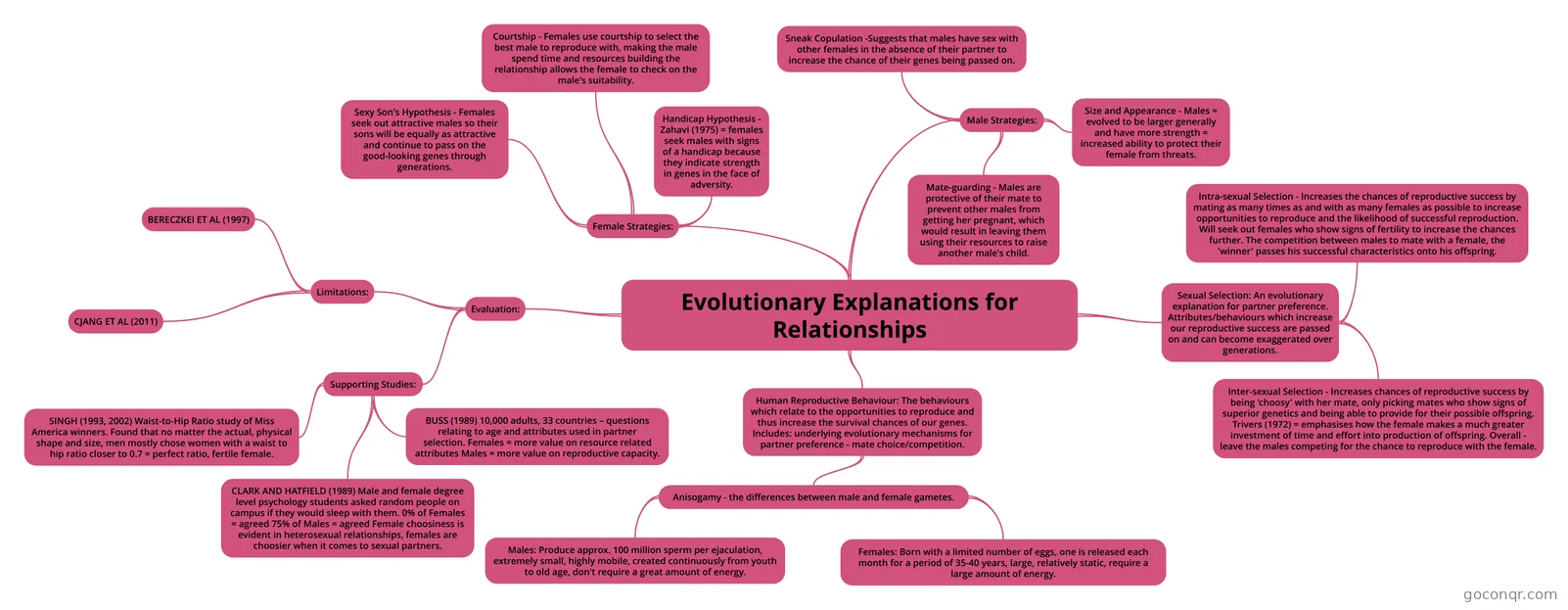
Mind map: Evolutionary Explanations for Relationships
Contenido del mapa
Evolutionary Explanations for Relationships
Human Reproductive Behaviour: The behaviours which relate to the opportunities to reproduce and thus increase the survival chances of our genes. Includes: underlying evolutionary mechanisms for partner preference - mate choice/competition.
- Anisogamy - the differences between male and female gametes.
- Males: Produce approx. 100 million sperm per ejaculation, extremely small, highly mobile, created continuously from youth to old age, don't require a great amount of energy.
- Females: Born with a limited number of eggs, one is released each month for a period of 35-40 years, large, relatively static, require a large amount of energy.
- Anisogamy - the differences between male and female gametes.
Sexual Selection: An evolutionary explanation for partner preference. Attributes/behaviours which increase our reproductive success are passed on and can become exaggerated over generations.
- Inter-sexual Selection - Increases chances of reproductive success by being 'choosy' with her mate, only picking mates who show signs of superior genetics and being able to provide for their possible offspring. Trivers (1972) = emphasises how the female makes a much greater investment of time and effort into production of offspring. Overall - leave the males competing for the chance to reproduce with the female.
- Intra-sexual Selection - Increases the chances of reproductive success by mating as many times as and with as many females as possible to increase opportunities to reproduce and the likelihood of successful reproduction. Will seek out females who show signs of fertility to increase the chances further. The competition between males to mate with a female, the 'winner' passes his successful characteristics onto his offspring.
Male Strategies:
- Mate-guarding - Males are protective of their mate to prevent other males from getting her pregnant, which would result in leaving them using their resources to raise another male's child.
- Sneak Copulation -Suggests that males have sex with other females in the absence of their partner to increase the chance of their genes being passed on.
- Size and Appearance - Males = evolved to be larger generally and have more strength = increased ability to protect their female from threats.
Female Strategies:
- Sexy Son's Hypothesis - Females seek out attractive males so their sons will be equally as attractive and continue to pass on the good-looking genes through generations.
- Courtship - Females use courtship to select the best male to reproduce with, making the male spend time and resources building the relationship allows the female to check on the male's suitability.
- Handicap Hypothesis - Zahavi (1975) = females seek males with signs of a handicap because they indicate strength in genes in the face of adversity.
Evaluation:
- Supporting Studies:
- BUSS (1989) 10,000 adults, 33 countries – questions relating to age and attributes used in partner selection. Females = more value on resource related attributes Males = more value on reproductive capacity.
- CLARK AND HATFIELD (1989) Male and female degree level psychology students asked random people on campus if they would sleep with them. 0% of Females = agreed 75% of Males = agreed Female choosiness is evident in heterosexual relationships, females are choosier when it comes to sexual partners.
- SINGH (1993, 2002) Waist-to-Hip Ratio study of Miss America winners. Found that no matter the actual, physical shape and size, men mostly chose women with a waist to hip ratio closer to 0.7 = perfect ratio, fertile female.
- Limitations:
- BERECZKEI ET AL (1997)
- CJANG ET AL (2011)
- Supporting Studies:
Información
- Descripción
- A level Psychology Mapa Mental sobre Evolutionary Explanations for Relationships, creado por Laura Anten el 20/03/2019.
- Creado por
- Laura Anten
- Visitas
- 2
- Valoración