
Mapa mental
early relationships
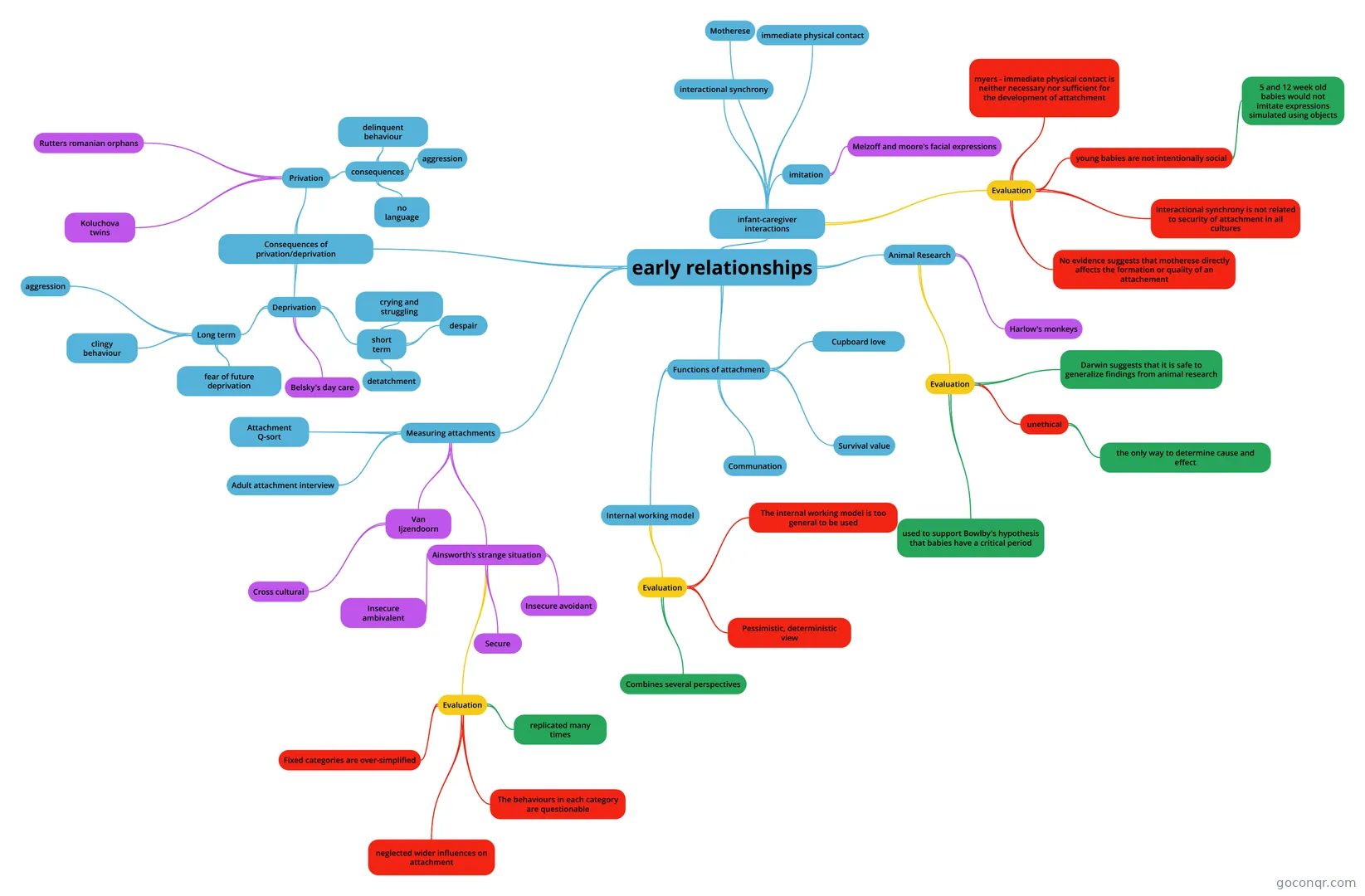
Mind map: Early relationships
Contenido del mapa
early relationships
infant-caregiver interactions
- immediate physical contact
- for the formation of a bond
- imitation
- shows children are innately social
- Melzoff and moore's facial expressions
- significant association between the models behaviour and the infants behaviour. Infants are able to imitate specific facial expressions or hand movements
- interactional synchrony
- babies coordinate their actions in time with adult speech. securely attached bonds had more interactional synchrony - Isabella
- Motherese
- adults use distinctive language patterns when talking to children. Usually slow, repetitive, varied in intonation and consisting of small messages
- Evaluation
- myers - immediate physical contact is neither necessary nor sufficient for the development of attatchment
- young babies are not intentionally social
- babies will respond in a similar way to inanimate objects
- 5 and 12 week old babies would not imitate expressions simulated using objects
- Interactional synchrony is not related to security of attachment in all cultures
- No evidence suggests that motherese directly affects the formation or quality of an attachement
- immediate physical contact
Animal Research
- Harlow's monkeys
- infant monkeys preferred to spend time close to the cloth mother even though food was on the wire mother. These monkeys were antisocial and aggressive
- Evaluation
- Darwin suggests that it is safe to generalize findings from animal research
- All species are genetically related. The field of comparative psychology involves studing other species then making extrapolations
- unethical
- caused the monkey's distress
- the only way to determine cause and effect
- used to support Bowlby's hypothesis that babies have a critical period
- Darwin suggests that it is safe to generalize findings from animal research
- Harlow's monkeys
Functions of attachment
- Cupboard love
- infants attach to the person who provides nurture in the form of food
- Survival value
- animals display an innate, instinctual drive to maintain proximity to caregiver for protection
- Communation
- babies attach to those who can best communicate with them and understand their needs
- Internal working model
- early relationships act as a model for future ones
- Evaluation
- The internal working model is too general to be used
- Pessimistic, deterministic view
- suggesting if your first relationship is unhappy and insecure then all future relationships will be
- Combines several perspectives
- Cognitive perspective - understanding of attachment Behaviourist - rewarding behaviour makes it likely to be repeated
- Cupboard love
Measuring attachments
- Ainsworth's strange situation
- using mainly proximity seeking and maintenance of proximity ainsworth found 65% of infants have secure attachments, then insecure avoidant and insecure ambivalent
- Insecure avoidant
- ignores mother, treats her like a stranger
- Secure
- happy with mother, distressed when mother leaves, wary of stranger
- Insecure ambivalent
- fussy, difficult and cries a lot. Distressed when mother leaves, not comforted by her return
- Evaluation
- replicated many times
- to test reliability over time and over culture
- others have found a relationship between infant attachment and later life attachment
- The behaviours in each category are questionable
- proximity seeking is seen as a sign of a secure attachment, however a secure infant are often happy to explore
- neglected wider influences on attachment
- additional factors might affect security of attachment e.g. temperament or socio-economic background
- Fixed categories are over-simplified
- it is more sensible to consider attachment as a two dimensional construct
- replicated many times
- Van Ijzendoorn
- German infants had the highest proportion of insecure avoidant infants. Israeli and Japanese infants showed the highest proportion of insecure ambivalent behaviour
- Cross cultural
- Adult attachment interview
- people fall into 4 categories - insecure dismissing autonomous secure insecure preoccupied unresolved
- Attachment Q-sort
- on a scale of 1 - 9, 1 being least like child and 9 most like the child
- Ainsworth's strange situation
Consequences of privation/deprivation
- Deprivation
- short term
- crying and struggling
- despair
- detatchment
- Long term
- fear of future deprivation
- clingy behaviour
- aggression
- Belsky's day care
- 26% of children in day care for less than 20 hours a week showed insecure attachments compared to 41% for more than 20 hours
- short term
- Privation
- consequences
- delinquent behaviour
- aggression
- no language
- Koluchova twins
- within 3 years (from 7 - 10) the tins had adopted language and had an average intelligence level with normal attachments
- Rutters romanian orphans
- around 50% of romanian orphans showed intellectual deficits. British orphans showed none. After 4 years there was no significant difference
- consequences
- Deprivation
Información
- Descripción
- mind map for all of the key information on social development
- Creado por
- Choon Fuller
- Visitas
- 40
- Etiquetas
- Valoración