
Mapa mental
Forensic
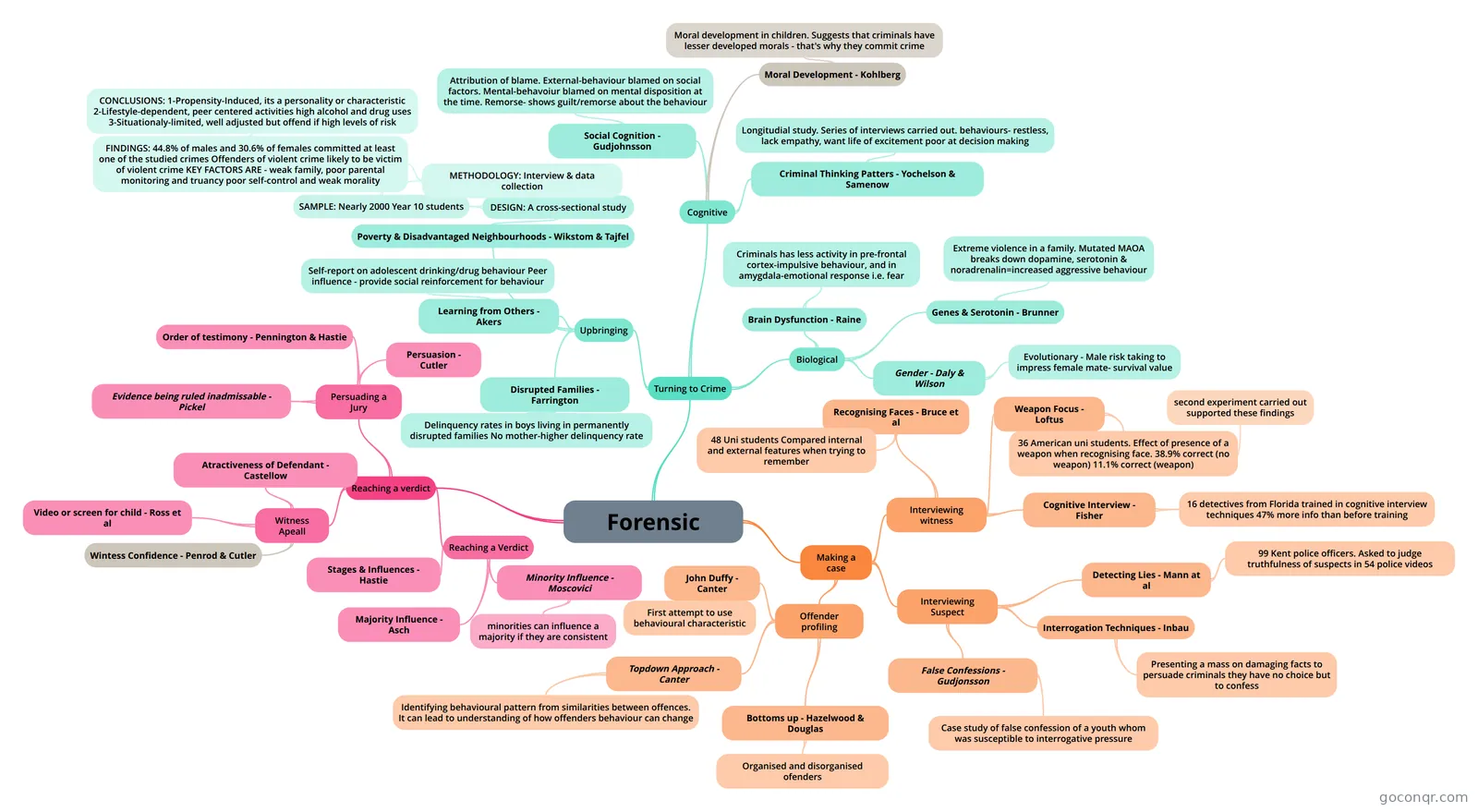
Mind map: Forensic psychology
Contenido del mapa
Forensic
Turning to Crime
- Upbringing
- Disrupted Families - Farrington
- Delinquency rates in boys living in permanently disrupted families No mother-higher delinquency rate
- Learning from Others - Akers
- Self-report on adolescent drinking/drug behaviour Peer influence - provide social reinforcement for behaviour
- Poverty & Disadvantaged Neighbourhoods - Wikstom & Tajfel
- DESIGN: A cross-sectional study
- SAMPLE: Nearly 2000 Year 10 students
- METHODOLOGY: Interview & data collection
- FINDINGS: 44.8% of males and 30.6% of females committed at least one of the studied crimes Offenders of violent crime likely to be victim of violent crime KEY FACTORS ARE - weak family, poor parental monitoring and truancy poor self-control and weak morality
- CONCLUSIONS: 1-Propensity-Induced, its a personality or characteristic 2-Lifestyle-dependent, peer centered activities high alcohol and drug uses 3-Situationaly-limited, well adjusted but offend if high levels of risk
- FINDINGS: 44.8% of males and 30.6% of females committed at least one of the studied crimes Offenders of violent crime likely to be victim of violent crime KEY FACTORS ARE - weak family, poor parental monitoring and truancy poor self-control and weak morality
- METHODOLOGY: Interview & data collection
- SAMPLE: Nearly 2000 Year 10 students
- DESIGN: A cross-sectional study
- Disrupted Families - Farrington
- Biological
- Brain Dysfunction - Raine
- Criminals has less activity in pre-frontal cortex-impulsive behaviour, and in amygdala-emotional response i.e. fear
- Genes & Serotonin - Brunner
- Extreme violence in a family. Mutated MAOA breaks down dopamine, serotonin & noradrenalin=increased aggressive behaviour
- Gender - Daly & Wilson
- Evolutionary - Male risk taking to impress female mate- survival value
- Brain Dysfunction - Raine
- Cognitive
- Criminal Thinking Patters - Yochelson & Samenow
- Longitudial study. Series of interviews carried out. behaviours- restless, lack empathy, want life of excitement poor at decision making
- Moral Development - Kohlberg
- Moral development in children. Suggests that criminals have lesser developed morals - that's why they commit crime
- Social Cognition - Gudjohnsson
- Attribution of blame. External-behaviour blamed on social factors. Mental-behavoiur blamed on mental disposition at the time. Remorse- shows guilt/remorse about the behaviour
- Criminal Thinking Patters - Yochelson & Samenow
- Upbringing
Reaching a verdict
- Persuading a Jury
- Order of testimony - Pennington & Hastie
- Evidence being ruled inadmissable - Pickel
- Persuasion - Cutler
- Reaching a Verdict
- Minority Influence - Moscovici
- minorities can influence a majority if they are consistent
- Majority Influence - Asch
- Stages & Influences - Hastie
- Minority Influence - Moscovici
- Witness Apeall
- Atractiveness of Defendant - Castellow
- Video or screen for child - Ross et al
- Wintess Confidence - Penrod & Cutler
- Persuading a Jury
Making a case
- Offender profiling
- Topdown Approach - Canter
- Identifying behavioural pattern from similarities between offences. It can lead to understanding of how offenders behaviour can change
- John Duffy - Canter
- First attempt to use behavioural characteristic
- Bottoms up - Hazelwood & Douglas
- Organised and disorganised ofenders
- Topdown Approach - Canter
- Interviewing witness
- Weapon Focus - Loftus
- 36 American uni students. Effect of presence of a weapon when recognising face. 38.9% correct (no weapon) 11.1% correct (weapon)
- second experiment carried out supported these findings
- 36 American uni students. Effect of presence of a weapon when recognising face. 38.9% correct (no weapon) 11.1% correct (weapon)
- Recognising Faces - Bruce et al
- 48 Uni students Compared internal and external features when trying to remember
- Cognitive Interview - Fisher
- 16 detectives from Florida trained in cognitive interview techniques 47% more info than before training
- Weapon Focus - Loftus
- Interviewing Suspect
- Interrogation Techniques - Inbau
- Presenting a mass on damaging facts to persuade criminals they have no choice but to confess
- False Confessions - Gudjonsson
- Case study of false confession of a youth whom was susceptible to interrogative pressure
- Detecting Lies - Mann at al
- 99 Kent police officers. Asked to judge truthfulness of suspects in 54 police videos
- Interrogation Techniques - Inbau
- Offender profiling
Información
- Descripción
- A2 Forensic Psychology OCR
- Creado por
- Taran Sahota
- Visitas
- 40
- Etiquetas
- Valoración