
Mapa mental
The Multi store model of memory
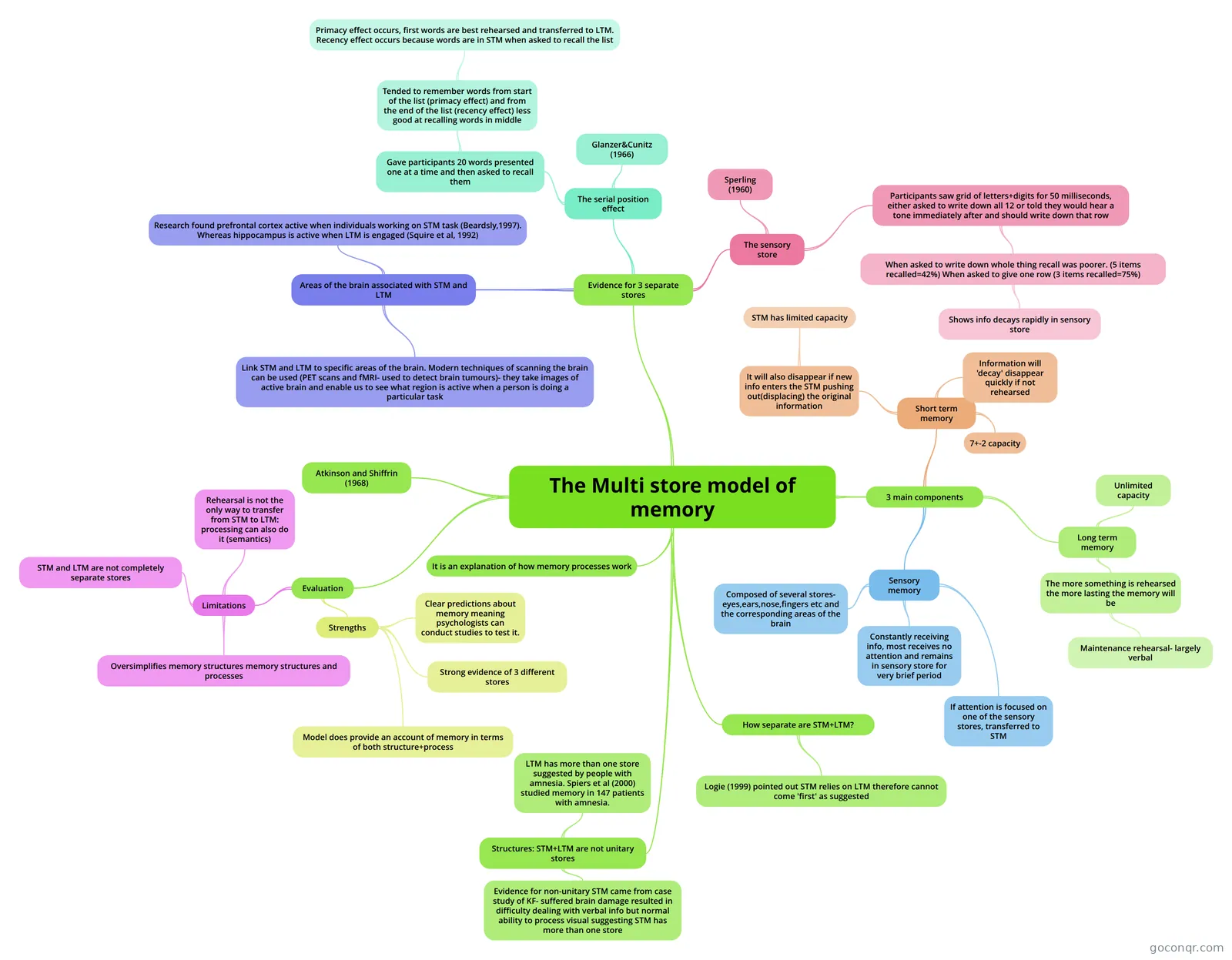
Mind map: Multi-store model of memory
Contenido del mapa
The Multi store model of memory
It is an explanation of how memory processes work
3 main components
- Sensory memory
- Composed of several stores- eyes,ears,nose,fingers etc and the corresponding areas of the brain
- Constantly receiving info, most receives no attention and remains in sensory store for very brief period
- If attention is focused on one of the sensory stores, transferred to STM
- Short term memory
- Information will 'decay' disappear quickly if not rehearsed
- It will also disappear if new info enters the STM pushing out(displacing) the original information
- STM has limited capacity
- 7+-2 capacity
- Long term memory
- The more something is rehearsed the more lasting the memory will be
- Maintenance rehearsal- largely verbal
- Unlimited capacity
- The more something is rehearsed the more lasting the memory will be
- Sensory memory
Atkinson and Shiffrin (1968)
Evidence for 3 separate stores
- The sensory store
- Sperling (1960)
- Participants saw grid of letters+digits for 50 milliseconds, either asked to write down all 12 or told they would hear a tone immediately after and should write down that row
- When asked to write down whole thing recall was poorer. (5 items recalled=42%) When asked to give one row (3 items recalled=75%)
- Shows info decays rapidly in sensory store
- When asked to write down whole thing recall was poorer. (5 items recalled=42%) When asked to give one row (3 items recalled=75%)
- The serial position effect
- Glanzer&Cunitz (1966)
- Gave participants 20 words presented one at a time and then asked to recall them
- Tended to remember words from start of the list (primacy effect) and from the end of the list (recency effect) less good at recalling words in middle
- Primacy effect occurs, first words are best rehearsed and transferred to LTM. Recency effect occurs because words are in STM when asked to recall the list
- Tended to remember words from start of the list (primacy effect) and from the end of the list (recency effect) less good at recalling words in middle
- Areas of the brain associated with STM and LTM
- Link STM and LTM to specific areas of the brain. Modern techniques of scanning the brain can be used (PET scans and fMRI- used to detect brain tumours)- they take images of active brain and enable us to see what region is active when a person is doing a particular task
- Research found prefrontal cortex active when individuals working on STM task (Beardsly,1997). Whereas hippocampus is active when LTM is engaged (Squire et al, 1992)
- The sensory store
Evaluation
- Strengths
- Strong evidence of 3 different stores
- Model does provide an account of memory in terms of both structure+process
- Clear predictions about memory meaning psychologists can conduct studies to test it.
- Limitations
- Oversimplifies memory structures memory structures and processes
- STM and LTM are not completely separate stores
- Rehearsal is not the only way to transfer from STM to LTM: processing can also do it (semantics)
- Strengths
Structures: STM+LTM are not unitary stores
- Evidence for non-unitary STM came from case study of KF- suffered brain damage resulted in difficulty dealing with verbal info but normal ability to process visual suggesting STM has more than one store
- LTM has more than one store suggested by people with amnesia. Spiers et al (2000) studied memory in 147 patients with amnesia.
How separate are STM+LTM?
- Logie (1999) pointed out STM relies on LTM therefore cannot come 'first' as suggested
Información
- Descripción
- A Levels (Psychology A- Unit 1 Memory) Psychology Mapa Mental sobre The Multi store model of memory, creado por lucyhacking el 26/11/2013.
- Creado por
- lucyhacking
- Visitas
- 281
- Etiquetas
- Valoración