
Mapa mental
Social Exchange Theory - Maintenance
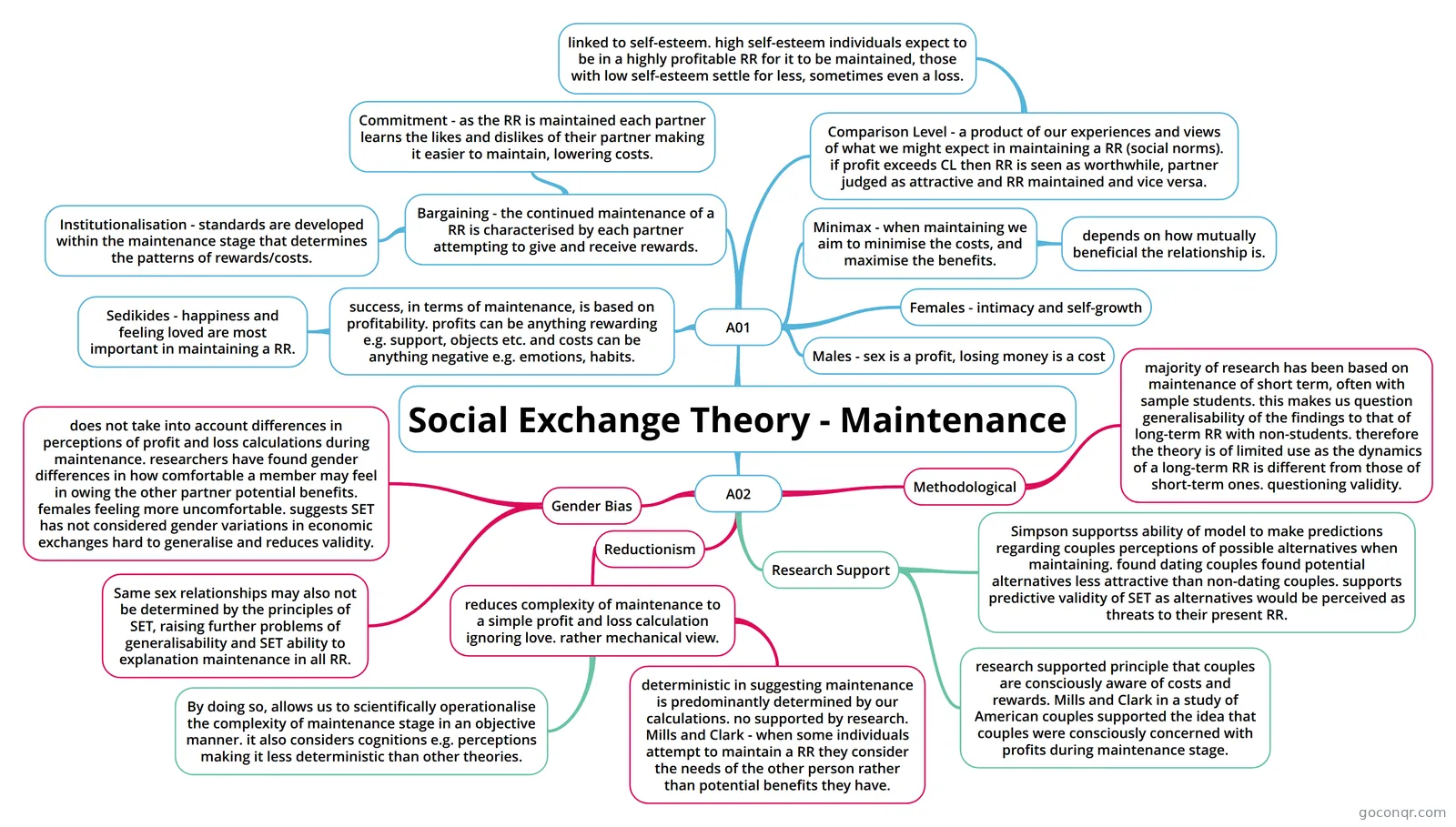
Mind map: Social Exchange Theory Maintenance
Contenido del mapa
Social Exchange Theory - Maintenance
A01
- success, in terms of maintenance, is based on profitability. profits can be anything rewarding e.g. support, objects etc. and costs can be anything negative e.g. emotions, habits.
- Sedikides - happiness and feeling loved are most important in maintaining a RR.
- Females - intimacy and self-growth
- Males - sex is a profit, losing money is a cost
- Minimax - when maintaining we aim to minimise the costs, and maximise the benefits.
- depends on how mutually beneficial the relationship is.
- Bargaining - the continued maintenance of a RR is characterised by each partner attempting to give and receive rewards.
- Commitment - as the RR is maintained each partner learns the likes and dislikes of their partner making it easier to maintain, lowering costs.
- Institutionalisation - standards are developed within the maintenance stage that determines the patterns of rewards/costs.
- Comparison Level - a product of our experiences and views of what we might expect in maintaining a RR (social norms). if profit exceeds CL then RR is seen as worthwhile, partner judged as attractive and RR maintained and vice versa.
- linked to self-esteem. high self-esteem individuals expect to be in a highly profitable RR for it to be maintained, those with low self-esteem settle for less, sometimes even a loss.
- success, in terms of maintenance, is based on profitability. profits can be anything rewarding e.g. support, objects etc. and costs can be anything negative e.g. emotions, habits.
A02
- Methodological
- majority of research has been based on maintenance of short term, often with sample students. this makes us question generalisability of the findings to that of long-term RR with non-students. therefore the theory is of limited use as the dynamics of a long-term RR is different from those of short-term ones. questioning validity.
- Research Support
- research supported principle that couples are consciously aware of costs and rewards. Mills and Clark in a study of American couples supported the idea that couples were consciously concerned with profits during maintenance stage.
- Simpson supportss ability of model to make predictions regarding couples perceptions of possible alternatives when maintaining. found dating couples found potential alternatives less attractive than non-dating couples. supports predictive validity of SET as alternatives would be perceived as threats to their present RR.
- Reductionism
- reduces complexity of maintenance to a simple profit and loss calculation ignoring love. rather mechanical view.
- deterministic in suggesting maintenance is predominantly determined by our calculations. no supported by research. Mills and Clark - when some individuals attempt to maintain a RR they consider the needs of the other person rather than potential benefits they have.
- By doing so, allows us to scientifically operationalise the complexity of maintenance stage in an objective manner. it also considers cognitions e.g. perceptions making it less deterministic than other theories.
- reduces complexity of maintenance to a simple profit and loss calculation ignoring love. rather mechanical view.
- Gender Bias
- does not take into account differences in perceptions of profit and loss calculations during maintenance. researchers have found gender differences in how comfortable a member may feel in owing the other partner potential benefits. females feeling more uncomfortable. suggests SET has not considered gender variations in economic exchanges hard to generalise and reduces validity.
- Same sex relationships may also not be determined by the principles of SET, raising further problems of generalisability and SET ability to explanation maintenance in all RR.
- Methodological
Información
- Descripción
- A-Level (Printed) Psychology Mapa Mental sobre Social Exchange Theory - Maintenance, creado por Sophie Edroff el 16/12/2015.
- Creado por
- Sophie Edroff
- Visitas
- 0
- Valoración
Más sobre Relationship maintenance