
Mapa mental
Topic 4: Learning psychology
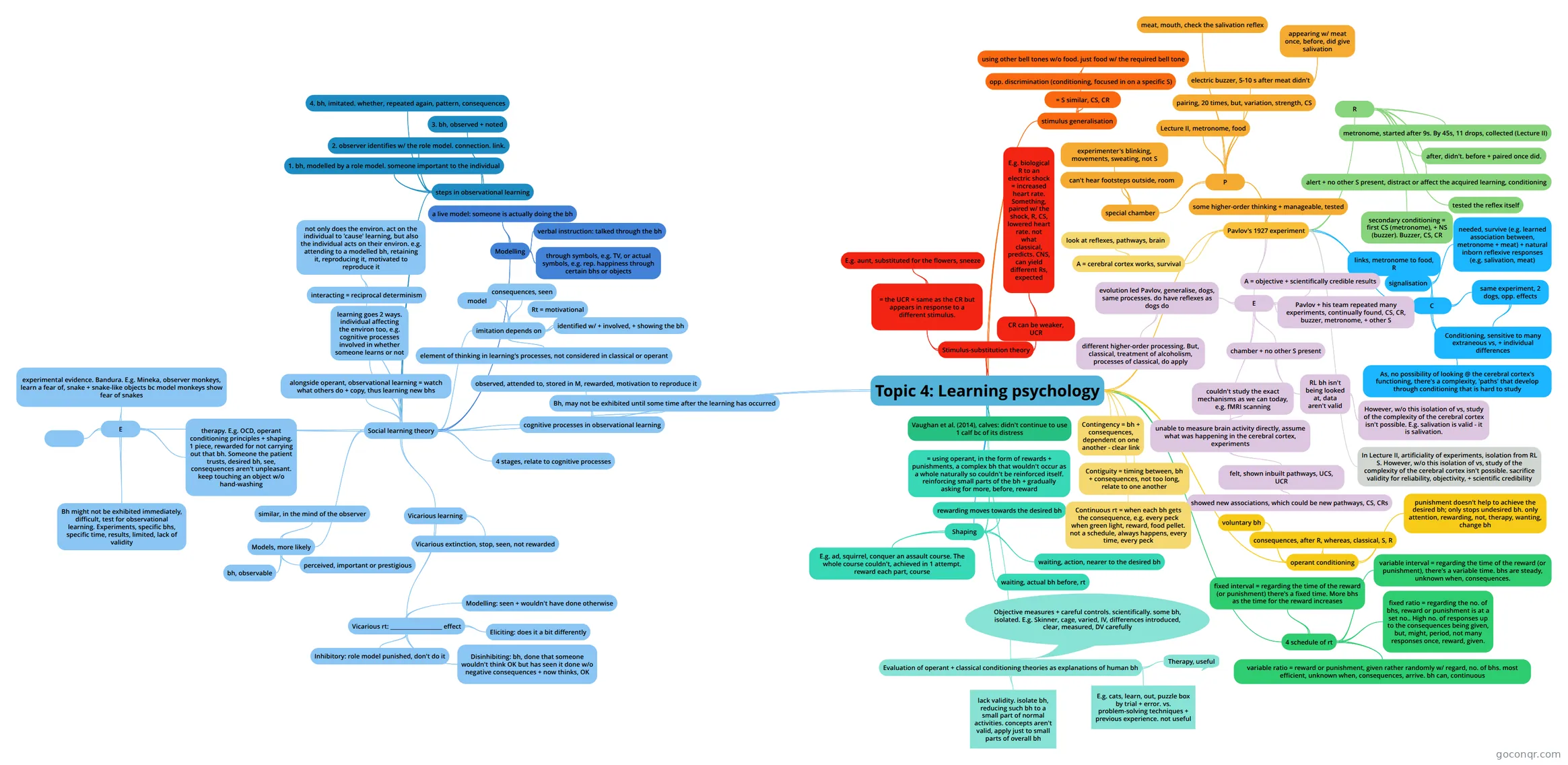
Mind map: Learning psychology
Contenido del mapa
Topic 4: Learning psychology
·
- Shaping
- waiting, actual bh before, rt
- waiting, action, nearer to the desired bh
- rewarding moves towards the desired bh
- = using operant, in the form of rewards + punishments, a complex bh that wouldn't occur as a whole naturally so couldn't be reinforced itself. reinforcing small parts of the bh + gradually asking for more, before, reward
- E.g. ad, squirrel, conquer an assault course. The whole course couldn't, achieved in 1 attempt. reward each part, course
- Shaping
Vaughan et al. (2014), calves: didn't continue to use 1 calf bc of its distress
Evaluation of operant + classical conditioning theories as explanations of human bh
- Objective measures + careful controls. scientifically. some bh, isolated. E.g. Skinner, cage, varied, IV, differences introduced, clear, measured, DV carefully
- Therapy, useful
- E.g. cats, learn, out, puzzle box by trial + error. vs. problem-solving techniques + previous experience. not useful
- lack validity. isolate bh, reducing such bh to a small part of normal activities. concepts aren't valid, apply just to small parts of overall bh
Social learning theory
- alongside operant, observational learning = watch what others do + copy, thus learning new bhs
- learning goes 2 ways. individual affecting the environ too, e.g. cognitive processes involved in whether someone learns or not
- interacting = reciprocal determinism
- not only does the environ. act on the individual to 'cause' learning, but also the individual acts on their environ. e.g. attending to a modelled bh, retaining it, reproducing it, motivated to reproduce it
- steps in observational learning
- 1. bh, modelled by a role model. someone important to the individual
- 2. observer identifies w/ the role model. connection. link.
- 3. bh, observed + noted
- 4. bh, imitated. whether, repeated again, pattern, consequences
- Modelling
- a live model: someone is actually doing the bh
- verbal instruction: talked through the bh
- through symbols, e.g. TV, or actual symbols, e.g. rep. happiness through certain bhs or objects
- imitation depends on
- model
- consequences, seen
- Rt = motivational
- identified w/ + involved, + showing the bh
- element of thinking in learning's processes, not considered in classical or operant
- cognitive processes in observational learning
- observed, attended to, stored in M, rewarded, motivation to reproduce it
- Bh, may not be exhibited until some time after the learning has occurred
- 4 stages, relate to cognitive processes
- Vicarious learning
- Vicarious extinction, stop, seen, not rewarded
- Vicarious rt: ___________________ effect
- Modelling: seen + wouldn't have done otherwise
- Eliciting: does it a bit differently
- Disinhibiting: bh, done that someone wouldn't think OK but has seen it done w/o negative consequences + now thinks, OK
- Inhibitory: role model punished, don't do it
- Models, more likely
- similar, in the mind of the observer
- perceived, important or prestigious
- bh, observable
- E
- experimental evidence. Bandura. E.g. Mineka, observer monkeys, learn a fear of, snake + snake-like objects bc model monkeys show fear of snakes
- therapy. E.g. OCD, operant conditioning principles + shaping. 1 piece, rewarded for not carrying out that bh. Someone the patient trusts, desired bh, see, consequences aren't unpleasant. keep touching an object w/o hand-washing
- Bh might not be exhibited immediately, difficult, test for observational learning. Experiments, specific bhs, specific time, results, limited, lack of validity
Stimulus-substitution theory
- = the UCR = same as the CR but appears in response to a different stimulus.
- E.g. aunt, substituted for the flowers, sneeze
- CR can be weaker, UCR
- E.g. biological R to an electric shock = increased heart rate. Something, paired w/ the shock, R, CS, lowered heart rate. not what classical, predicts. CNS, can yield different Rs, expected
- = the UCR = same as the CR but appears in response to a different stimulus.
stimulus generalisation
- = S similar, CS, CR
- opp. discrimination (conditioning, focused in on a specific S)
- using other bell tones w/o food. just food w/ the required bell tone
Pavlov's 1927 experiment
- A = cerebral cortex works, survival
- look at reflexes, pathways, brain
- some higher-order thinking + manageable, tested
- In Lecture II, artificiality of experiments, isolation from RL S. However, w/o this isolation of vs, study of the complexity of the cerebral cortex isn't possible. sacrifice validity for reliability, objectivity, + scientific credibility
- P
- special chamber
- can't hear footsteps outside, room
- experimenter's blinking, movements, sweating, not S
- Lecture II, metronome, food
- pairing, 20 times, but, variation, strength, CS
- meat, mouth, check the salivation reflex
- electric buzzer, 5-10 s after meat didn't
- appearing w/ meat once, before, did give salivation
- special chamber
- R
- metronome, started after 9s. By 45s, 11 drops, collected (Lecture II)
- tested the reflex itself
- after, didn't. before + paired once did.
- alert + no other S present, distract or affect the acquired learning, conditioning
- secondary conditioning = first CS (metronome), + NS (buzzer). Buzzer, CS, CR
- C
- signalisation
- links, metronome to food, R
- needed, survive (e.g. learned association between, metronome + meat) + natural inborn reflexive responses (e.g. salivation, meat)
- same experiment, 2 dogs, opp. effects
- Conditioning, sensitive to many extraneous vs, + individual differences
- As, no possibility of looking @ the cerebral cortex's functioning, there's a complexity, 'paths' that develop through conditioning that is hard to study
- signalisation
- E
- A = objective + scientifically credible results
- Pavlov + his team repeated many experiments, continually found, CS, CR, buzzer, metronome, + other S
- chamber + no other S present
- RL bh isn't being looked at, data aren't valid
- However, w/o this isolation of vs, study of the complexity of the cerebral cortex isn't possible. E.g. salivation is valid - it is salivation.
- RL bh isn't being looked at, data aren't valid
- unable to measure brain activity directly, assume what was happening in the cerebral cortex, experiments
- felt, shown inbuilt pathways, UCS, UCR
- showed new associations, which could be new pathways, CS, CRs
- couldn't study the exact mechanisms as we can today, e.g. fMRI scanning
- felt, shown inbuilt pathways, UCS, UCR
- evolution led Pavlov, generalise, dogs, same processes. do have reflexes as dogs do
- different higher-order processing. But, classical, treatment of alcoholism, processes of classical, do apply
- A = cerebral cortex works, survival
operant conditioning
- voluntary bh
- consequences, after R, whereas, classical, S, R
- punishment doesn't help to achieve the desired bh; only stops undesired bh. only attention, rewarding, not, therapy, wanting, change bh
Contingency = bh + consequences, dependent on one another - clear link
Contiguity = timing between, bh + consequences, not too long, relate to one another
Continuous rt = when each bh gets the consequence, e.g. every peck when green light, reward, food pellet. not a schedule, always happens, every time, every peck
4 schedule of rt
- fixed interval = regarding the time of the reward (or punishment) there's a fixed time. More bhs as the time for the reward increases
- variable interval = regarding the time of the reward (or punishment), there's a variable time. bhs are steady, unknown when, consequences.
- fixed ratio = regarding the no. of bhs, reward or punishment is at a set no.. High no. of responses up to the consequences being given, but, might, period, not many responses once, reward, given.
- variable ratio = reward or punishment, given rather randomly w/ regard, no. of bhs. most efficient, unknown when, consequences, arrive. bh can, continuous
Información
- Descripción
- Topic 4, Learning. Pavlov. Social learning theory
- Creado por
- Maria Angela Samonte
- Visitas
- 62
- Etiquetas
- Valoración