
Mapa mental
Unit 3: Eating Behaviours: Biological
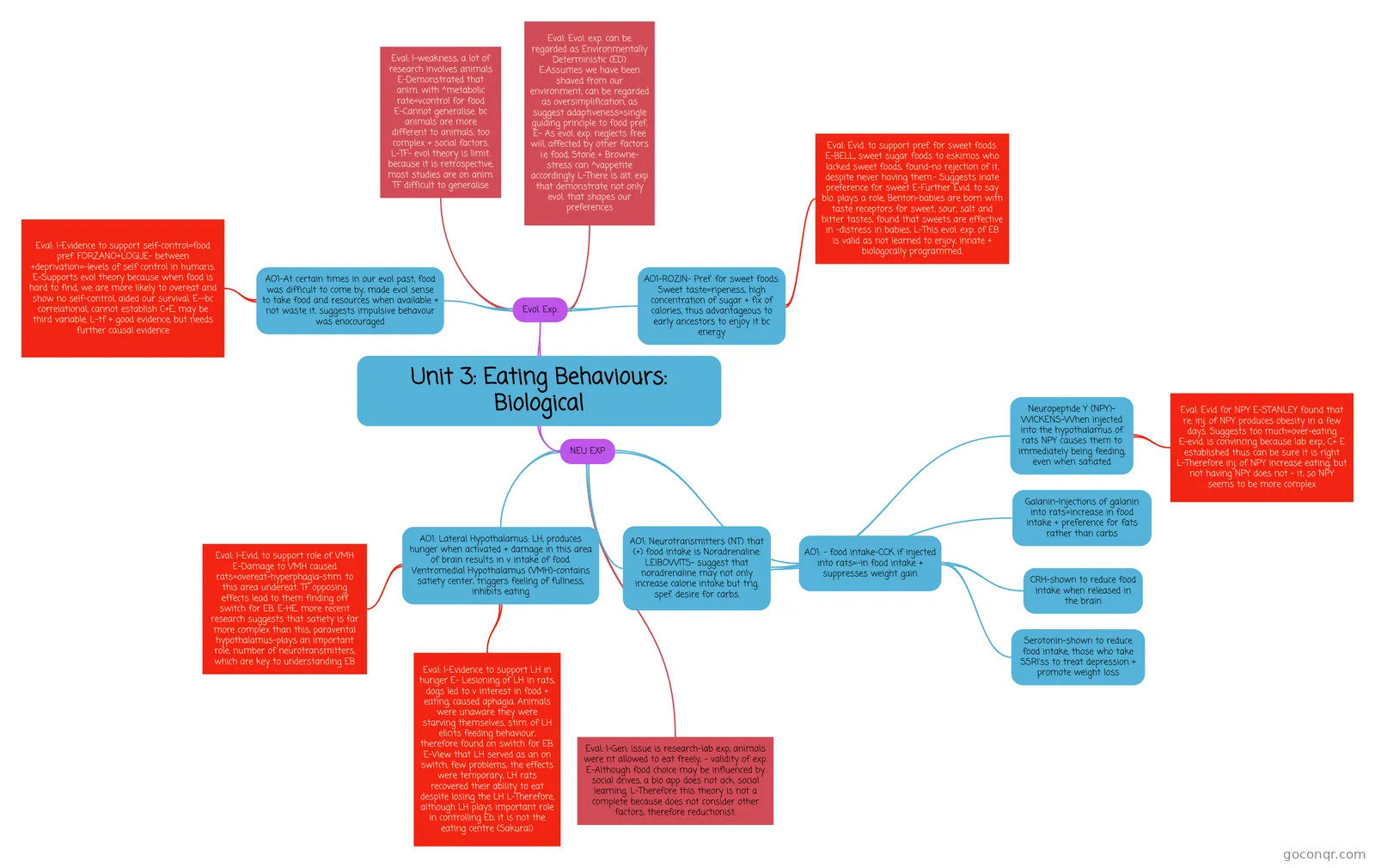
Mind map: Biological explanations of eating behaviours
Contenido del mapa
Unit 3: Eating Behaviours: Biological
Evol. Exp.
- AO1-ROZIN- Pref. for sweet foods: Sweet taste=ripeness, high concentration of sugar + fix of calories, thus advantageous to early ancestors to enjoy it bc energy
- Eval: Evid. to support pref. for sweet foods. E-BELL, sweet sugar foods to eskimos who lacked sweet foods, found-no rejection of it, despite never having them.- Suggests inate preference for sweet E-Further Evid. to say bio. plays a role, Benton-babies are born with taste receptors for sweet, sour, salt and bitter tastes, found that sweets are effective in -distress in babies. L-This evol. exp. of EB is valid as not learned to enjoy, innate + biologocally programmed.
- AO1-At certain times in our evol past, food was difficult to come by, made evol sense to take food and resources when available + not waste it, suggests impulsive behavour was enocouraged
- Eval: I-Evidence to support self-control=food pref. FORZANO+LOGUE- between +deprivation=-levels of self control in humans. E-Supports evol theory because when food is hard to find, we are more likely to overeat and show no self-control, aided our survival. E--bc correlational, cannot establish C+E, may be third variable. L-tf + good evidence, but needs further causal evidence
- Eval: I-weakness, a lot of research involves animals E-Demonstrated that anim. with ^metabolic rate=vcontrol for food E-Cannot generalise. bc animals are more different to animals, too complex + social factors. L-TF- evol theory is limit. because it is retrospective, most studies are on anim. TF difficult to generalise
- Eval: Evol. exp. can be regarded as Environmentally Deterministic (ED) E:Assumes we have been shaved from our environment, can be regarded as oversimplification, as suggest adaptiveness=single guiding principle to food pref. E- As evol. exp. neglects free will, affected by other factors i.e food, Stone + Browne- stress can ^vappetite accordingly L-There is alt. exp that demonstrate not only evol. that shapes our preferences
- AO1-ROZIN- Pref. for sweet foods: Sweet taste=ripeness, high concentration of sugar + fix of calories, thus advantageous to early ancestors to enjoy it bc energy
NEU EXP
- AO1: Lateral Hypothalamus: LH, produces hunger when activated + damage in this area of brain results in v intake of food. Ventromedial Hypothalamus (VMH)-contains satiety center, triggers feeling of fullness, inhibits eating
- Eval: I-Evidence to support LH in hunger E- Lesioning of LH in rats, dogs led to v interest in food + eating, caused aphagia. Animals were unaware they were starving themselves, stim. of LH elicits feeding behaviour, therefore found on switch for EB. E-View that LH served as an on switch, few problems, the effects were temporary, LH rats recovered their ability to eat despite losing the LH L-Therefore, although LH plays important role in controlling Eb, it is not the eating centre (Sakurai)
- Eval: I-Evid. to support role of VMH E-Damage to VMH caused rats=overeat-hyperphagia-stim. to this area undereat. TF opposing effects lead to them finding off switch for EB. E-HE, more recent research suggests that satiety is far more complex than this, paravental hypothalamus-plays an important role, number of neurotransmitters, which are key to understanding EB
- AO1: Neurotransmitters (NT) that (+) food intake is Noradrenaline: LEIBOWITS- suggest that noradrenaline may not only increase calorie intake but trig. spef. desire for carbs.
- Neuropeptide Y (NPY)- WICKENS-When injected into the hypothalamus of rats NPY causes them to immediately being feeding, even when satiated
- Eval: Evid for NPY E-STANLEY found that re. inj. of NPY produces obesity in a few days. Suggests too much=over-eating E-evid. is convincing because lab exp., C+ E established thus can be sure it is right L-Therefore inj. of NPY increase eating, but not having NPY does not - it, so NPY seems to be more complex
- Galanin-Injections of galanin into rats=increase in food intake + preference for fats rather than carbs
- Neuropeptide Y (NPY)- WICKENS-When injected into the hypothalamus of rats NPY causes them to immediately being feeding, even when satiated
- AO1: - food intake-CCK if injected into rats=-in food intake + suppresses weight gain
- CRH-shown to reduce food intake when released in the brain
- Serotonin-shown to reduce food intake, those who take SSRI'ss to treat depression + promote weight loss
- Eval: I-Gen. issue is research-lab exp, animals were nt allowed to eat freely, - validity of exp. E-Although food choice may be influenced by social drives, a bio app does not ack. social learning. L-Therefore this theory is not a complete because does not consider other factors, therefore reductionist.
- AO1: Lateral Hypothalamus: LH, produces hunger when activated + damage in this area of brain results in v intake of food. Ventromedial Hypothalamus (VMH)-contains satiety center, triggers feeling of fullness, inhibits eating
Información
- Descripción
- A-Level Psychology Mapa Mental sobre Unit 3: Eating Behaviours: Biological, creado por Patrick Calvento el 29/04/2016.
- Creado por
- Patrick Calvento
- Visitas
- 5
- Etiquetas
- Valoración
Más sobre Biological control of eating behaviour