
Mapa mental
Personality
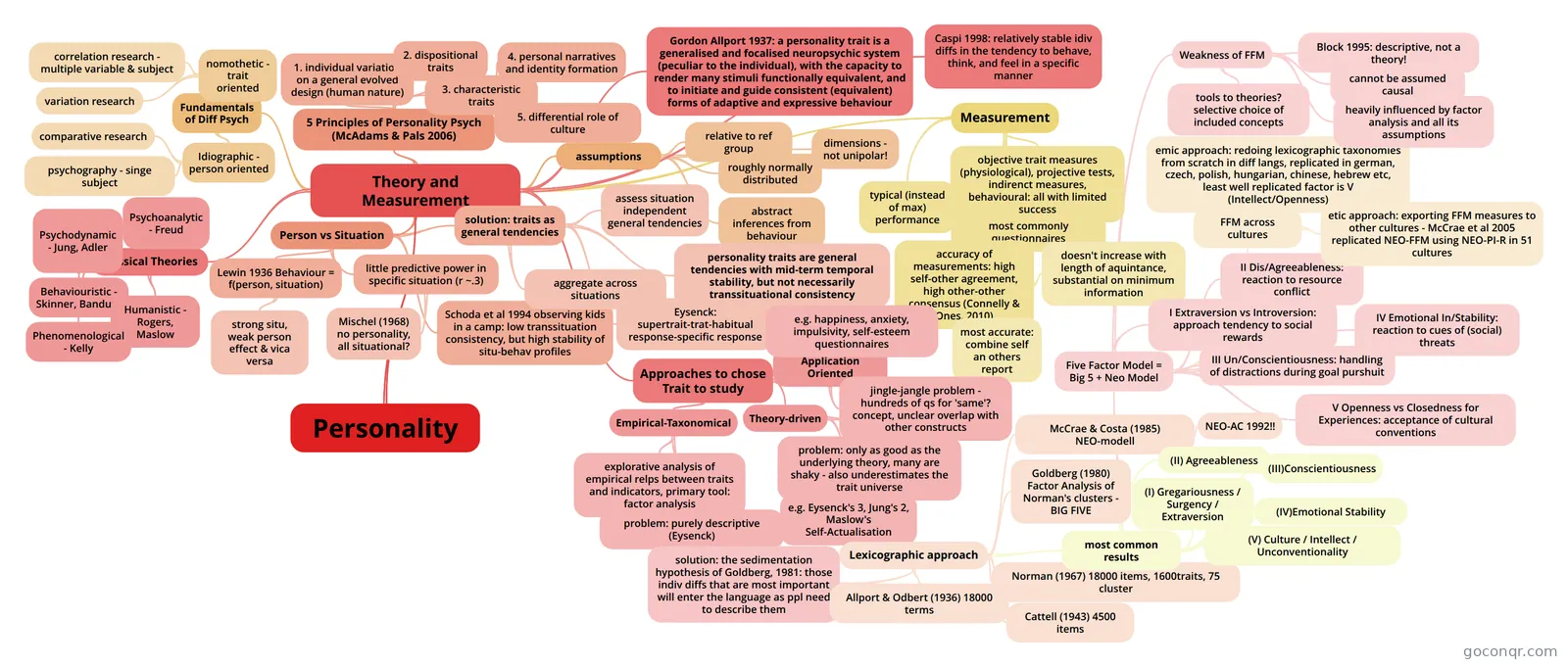
Mind map: Personality theory and measurement
Contenido del mapa
Personality
Theory and Measurement
- Classical Theories
- Psychodynamic - Jung, Adler
- Psychoanalytic - Freud
- Behaviouristic - Skinner, Bandura
- Humanistic - Rogers, Maslow
- Phenomenological - Kelly
- Fundamentals of Diff Psych
- Idiographic - person oriented
- psychography - singe subject
- comparative research
- nomothetic - trait oriented
- variation research
- correlation research - multiple variable & subject
- Idiographic - person oriented
- 5 Principles of Personality Psych (McAdams & Pals 2006)
- 1. individual variation on a general evolved design (human nature)
- 2. dispositional traits
- 3. characteristic traits
- 4. personal narratives and identity formation
- 5. differential role of culture
- Gordon Allport 1937: a personality trait is a generalised and focalised neuropsychic system (peculiar to the individual), with the capacity to render many stimuli functionally equivalent, and to initiate and guide consistent (equivalent) forms of adaptive and expressive behaviour
- Caspi 1998: relatively stable idiv diffs in the tendency to behave, think, and feel in a specific manner
- assumptions
- abstract inferences from behaviour
- relative to ref group
- roughly normally distributed
- dimensions - not unipolar!
- Person vs Situation
- little predictive power in specific situation (r ~.3)
- Mischel (1968) no personality, all situational?
- Lewin 1936 Behaviour = f(person, situation)
- strong situ, weak person effect & vica versa
- Schoda et al 1994 observing kids in a camp: low transsituation consistency, but high stability of situ-behav profiles
- solution: traits as general tendencies
- aggregate across situations
- assess situation independent general tendencies
- personality traits are general tendencies with mid-term temporal stability, but not necessarily transsituational consistency
- Eysenck: supertrait-trat-habitual response-specific response
- little predictive power in specific situation (r ~.3)
- Measurement
- typical (instead of max) performance
- most commonly questionnaires
- objective trait measures (physiological), projective tests, indirenct measures, behavioural: all with limited success
- accuracy of measurements: high self-other agreement, high other-other consensus (Connelly & Ones, 2010)
- doesn't increase with length of aquintance, substantial on minimum information
- most accurate: combine self an others report
- Approaches to chose Trait to study
- Application Oriented
- e.g. happiness, anxiety, impulsivity, self-esteem questionnaires
- jingle-jangle problem - hundreds of qs for 'same'? concept, unclear overlap with other constructs
- Theory-driven
- e.g. Eysenck's 3, Jung's 2, Maslow's Self-Actualisation
- problem: only as good as the underlying theory, many are shaky - also underestimates the trait universe
- Empirical-Taxonomical
- explorative analysis of empirical relps between traits and indicators, primary tool: factor analysis
- problem: purely descriptive (Eysenck)
- solution: the sedimentation hypothesis of Goldberg, 1981: those indiv diffs that are most important will enter the language as ppl need to describe them
- Lexicographic approach
- Allport & Odbert (1936) 18000 terms
- Cattell (1943) 4500 items
- Goldberg (1980) Factor Analysis of Norman's clusters - BIG FIVE
- Norman (1967) 18000 items, 1600traits, 75 cluster
- McCrae & Costa (1985) NEO-modell
- NEO-AC 1992!!
- most common results
- (I) Gregariousness / Surgency / Extraversion
- (II) Agreeableness
- (III)Conscientiousness
- (IV)Emotional Stability
- (V) Culture / Intellect / Unconventionality
- Five Factor Model = Big 5 + Neo Model
- I Extraversion vs Introversion: approach tendency to social rewards
- II Dis/Agreeableness: reaction to resource conflict
- III Un/Conscientiousness: handling of distractions during goal purshuit
- IV Emotional In/Stability: reaction to cues of (social) threats
- V Openness vs Closedness for Experiences: acceptance of cultural conventions
- FFM across cultures
- emic approach: redoing lexicographic taxonomies from scratch in diff langs, replicated in german, czech, polish, hungarian, chinese, hebrew etc, least well replicated factor is V (Intellect/Openness)
- etic approach: exporting FFM measures to other cultures - McCrae et al 2005 replicated NEO-FFM using NEO-PI-R in 51 cultures
- Weakness of FFM
- Block 1995: descriptive, not a theory!
- cannot be assumed causal
- heavily influenced by factor analysis and all its assumptions
- tools to theories? selective choice of included concepts
- Lexicographic approach
- solution: the sedimentation hypothesis of Goldberg, 1981: those indiv diffs that are most important will enter the language as ppl need to describe them
- Application Oriented
- Classical Theories
Información
- Descripción
- Psych 3 exam prep Mapa Mental sobre Personality, creado por nita.b el 05/05/2013.
- Creado por
- nita.b
- Visitas
- 144
- Etiquetas
- Valoración