
Mapa mental
The Salt March 1930
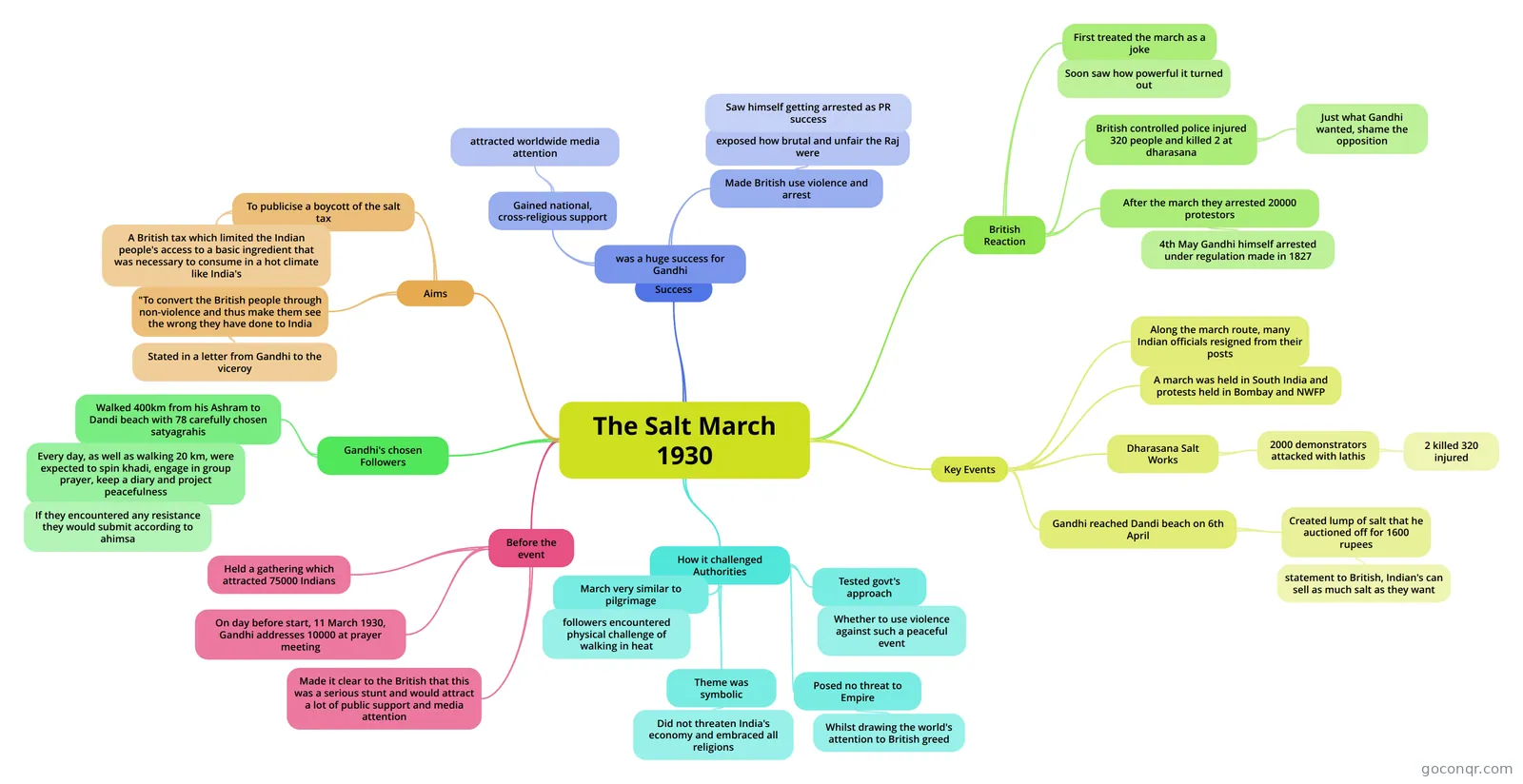
Mind map: The Salt March 1930
Contenido del mapa
The Salt March 1930
Aims
- To publicise a boycott of the salt tax
- A British tax which limited the Indian people's access to a basic ingredient that was necessary to consume in a hot climate like India's
- "To convert the British people through non-violence and thus make them see the wrong they have done to India
- Stated in a letter from Gandhi to the viceroy
- To publicise a boycott of the salt tax
Gandhi's chosen Followers
- Walked 400km from his Ashram to Dandi beach with 78 carefully chosen satyagrahis
- Every day, as well as walking 20 km, were expected to spin khadi, engage in group prayer, keep a diary and project peacefulness
- If they encountered any resistance they would submit according to ahimsa
- Every day, as well as walking 20 km, were expected to spin khadi, engage in group prayer, keep a diary and project peacefulness
- Walked 400km from his Ashram to Dandi beach with 78 carefully chosen satyagrahis
Before the event
- Held a gathering which attracted 75000 Indians
- On day before start, 11 March 1930, Gandhi addresses 10000 at prayer meeting
- Made it clear to the British that this was a serious stunt and would attract a lot of public support and media attention
How it challenged Authorities
- March very similar to pilgrimage
- followers encountered physical challenge of walking in heat
- Theme was symbolic
- Did not threaten India's economy and embraced all religions
- Posed no threat to Empire
- Whilst drawing the world's attention to British greed
- Tested govt's approach
- Whether to use violence against such a peaceful event
- March very similar to pilgrimage
Key Events
- Along the march route, many Indian officials resigned from their posts
- A march was held in South India and protests held in Bombay and NWFP
- Dharasana Salt Works
- 2000 demonstrators attacked with lathis
- 2 killed 320 injured
- 2000 demonstrators attacked with lathis
- Gandhi reached Dandi beach on 6th April
- Created lump of salt that he auctioned off for 1600 rupees
- statement to British, Indian's can sell as much salt as they want
- Created lump of salt that he auctioned off for 1600 rupees
British Reaction
- First treated the march as a joke
- Soon saw how powerful it turned out
- British controlled police injured 320 people and killed 2 at dharasana
- Just what Gandhi wanted, shame the opposition
- After the march they arrested 20000 protestors
- 4th May Gandhi himself arrested under regulation made in 1827
- First treated the march as a joke
Success
- was a huge success for Gandhi
- Gained national, cross-religious support
- attracted worldwide media attention
- Made British use violence and arrest
- exposed how brutal and unfair the Raj were
- Saw himself getting arrested as PR success
- exposed how brutal and unfair the Raj were
- Gained national, cross-religious support
- was a huge success for Gandhi
Información
- Descripción
- A-Levels India History Mapa Mental sobre The Salt March 1930, creado por jacksearle el 06/05/2013.
- Creado por
- jacksearle
- Visitas
- 919
- Etiquetas
- Valoración
Más sobre Civil Disobedience Movement and Salt March