
Flashcards
Measurement & Intelligence

Cards in this deck (25)
- 1Intelligence What is Intelligence?Multifaceted, functional, & culturally defined.
“The ability to learn and remember information, to recognise concepts and their relations, and to apply the information to their own behaviour in an adaptive way.” (Neisser et al., 1996) - 2INTELLIGENCE MODELS HORN & CATTELL’S GF-GC THEORY Intelligence comprises:

- 3INTELLIGENCE MODELS CATTELL-HORN-CARROLL THEORY Intelligence comprises:

- 4INTELLIGENCE MODELS WHAT ARE STERNBERG’S TRIARCHIC THEORY OF INTELLIGENCE, THREE TYPES OF INTELLIGENCE:Three types of intelligence:
Analytical intelligence:
academic, computational problem solving
Creative intelligence:
imagination, innovation in novel contexts
Practical intelligence:
“street smarts”, adapting to context - 5INTELLIGENCE MODELS What are GARDNER’S THEORY OF MULTIPLE INTELLIGENCES 8 (maybe 9) forms of intelligence?

- 6INTELLIGENCE MODELS What are the Criterion for selecting intelligences in GARDNER’S THEORY OF MULTIPLE INTELLIGENCES?Criterion for selecting intelligences:
> Isolated areas in the brain responsible
for each type of intelligence
> Developmental:
some intelligences develop earlier than others
> Savants/prodigies:
lack some intelligence areas,
but good in others - 7INTELLIGENCE MODELS What is the meaning of EMOTIONAL INTELLIGENCE (Salovey & Mayer, 1990; Goleman, 1996)?“The ability to monitor one’s own and others’ feelings and emotions, discriminate among them, and to use this information to guide one’s thinking and actions”
- 8INTELLIGENCE MODELS EMOTIONAL INTELLIGENCE What are Goleman's 5 domains of emotional intelligence?1. self-awareness (knowing your emotions)
2. self-regulation (managing your emotions)
3. self-motivation (motivating yourself)
4. empathy (understanding others’ emotions)
5. handling relationships (managing others’ emotions) - 9INTELLIGENCE MEASUREMENT What did THE STANFORD-BINET SCALE introduce?THE STANFORD-BINET SCALE (Terman, 1916)
Introduced measure of IQ in terms of chronological age and a measured mental age. - 10INTELLIGENCE MEASUREMENT THE STANFORD-BINET SCALE (Terman, 1916) Problems with then..Problem
Highest items for measuring mental age were age 16items, but chronological age keeps rising.
IQs would therefore decrease after age 16. - 11INTELLIGENCE MEASUREMENT THE STANFORD-BINET SCALE (Terman, 1916) How IQ is calculated Currently:Nowadays, IQ calculated in terms of a deviation score in relation to the population
Based on a normal distribution with a mean of 100 and a standard deviation of 15
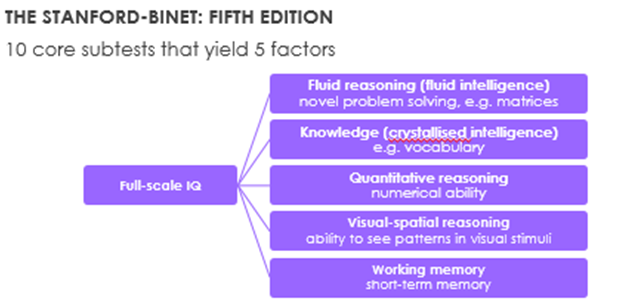
- 12INTELLIGENCE MEASUREMENT THE STANFORD-BINET: FIFTH EDITION
- 13INTELLIGENCE MEASUREMENT WECHSLER INTELLIGENCE SCALES. Wechsler Adult Intelligence Scale:Wechsler Adult Intelligence Scale
► current version: WAIS-IV (2008)
► Overall IQ broken down into four indices:
> verbal comprehension index
> working memory index
> perceptual reasoning index
> processing speed index - 14INTELLIGENCE MEASUREMENT WECHSLER INTELLIGENCE SCALES. Wechsler Adult Intelligence WAIS-IV SUPPLEMENTARY TEST:
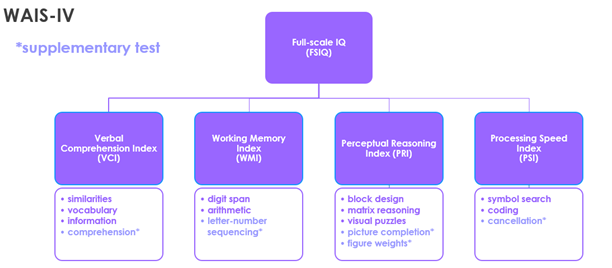
- 15INTELLIGENCE MEASUREMENT WECHSLER INTELLIGENCE SCALES. Wechsler Intelligence Scale for Children: (age 7 - 16) Wechsler Preschooler & Primary Scale of Intelligence (ages < 7)► current version: WISC-V (2014)
- 16INTELLIGENCE MEASUREMENT WAIS-IV: VCI EXAMPLE SUBTESTS:

- 17INTELLIGENCE MEASUREMENT WAIS-IV: VCI MORE EXAMPLE SUBTESTS:

- 18WAIS-IV: PRI EXAMPLE SUBTESTS Some subtests were:Some subtests were: visual puzzles, block designs, matrix reasoning, picture completion, figure weights
- 19WAIS-IV: PSI EXAMPLE SUBTESTS Some subtests were:Some subtests were: Symbol search, coding, cancellation (with shapes).
- 20RAVEN’S PROGRESSIVE MATRICES> Matrices in order of increasing difficulty
> Identify the missing element to complete the pattern
> Non-verbal test
> Reasoning ability (Spearman’s g)
> Independent of language, reading and writing skills
> Used for selection
- 21INTELLIGENCE DETERMINANTS TWIN STUDIESTWIN STUDIES
> Identical twins are more genetically similar than fraternal twins
> Environment in which identical & fraternal twins are reared are equal/similar
> If intelligence is more similar in identical than fraternal twins this must be due to their greater genetic similarity - 22INTELLIGENCE DETERMINANTS TWIN STUDIESTWIN STUDIES
Average correlations in intelligence between…
… identical twins: .86
… fraternal twins: .62
… identical twins
(reared apart): .75 - 23INTELLIGENCE DETERMINANTS ADOPTION STUDIESADOPTION STUDIES
Average correlations in intelligence between adopted child and…
… biological parent
(living apart): .31
… adoptive parent
(living together): .16 - 24Is intelligence heritable?Intelligence heritability estimation = ~50%
Different intellectual abilities vary in heritability
But environment also important for intelligence as well! - 25CREATIVITY CREATIVITY DETERMINANTSCorrelations with intelligence vary from small (.10) to moderate (.50)
► Intelligence is necessary, but not sufficient, for creativity
Research into creativity shows the importance of:
► years of preparation to develop expertise
► high levels of intrinsic motivation
► a “risk-taking” attitude
► an intellectually and emotionally supportive environment
Plomin (1990): 20% variation in creativity is due to genetic factors
► Twin study correlations
> Identical twins: .61
> Fraternal twins: .50