
Flashcards
Psychopathology: Week 1-3 Lecture SAQs
Cards in this deck (54)
- 1Why do diagnosis matter?Useful way to label and thus manage it, identify if they are a danger to themselves, communication/common language between health professionals, implications on support systems and other institutions, understanding of self
- 2What is Psychopathology?A descriptive term used to describe behaviour, thoughts, feelings, and experiences, which are indicative of mental illness, even if they do not constitute a formal diagnosis (clinical description).
- 3What CAN be indicative of Abnormalty?Statistical infrequency
Personal distress
Disability/dysfunction - 4For clinicians, considerations of psychopathology cover three aspects of our work:1. Clinical Description, diagnostic formulation from client information
2. Causation (Aetiology)
3. Treatment and Outcome (Prognosis) - 5What is a ‘Mental Disorder’?clinically significant disturbance in an individual’s cognition, emotion regulation or behaviour…usually (not always) associated with significant distress or disability in social, occupational or other important activities
- 6Why Diagnose or Classify Psychopathology?• Research: test treatment efficacy and understand etiology
• Education: teach psychopathology
• Information Management: measure and pay for care
Communication: among clinicians, between science and practice
• Clinical: facilitate identification of treatment, and prevention of mental disorders, descriptive of experience, possible etiology and prognosis. - 7The case against diagnosis/classification includes• Bias or restricted thinking
• Associated with jargon
• Inhibit research
• Stigmatising and implications for the self
• Some institutions and people contend that mental disorder is a myth to fund the pharmaceutical industry - i.e Scientology, Thomas Szasz - 8Signs are:objective findings observed by a clinician
- 9Symptomssubjective complaints reported by a patient
- 10Syndromesigns, symptoms and events that occur in a particular pattern and indicate the existence of a particular disorder/construct
- 11 Disorder A syndrome which can be discriminated from other syndromes;
To be labelled a disorder means there is a distinct course to the syndrome and the age and gender characteristics of the disorder have been described. In some cases prognosis may also be known - 12 Disease For a disorder to be labelled a disease, there has to be indications of abnormal physiological processes or structural abnormalities,
- 13Methods of Assessment of PsychopathologyPen and paper tests
• Clinical interviews- more scripted means more accurate
• Behavioural assessment
• Activity Diaries
• Psychological tests, eg. MMPI
• Medical tests
• Psychophysiological tests
• Neuropsychological tests
• Context is important. - 14Approaches to Classification1. Categorical: divides psychological disorders into categories based on criteria sets with defining features.
2. Dimensional: aspects of psychopathology are quantified on a scale. - 15Models of mental illness/psychopathologyBiological Paradigm
Social and developmental factors
Psychoanalytic paradigm
Stress-diathesis models
Cognitive Models
Biopsychosocial models - 16Clinical staging model (McGorry et al. 2006)• Model adopted from cancer staging (stages reflecting disease – here disorder – progression). Combine dimensional/continuous benefits
• Focus on identifying those at risk and facilitating early intervention.
In most cases, mental disorders develop over time with worsening severity
• Staging model aims to define various stages of the development of disorder;
• Preventive focus: central goal is to stop emergence of first episode of disorder.
• If complete prevention is not possible, then the aim is to prevent progression to later stage, prevent worsening and poor prognosis
• Focus on identifying those at risk and facilitating early intervention.
In most cases, mental disorders develop over time with worsening severity
• Staging model aims to define various stages of the development of disorder;
• Preventive focus: central goal is to stop emergence of first episode of disorder.
• If complete prevention is not possible, then the aim is to prevent progression to later stage, prevent worsening and poor prognosis - 17Transdiagnostic model• A move away from notion that each type of mental illness is associated with unique underlying cognitive and potentially neurological factors;
• Recognition of shared aetiological and maintenance factors;
• May account for high levels of comorbidity between disorders - such as anxiety and depressive disorders - 18Prodromal Syndromebut the technical term used by mental health professionals to describe a specific group of symptoms that may precede the onset of a mental illness
- 19Psychosis• Term ‘psychosis’ is an umbrella term meaning ‘out of touch with reality’
• Can refer to a variety of clusters of symptoms
-Psychotic symptoms can occur in a range of disorders including:
• organic presentations like dementia.
• Substance use: amphetamine psychosis, and so on
-At the disorder level, psychosis refers to a group of disorders distinguished from one another in terms of:
– symptom configuration (e.g., delusional disorder versus schizophrenia).
• Non-bizarre vs bizarre delusion
– duration (e.g., schizophrenia (lnger than 6 months) versus schizophreniform disorder)
– relative pervasiveness - in terms of both duration and the clinical picture - of psychotic symptoms versus affective symptoms - 20schizophrenia• Involves disruption in various aspects of perceiving, thinking, feeling and behaviour
• Phenomena associated with schizophrenia can be classified into two major groups of symptoms – positive symptoms and negative symptoms - 21– Positive symptoms – additive to normal experience• Hallucinations
• Delusions
• Flight of ideas - 22– Negative symptoms – deficit in normal function• Avolition
• Alogia
• Anhedonia
• Affective flattening
• Inattention - 23Schizotypal Personality Traits– Impulsive nonconformity
– Introvertive anhedonia- so pleasure, no social things
– Cognitive disorganisation
– Unusual experiences
-Increased risk of Schizoprenia - 24Associated features of Sz• Depression
• Suicide (5-10% of people diagnosed with sz die by suicide: Palmer et al., 2005)
• Anxiety
• PTSD- trauma may be the experience of psychosis itself OR associated with treatment
• Substance use problems
• Poor quality of life in general- occupational, relationship, social and emotional functioning
• Stigma - 25History of the concept of schizophreniaBenedict Augustine Morel (1860) – ‘demence precoce’
• The first attempt at a rigorous description of what we now know as schizophrenia-eary sign of dementia.
Emil Kraepelin (1898) – ‘dementia praecox’ Early life dementia
• A refined and more formal definition
• Emphasised early onset and deteriorating course
Paul Eugen Bleuler (1911) - ‘schizophrenia’
• A broader definition
• Disagreed with Kraepelin – based on his observation that schizophrenia does not necessarily display early onset, deteriorating course and therefore not characteristic of a dementia
• Schneider (1959) - emphasised ‘first rank symptoms’. emphasised ‘first rank symptoms’(presence=schizo diagnosable) and made the diagnosis on cross section (deemed duration criteria not necessary!)
-Patrick McGorry (late 1980s present).: Over-focus on chronic samples who are only representative of very poor outcome patients and are contaminated by institutionalisation, medication side-effects, etc
Richard Bentall (1990’s - present).
– Need to study psychotic symptoms individually, not schizophrenia as a construct. - 26Schizophrenia – Outcomes• Associated with very poor prognosis. Why? Partly because chronic populations have been studied. What factors lead to recovery, and treatment of mild populations?
• Clinician’s illusion – that who clinicians see in hospital are representative of all patients with that diagnosis - 27Other Aetiological theories in brief/Other things that contribute to Psychosis• Stress-vulnerability model
• Biochemical model
Dopamine: Biological Approaches
• Influenza and season of birth hypotheses
Expressed Negative Emotion - 28Neurocognition in schizophrenia• Sustained auditory and visual attention
• Problematic initial processing of information into sensory memory.
• Impaired detection of relevant stimuli that are embedded in irrelevant ‘noise’.
• Problematic organisation of information in working memory.
• Executive function
• Language - thought disorders - 29Social Cognition in schizophreniaEmotion perception – the ability to comprehend emotional cues in a social context
Social perception – the ability to comprehend communicative cues in a social context – may not be emotional - 30Psychosis and treatment• Pharmacological treatment- primary approach in acute phase of illness
• Best practice: low-dose approach
• ‘Atypical anti-psychotics’ fewer side effects than ‘typicals’
• Soteria model (Bola & Mosher, 2003)
– Highly supportive care, usually medication free, living in a community
– Comparable results to treatment as usual - 31Psychologists's role• CBT- addressing hallucinations, delusions, negative symptoms
• Substance use
• Family education
• Psychoeducation of patient
• Relapse prevention
• Occupational and social functioning - 32Current issues and debate• No biological markers or physiological tests to diagnose schizophrenia;
• Aetiology continues to be uncertain;
• No clear evidence that the concept of schizophrenia is a valid construct.
• Continuum vs categorical models
• Emphasis of hallucinations and delusions in diagnostic criteria increases reliability of diagnoses at the cost of validity.
• Schizophrenia has a long history of neglect, demonisation and concealment;
• Numerous studies have demonstrated that sz is less recognised by general public than other disorders such as depression;
• Myths highlighted in lecture are damaging to individuals with sz because they maintain a culture and environment that heightens risk of prejudice and discrimination- thereby limiting opportunities for recovery and increasing stress - 33Stigma• Schizophrenia has a long history of neglect, demonisation and concealment;
• Numerous studies have demonstrated that sz is less recognised by general public than other disorders such as depression;
• Myths highlighted in lecture are damaging to individuals with sz because they maintain a culture and environment that heightens risk of prejudice and discrimination- thereby limiting opportunities for recovery and increasing stress. - 34What is stress?Stress is the physical, mental and emotional human response to a particular stimulus, otherwise called as ‘stressor’.
Stress is a biological and psychological response experienced on encountering a threat that we feel we do not have the resources to deal with - 35Biological conceptualisation of stress?
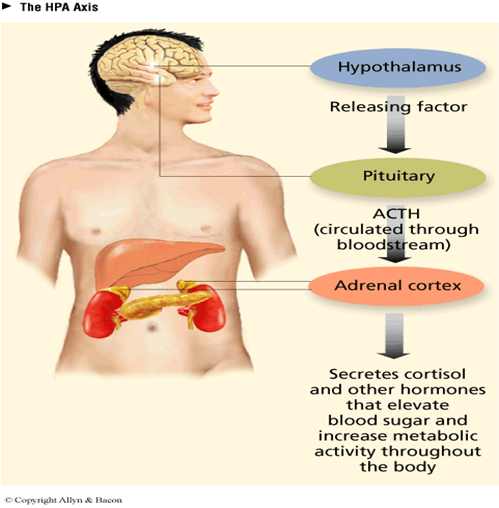
- 36Psychological conceptualizations of stress?Stress as a stimulus
A stressful event elicits a coping response;
Externalises the cause of distress;
Life events, hassles, traumatic events etc;
Assumes that all individuals will respond in the same way to a given stressor.
Stress as a response
An individual can describe feeling ‘stressed’ or ‘distressed’;
Difficult to identify what will elicit this response and what will not;
Also, a ‘stress response’ may occur in reaction to events that are not normally themselves stress provoking. - 37Types of stress ?Acute Stress
Episodic Stress
Chronic Stress - 38Type A and Type B personalities70% of the 257 participants had a Type A personality. This means that people who are classified in Type B respond to stress better than those in Type A.
- 39Personality TraitsThe Big Five personality traits are...OCEAN
- 40Model for stressPsychological conceptualisations
Stimulus- Organism- Response models
Transactional model of stress - 41What is anxiety?A negative mood state characterised by apprehension about the future- fear of loss
- 42Associated mood states of anxiety:Fear: an immediate alarm reaction to danger characterised by strong escapist tendencies;
Panic: an abrupt experience of intense fear or acute discomfort, accompanied by physical symptoms that usually include heart palpitations, chest pain, shortness of breath and dizziness - 43What is Anxiety disorders?Characterised by excessive anxiety, involve excessive avoidance and escapist tendencies and causes clinically significant distress and impairment
- 44What is worry?a chain of thoughts and images, negatively affect-laden and relatively uncontrollable
- 45GAD diagnostic criteriaExcessive anxiety and worry (apprehensive expectation), occurring more days than not for at least 6 months, about a number of events or activities (such as work or school performance).
- 46Pathways to anxiety disordersGenetics,illness, trauma, early childhood experiences, being female
- 47psychological processes of GAD include:Biases in thinking and reasoning
Worry as avoidance
Beliefs about worry - 48GAD - TreatmentMedication: short term effects (benzo’s)
Psychological treatment: similar short term effects as medication but better long-term effects.
Psychological treatment: largely focuses on the form of worry, rather than the content. - 49TraumaThe development of characteristic symptoms following exposure to one or more traumatic events (war, threatened or actual physical assault, threatened or actual sexual violence, taken hostage, disasters, accidents)
- 50PTSD- diagnostic criteriaIntrusive memories: thoughts keep recurring in order for person to make sense of what happened
Avoidance symptoms: Means of coping with high levels of distress assoc. with intrusive memories
Arousal symptoms: Body and mind stay alert to ensure that no future threat goes undetected - 51PTSD- Risk factorsPre trauma factors
Gender- female
Personality- high neuroticism
Age- young
Lower intelligence/lower education
Neuroticism
Unstable family during childhood
Pre-existing mood/anxiety disorder
Family history of mood/anxiety disorder
Trauma-related factors
Type of trauma e.g. interpersonal
Perceived degree of life threat
Predictability and controllability
Duration and frequency
Peri-traumatic reactions
Arousal- HR in acute post trauma phase
Dissociation at time of trauma
Post trauma factors
Level of social support and positive support
Validation of the experience
Opportunities to ‘process’ the experience - 52PTSD- diagnostic criteria 1Criterion A: Exposure to stressor
The person was exposed to: death, threatened death, actual or threatened serious injury, or actual or threatened sexual violence, as follows: (1 required)
Direct exposure. / Witnessing, in person. /Indirectly, by learning that a close relative or close friend was exposed to trauma.
Repeated or extreme indirect exposure to aversive details of the event(s), usually in the course of professional duties (e.g., first responders, collecting body parts; professionals repeatedly exposed to details of child abuse).
Criterion B: intrusion symptoms (1 or more)
The traumatic event is persistently re-experienced in the following way(s): (1 required)
Recurrent, involuntary, and intrusive memories. Note: Children older than 6 may express this symptom in repetitive
Recurrent Dreams
Dissociative reactions (flashbacks) in which individual feels or acts as if the traumatic event is occurring.
Intense or prolonged psychological distress at exposure to internal or external cues that symbolize or resemble and aspect of the event. - 53PTSD- diagnostic criteria 2Criterion C: avoidance
Persistent effortful avoidance of distressing trauma-related stimuli after the event:(1 required)
Criterion D: alterations in cognitions and mood
Inability to remember important aspects of the traumatic event.
Exaggerated negative beliefs or expectations about self/world
Persistent distorted cognitions about cause or consequences of trauma
Persistent negative emotional state (fear, horror)
Feelings of detachment
Persistent inability to experience positive emotion - 54PTSD- diagnostic criteria 3Criterion E: Marked alteration in arousal
Irritability
Reckless or self destructive behaviour
Hypervigilance
Exaggerated startle
Problems with concentration
Sleep disturbance.
F: Duration of symptoms (in Criteria B, C, D and E) for more than one month.
Criterion G: functional significance
Criterion H: attribution: Disturbance is not due to medication, substance use, or other illness.
Information
- Description
- Psychology Flashcards on Psychopathology: Week 1-3 Lecture SAQs, created by Taylor Carre-Riddell on 07/03/2018.
- Created by
- Taylor Carre-Riddell
- Views
- 4
- Tags
- Rating