
Flashcards
Astronomy Test 2
Cards in this deck (105)
- 1During a supernova, how much more luminous can a star get10 to the 8th times brighter
(20 magnitudes brighter) - 2How fast can the shedding layers of a star travelsupersonic speeds
- 3How can supernovae form a different kind of nebulastar layer shells collide with interstellar matter causing gas to glow
- 4Why do nebulae glowfrom the aftermath shockwave from supernovas
- 5What is an accreting white dwarfoccurs in binary systems
red giant mass attracted by the gravity of dwarf
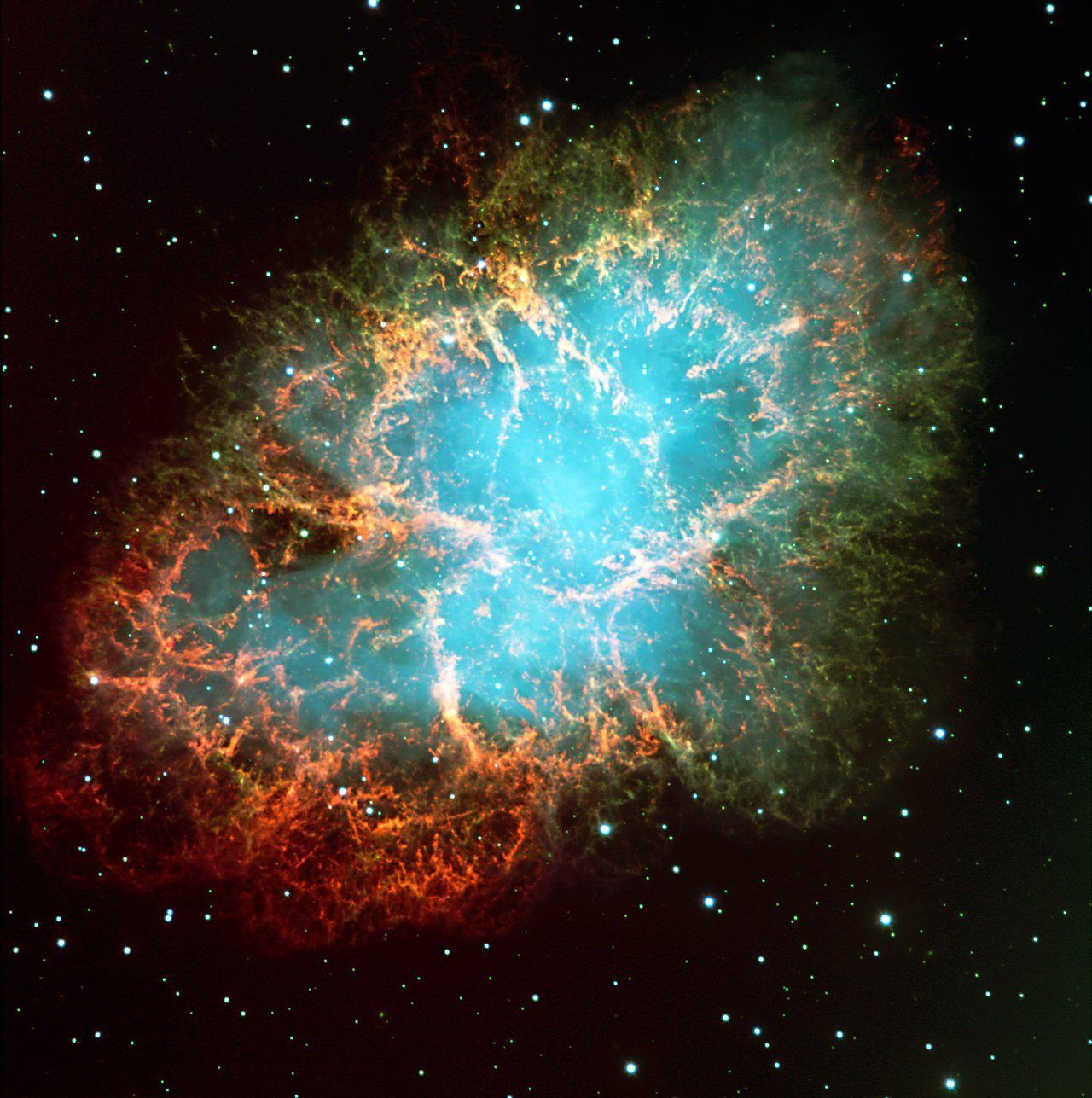
white dwarf mass can overpower the Chandrasekhar limit and become Supernova - 6three part question: What kind of supernova is the crab nebula what is spiralling in the magnetic field what is inside this nebulacore collapse supernova
electron spiralling in magnetic field
neutron star inside - 7how can supernovas occur in binary systemswith white dwarfs
mass from the red giant companion star is attracted by the gravity of the dwarf - 8how can white dwarf stars become supernovas in a binary systemmass of the white dwarf can exceed the Chandrasekhar limit and become a supernova
- 9how can a supernova collapse in on itselfin a binary system a supernova strips companion star of mass. this results in the doubling of the white dwarf supernova mass. if it exceeds 9 solar masses it collapses in on itself
- 10what determines type 1 supernovaewhite dwarf accretion
generally brighter
Carbon and Oxygen available
has a different light curve
nothing survives in type 1 supernovae e.g. no neutron star
constant luminosity - 11What determines a type 2show H spectral lines from super hot outer layers of the red supergiant
have weak H lines
Core collapse = massive stars > 8-10 solar masses
type 2 is 2 magnitudes dimmer than type 1 - 12what are neutron starsthe remains of the core of an exploding massive star
- 13what are the two types of stellar corpseswhite dwarfs and neutron stars
- 14what is the diameter of a neutron star that is 1 solar mass? what would be the gravity and the velocity from the surface30 kilometers (size of metro adelaide)
huge
1/2 the speed of light - 15what are pulsarsevidence of neutron stars
no obvious source
radio pulses have very precise period (time between pulses) - 16what are pulsars associated withexploding stars
- 17What is the white dwarf theorywhite dwarfs can't pulse 30 times per second
can't rotate or vibrate that fast as it would fly apart
need a much smaller object - neutron star theory revived - 18what is the model for neutron star pulsarsnormal stars spin therefore stars have angular momentum
at the end of a star's life, the core may shrink to neutron star
to conserve angular momentum it must spin faster as it shrinks (like an iceskater doing a pirouette) - 19What produces the radiation from a pulsarpulsars have intense magnetic fields
they have roughly the same total magnetic field as the original star but has spread over a surface area of 10 to the 9 times smaller. so the typical field strength is 10 to the 9 GAUSS - 20What is a pulsara large magnetic field with rapid rotation
- 21What is the pulsar modelrotation at tilted angle creates electric currents
natures power generator
if beams are facing earth, there are 2 pulses per rotation
radiation is emitted from magnetic pole regions - 22what does the rapid radiation and intense magnetic field makea huge electric generator
- 23what accelerates the protons and the electrons to high speedsthe intense electric field at the pulsars surface
- 24what do the pulsar beams radiate outprotons
electrons
Gamma Rays - 25what is the synchrotron radiation processprotons and electrons shoot out from the magnetic pole, spiral around the magnetic field lines and radiate energy
- 26what can the synchrotron process produceradio waves
only in young pulsars
visible light
UV light
X-rays - 27what do pulsars do with agethey slow down until eventually they can only produce radion waves
radiation shows due to conservation of energy - 28what is an orbital periodthe period of rotation of the binary system around its centre of mass
- 29what causes a radiation reduction in pulsarswhen a pulsar is eclipsed by another star
- 30Where are x-rays foundin the megallenic clouds
- 31what defines a short orbital periodstars are in close proximity
- 32what can a neutron star with a strong gravitational pull dothey capture gases escaping from their companion
- 33systems like pulsars emit x-rays sincea.) material from companion is funnelled towards the north and south magnetic poles of a neutron star
b.) the gas (travelling at 1/2 the speed of light) hits the surface of a neutron star, heating it to 10 to the 8th Kelvin
c.) heating leads to the emission of x-rays with typical luminosities of 10 to the 31st Watts (10,000 x brighter than sun over all wavelengths) - 34what is the reaction caused by the fusion in the accretion disknuclear detonation
- 35what is an escape velocitythe speed required to escape the gravitational pull of an object
- 36Is it possible to have an escape velocity that exceeds the speed of lightonly if the object is massive enough or if it is packed into a small volume
- 37What happens if a star is so massive that it squashes the neutron starblack hole is formed
- 38What prevents a stars core collapseelectron degeneracy pressure saves white dwarf from imploding
- 39what stops neutron star collapseneutron degeracy pressure
- 40what is hypernovaecaused by even more massive stars, nothing is left behind
although gravity strength is intense the black hole won't form - 41What is the Chandreasekhar limitif core mass is greater, degenerate electron pressure is overcome and we get a neutron star
if core mass is greater than ~ 3 solar masses (i.e. if original star is more massive than 10 solar masses) core can't be supported by neutron degeneracy pressure - 42Can something fight the collapse of a star? What happens to the volume, density and gravity in a stars collapsenothing
zero
infinity
gravity is so intense that the escape velocity exceeds the speed of light
i.e. not even light can escape from the star
A BLACK HOLE - 43what is needed for escape velocity > c (the speed of light)depends on the mass of the star
- 44What is the Schwartzchild radiusRs = 2GM ÷ c2
where G is Newton's gravitational constant. M is mass in kg, c is speed of light
result of general relativity - 45What are Phanerillic black holesthey are small and formed after the big bang
- 46What is the event horizonsphere around the black hole with radius = Rs
within this region the escape velocity is > c and no information can escape from within the Event Horizon
Point of No Return - 47What is a singularitycore collapse continues inside the event horizon producing a region of fine density and zero volume
space and time jumbled
effects cannot escape past it
things are sensible outside event horizon
we need Event horizons to keep the universe sane - 48How do we observe black holesbinary systems + black hole + normal star
if a star appears to wobble back and forth with a period of 5.6 days it is being perturbed by an invisible partner with a mass of 10 solar masses, that's massive enough to be a black hole - 49What is a black hole made ofgravity which creates an accretion disk
- 50What determines the mass of the companion starkeplers law
- 51What do you see if you get close enough to a black holeblack hole invisible
accretion disk visible
Jets visible (if lucky) - 52Where do x-rays come from and how is it createdaccretion disk surrounding black hole
gas captured from companion star orbits black hole forming a 4 million km disk
friction in disk leads to heating of the gas as it spirals towards the black hole
200km above hole, gas is hot enough to emit x-rays (still outside event horizon)
gas eventually swallows black hole - 53What is the new evidence of stellar-mass black holes - gravitational waveswhen 2 black holes are present and merge into one in 0.5 sec :. gravitational waves form and orbits decay. closer = faster orbiting
act like gravitational waves
light encircles black holes - 54What are gravitational waves caused bysymmetric body needs to orbit something near it
- 55When does gravitational strain occurwhen black holes merge
- 56What's the closest black hole to usthe black hole in the centre of the milky way galaxy
- 57what do neutron stats formheavier elements towards the bottom of the periodic table e.g. silver and gold
- 58Why does the Milky way appear so patchy in placesgas blocks out starlight
dust obscures the centre of Gravity
gas giving bias/unclear view of actual amount of stars in milky way seen from earth - 59What are variable starsstars in the late stages of their lives, on a HR diagram between Main sequence and red giants
luminosities change periodically
caused by the instability in the atmosphere of star - stars expand and contract - 60What does a slow wave on the HR diagram indicatemore luminosity due to star size
smallest star has a shorter wave - 61How can you calculate a stars magnitudesif you know a star's period, you can calculate its luminosity or its absolute magnitude
can also measure apparent magnitude m
Knowing m and M can calculate a distance to a star - 62what is the diameter of the galactic disk and what is its thickness75,000 ly
2,000 ly thick - 63How far away is our sun from the galactic centre~ 27,000 ly from centre
Distance unknown - 64What is the galactic nucleus surrounded byspherical distribution of stars, the nuclear bulge is 15,000 ly in diameter
a much larger spherical distribution of globular clusters defines the halo of the galaxy - 65What is our current knowledge of the milky wayFrom a distance disk appears bluish (populated by young hot O, B stars)
Central bulge and globular clusters would appear redder (contain many older, redder stars)
disk has spiral structure
calculated by distances to bright O and B stars
measuring effective distances to giant Hydrogen gas clouds - 66What is the spectral parallax methodas earth orbits, stars move :. we can estimate distance
- 67What is the doppler effectIncrease of decrease in frequency of sound, light or other waves as sources and observer move towards or away from eachother
effect causes sudden change in pitch noticible in a passing siren as well as red shift seen by astronomers - 68What is a doppler shiftcharge in frequency due to the doppler effect
sensitive to H gas - 69where does dark matter existhuge spherical distribution around galaxies perhaps even halos
Observable = 10%
Dark Matter = 90% for all galaxies
Applies for all galaxies - 70What are the characteristics of an OB starShort life span
Very bright
Blue stars attached to spiral arms - 71What is the galactic centreVery dense region in the sagittarius constellation
galactic centre not visible from earth however it is visible to infrared and radio wavelengths - 72What is now thought of Sagittarius AA super-massive black hole
more than a million solar masses
diameter = few light days
super massive black holes seem common in galaxies
strong evidence from the european southern observatory - 73What is general relativitymass causes the warping of space
Light travels in straight lines through warped space, so light appears bent (lensing) - 74What evidence is there of a black hole in our galaxyevidence points to a 3 million solar mass black hole in the Milky Way
Diameter is 1 light day (same size as solar system)
black hole is only explanation thus far
formed when galaxy formed?
luminosity comes from swallowing mass (accretion disk) - 75What is galactic rotationsuggested by spiral structure (if no rotation, stars would fall towards centre of gravity)
- 76How fast does the sun orbit the galactic centreclusters in high eccentric orbit around galactic centre but system in whole in not moving or rotating
:. an average of these random motions is a stationary background - 77What forms starlighthydrogen fusion
- 78What is the Galaxy's rotation curvemass outside orbit does not influence orbit
to determine mass out there, observe orbits, gas clouds further out
construct a rotation curve for the galaxy: orbital velocity as a function of distance from the GC
PROBLEM:
Kepler's 3rd Law, orbital speeds of stars beyond the confines of most of the galaxy's mass should decrease as the distance from GC increases - 79why haven't we seen the edge of the galaxy and the luminous matter yetas stars, glowing gas and dust only account for 1-10% of matter in the galaxy
- 80What are WIMPSWeakly interacting massive particles
non-baryonic
cold dark matter - 81What is a neutrinoproduced in stars and supernovas
little mass
move at speed of light
contribute to dark matter - 82what are the sources of dark matterneutrinos (hot dark matter)
WIMPS (cold dark matter) to be identified
very low mass stars - cold dark matter
Faint planets - cold dark matter
could be subatomic particle - 83what is the difference between hot and cold dark mattercold - slow moving matter
hot - fast moving matter - 84What are MACHOSMAssive Compact Halo Object
populate halo of galaxy
not enough to explain dark matter - 85what are the different types of galaxies and what they might representSpiral galaxies
Barred spiral galaxies
Elliptical galaxies
irregular galaxies
they might represent different evolutionary stages - 86what are giant and dwarf ellipticalsgiant - rare 20 times larger than normal Milky Way galaxies
dwarf - only contain a few million stars
often transparent
look like globular clusters - 87what are rich and poor galactic clustersdepends on number of members
e.g. our cluster is poor :. called the local group
galaxies are normally found in clusters - 88what happens when two galaxies mergeCan become bigger
Damages galaxy spiral arms
gravity makes things collide - 89describe the coma cluster300 MLY from us
Contains 1000 galaxies
Dominated by 2 giant galaxies near centre
contains mostly E and S0 galaxies
disk galaxy
no spiral arms
little free gas - 90describe the virgo clusternearest rich cludter
2500 galaxies
50 MLY away
covers 10º x 12º area of sky
contains spiral galaxies
relatively uncrowded
10º expands :. larger than 24 moons - 91what is the evolution of galaxiesborn spiral type
sometimes galaxies collide and forms an elliptical galaxy
merger trigers star formation using gas and dust
ellipticals are void of free gas with star formation completed long ago
spirals form stars in slow continuous fashion - 92what is hubble's lawdistant galaxies are moving away from us
spectra are redshifted
galaxies have recessional velocity
direct relationship between distance to galaxy and size of redshift
galaxies closer to us move slower
further galaxies move faster - 93why are redshifts difficult to measuredifficult especially for nearby galaxies as they orbit centre of cluster
component of velocity must be subtracted
distance hard to measure
galaxies can orbit on own axis - 94what is a quasarlook like stars but not stars
have enormous redshifts
Hundreds now known
appears bright and distant
luminous
brightness varies in long/short periods
thought to be centre of unusual/powerful galaxies - 95why do large redshifts exista lot to do with expansion of universe
lack of knowledge = we cannot assign distance to distant quasars
light travelled long distance
produced in early life of universe
redshifts used for small things - 96What are Seyfert galaxiesspiral galaxies with bright star-like nuclei and strong, broad emission lines in their spectra
some shine as brightly as dim quasars
matter ejected from nuclei of seyfert galaxies
turbulence = temp of gas - 97what powers active galaxies and wuasarssupermassive black holes power these objects
- 98what is the expanding universecaused by expansion of space
expanding balloon analogy
coins (representing galaxies) glued to balloon
balloon inflates, amount of space between coins increases
according to one coin, all coins move away, distant ones move faster (Hubble's law)
expansion causes light's wavelength to get stretched out (redder) - 99What is the big bang modeluniverse expands
New matter created continuously so universe always looks the same
~ one hydrogen atom per cubic metre per billion years
universe has finite age
age of universe 14 billion years - 100what is the big bang theoryspace expanded from nothingness
a singularity
short time after big bang Planck time (quantum mechanics) jumble resolved
space/time began
expansion of universe
helium abundance
microwave background radiation - 101What do the sun and stars consist of75% hydrogen
24% Helium
1% heavier elements
blackbody (stars) temperature of radiation is near 0º - 102Is the universe evenly distributed and what is the universe filled with on a big enough scaleUniverse is apparently not uniform in distribution of matter
planets, stars, galaxies, clusters and superclusters
on a large scale universe can be filled with superclusters - 103What is homegenity and isotropyhomogeneity - same within all volumes
isotropy - same in all directions (prediction of big bang theory) - 104what is the fate of the universedepends on balance between
a.) expansion of space and gravitational attraction of matter within universe - 105why is it called a flat universebased on Einstein's theory of relativity
presence of mass causes curvature of space-time :. this is how Einstein defined gravity
Masses attract eachother
empty space has curvature
evidence suggests our universe has 0 curvature :. flat
Information
- Description
- Tertiary Astronomy Flashcards on Astronomy Test 2, created by Olivia Gniadek on 24/09/2018.
- Created by
- Olivia Gniadek
- Views
- 2
- Rating