
Flashcards
Additional Biology - Enzymes
Cards in this deck (19)
- 1What are proteins made of?Protein molecules are made up of long chains of amino acids. The long chains are folded to produce specific shapes. The shape of a protein depends on its protein
- 2Proteins can be:. Structural components of tissues, such as muscle
. Hormones
. Antibodies
. Catalysts - 3Enzymes are biological catalysts......they speed up reactions
- 4Enzymes can:. Build large molecules from many smaller ones e.g. building starch from glucose molecules
. Change one molecule into another one e.g. convert one type of sugar into another one
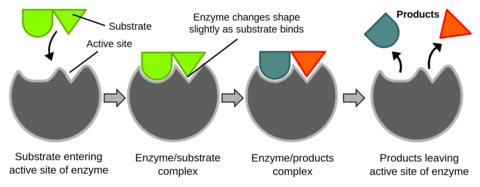
. Break down large molecules into smaller ones e.g. all the digestive enzymes do this. - 5Enzyme diagram
- 6How does temperature affect enzyme action?. Reactions take place faster when it is warmer. At higher temperatures, the molecules move around more quickly and so collide with each other more often, and with more energy.
. If the temperature gets too hot the enzyme stops working because the active site changes shape. We say that the enzyme becomes denatured. - 7How does the pH affect enzyme action?. Each enzyme works best at a particular pH value. Some work best in acid conditions, such as the stomach, but others need neutral or alkaline conditions.
. If the pH is too acidic or alkaline for the enzyme, then the active site could change shape. Then the enzyme becomes denatured. - 8What is meant by the term denatured?Change the shape of an enzyme so that it can no longer speed up the rate of a reaction.
- 9What are the 3 main enzymes in digestion?. Amylase
. Protease
. Lipase - 10AmylaseAmylase is produced by the salivary glands, the pancreas and the small intestine. Amylase catalyses the digestion of starch into sugars in the mouth and small intestine.
- 11ProteaseProtease is produced by the stomach, the pancreas and the small intestine. Protease catalyses the breakdown of proteins into amino acids in the stomach and small intestine.
- 12LipaseLipase is produced by the pancreas and small intestine. Lipase catalyses the breakdown of lipids (fats and oils) to fatty acids and glycerol.
- 13Where do protease enzymes work best?In acidic conditions. Glands in the stomach wall produce hydrochloric acid to create very acidic conditions.
- 14In what conditions do amylase and lipase work best?In the small intestine. They work best when the conditions are slightly alkaline.
- 15Where is bile produced?The liver produces bile that is stored in the gall bladder. The alkaline bile is squirted into the small intestine and neutralises the stomach acid. Bile makes the conditions in the small intestine slightly alkaline.
- 16What is meant by isomerase?An enzyme that converts one form of a molecule into another.
- 17Biological detergentsBiological detergents contain proteases and lipases that digest food stains. They work at lower temperatures than ordinary washing powders. This saves energy and money spent on electricity.
- 18What is Isomerase used for?Isomerase is used to convert glucose syrup into fructose syrup. Fructose is much sweeter, so less is needed in food. The foods, therefore, are not so fattening.
- 19What are carbohydrases used for?They are used to convert starch into sugar syrup for use in foods.
Information
- Description
- GCSE Science Flashcards on Additional Biology - Enzymes, created by Oliviax on 18/04/2015.
- Created by
- Oliviax · Apr 2015
- Updated
- Feb 19, 2016
- Views
- 25
- Tags
- Rating