
Flashcards
Memory
Cards in this deck (25)
- 1CapacitySTM:
Assessed using digit span (Jacobs, 1887), average of 9.3 items and 7.3 for letters
7+-2, (Miller, 1956) review of psychological research, also discovered chunking increases capacity
LTM:
Unlimited - 2Capacity (EVALUATION)1. (Cowan, 2001) May be even more limited, found via review
2. (Simon, 1974) Chunking size matters, the larger the chunk = STM
3. (Jacobs, 1887) Individual difference i.e. age - 3DurationSTM:
Short duration (>18 seconds), disregarding verbal rehearsal. (Lloyd and Peterson, 1959) 24 Students, 8 trials, improvement given retention period
LTM:
Evidence for unlimited, but ambiguous, (Bahrich Et al, 1975) 400 participants with school photos and classmates - 4Duration (Evaluation)1. STM research was artificial, consonant syllables not ecologically valid
2. LTM reserach extremely external since research conducted both field and on real memories - 5CodingSTM:
ACOUSTIC
LTM:
SEMANTIC
(Baddeley, 1966) Used words both acoustically similar and semantically in two groups. Difficulty for the corresponding groups - 6Coding (EVALUATION)1. LTM not exclusive, (Frost, 1972) visual also a category
2. STM not exclusive, (Brandimote, 1992) visual used in coding since rehearsal was prevented therefore visual codes - 7The Multi-Store model of memoryAtkinson & Shiffrin, 1968
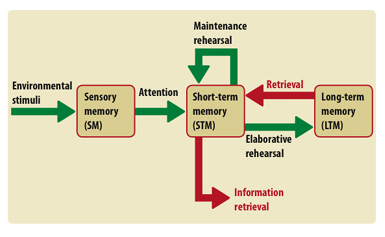
Enables transfer of information between stores
Sensory Register:
Large capacity, short duration (milliseconds)
Given attention, information transfers to STM
STM:
Limited capacity (5 items/chunks) so information decays, limited duration unless rehearsed
Maintenance rehearsal eventually creates LTM
LTM:
Potentially unlimited capacity and duration, forgetting may be due to a lack of accessibility
Retrieval from LTM comes through STM - 8Multi-Store model
- 9The Multi-Store model (EVALUATION)1. Lab Studies therefore high control
2. Case studies, i.e. HM, hippo-campus cut and links to LTM
3. MSM is to simple and states both stores are unitary - 10The Working Memory ModelBaddeley and Hitch, 1974
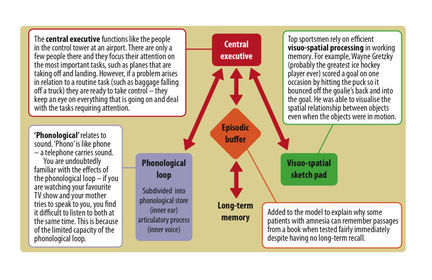
STM isnt one store, but multiple units
Central Executive: acts as attention, allocates tasks to slave system, no storage
Phonological loop: Preserves order of auditory information,
Phonological store holds words
Articulatory process performs maintenance rehearsal
Visuo-Spatial sketchpad: planning and processing visual / spatial tasks
Episodic buffer: Records events as they happen, links to LTM - 11The Working Memory Model
- 12The Working Memory Model (EVALUATION)1. Theory supported by dual tasks, (Hitch and Baddeley, 1976) Participants given two tasks, one to test CE the other AL = slower when 2 involved.
2. Evidence from KF, accident caused damage to STM, PL affected, VSS non-affected = separate units
3. Only involves STM and ignores SM and LTM, not a comprehensive model cannot be applied - 13Types of LTMEpisodic Memories: Personal memories of an event that form a sequence, include details that are contextual and emotional
Semantic Memories: Knowledge shared by everyone which can be abstract or concrete, acquired via episodic
Procedural Memories: Knowing how to do stuff/performing actions, become automatic through repetition and are disrupted by thinking about them - 14Explanation for forgetting: InterferenceWhen two memories disrupt the ability to recall, more likely to occur when the memories are similar
Retroactive interference:
Current attempts to learn something interact with past leaning
(Muller and Pilzecker)
Nonsense syllables (6 mins) then retention, one group intervening task, these perform worse
Proactive Interference:
Past learning interferes with current attempts to learn something
(Underwood)
Analysis of word lists, more lists = worse recall - 15Interference Theory (EVALUATION)1. Research is quite artificial, word lists do not reflect life, lacks external validity
2. Individual differences, those with a greater Working memory, are less susceptible to PI
3. Can only explain some situations, Anderson concluded it does have an effect but to cover all ideas on forgetting is unclear - 16Explanation for forgetting Retrieval FailureDue to the lack of cues or a deficiency so you cannot recall the item
Context-Dependent: Physical state of learning
Abernerthy: Classroom/teacher
State-Dependent: Mental state of learning
Goodwin: Drunk
Encoding Specificity Principle:
Tulving & Thompson
1. Memory is effective when information present at encoding and retrieval
2. Cues do not have to be exact - 17Retrieval Failure (EVALUATION)1. Supporting evidence, done in lab, field and natural which supports therefore valid and reliable
2. Real-world application, ,used to improve recall i.e. Cognitive interview
3. Contradictions like MSM, complex associations, not considering all facts - 18Accuracy of eyewitness testimony Misleading Information (KEY STUDY)Loftus and Palmer, 1974
Experiment 1
45 students shown 7 different traffic accidents, after film given a questionnaire
'About how fast was the car going when they hit each other' - Critical question
Word hit changed: Smashed, Collided, Bumped, Contacted.
Smashed = 40.8
Contacted = 31.8
Experiment 2:
New group, with 1 minute video, return one week later with new question:
'Did you see any broken glass?'
Those who thought the car was travelling faster were more likely to think there was glass - 19Misleading InformationLeading questions suggest the desired answer
Post-event discussion may contaminate eyewitness memory of an event
Conformity effect, participants recollection influenced with other (Gabbert)
Repeat interviewing, especially problamatic with child witnesses (LeRooy) - 20Misleading Information (EVALUATION)1. Supporting evidence in natural setting, (Loftus) Bugs Bunny and Disney, altered recall
2. Majority of research is lab based, therefore inaccurate and unreliable
3. Individual differences, research has shown children are more influenced by interviewers - 21Accuracy of eyewitness testimony Anxiety (KEY STUDY)Johnson and Scott
The view of a weapon in the hand of a criminal diverts attention from important aspects because of anxiety
Asked participants to sit in a waiting room, heard an argument in the next room, man comes running out with either a greasy pen, or a bloody knife. Then asked to identify via photos
Pen = 49%
Knife = 33% - 22AnxietyStress reduces performance on complicated cognitive tasks
Evolutionary argument is adaptive to remember stress-inducing events
Yerkes-Dodson effect explains high accuracy in moderate levels and low for extreme values - 23Anxiety (EVALUATION)1. Weapon focus may not be down the anxiety, Surprise is suggested by Pickel, but natural experiment = little control
2. Real life vs Lab, Christianson and Hubinette
3. Individual differences, some people suffer from neuroticism, anxiety is increased - 24The Cognitive Interview1. Mental reinstatement of original context, physical and psychological, cued recall
2. Report everything, even details that may seem insignificant, may cue recall
3. Change order, reduces the effect of schemas
4. Change perspective, disrupts schemas - 25The Cognitive Interview (EVALUATION)1. Quantity over quality, a lot of information is rendered useless
2. Kohnken et al, analysis of 53 studies, most were lab based and students
3. NOt practical, i.e. costly, time-consuming and inadequate training (Dando and Milne)
Information
- Description
- Flashcards for all topics in Memory
- Created by
- olimcconnell
- Views
- 88
- Tags
- Rating