
Flashcards
Attachment AQA AS
Cards in this deck (41)
- 1AttachmentA strong, long lasting and close emotional bond between two people that causes distress on separation from the attached individual
- 2Schaffer and EmmersonFound that the majority of babies become attached to their mother first, possibly because infants spend more time with their mother
- 3Stages of attachment1. Pre-attachment (birth- 3 months). Babies prefer people to objects.
2. Indiscriminate attachment (2- 8 months). Let strangers hold them.
3. Discriminate attachment (7 months+). Distress at seperation and stranger anxiety.
4. Multiple attachments (9 months+)- Strong emotional ties with other caregivers. - 4LambFound that if fathers spend more time with infants, it does not enhance the attachment
- 5Men forming intense attachmentsMen are not psychologically equipped to form an intense attachment because they lack the sensitivity of women, either because of biological or social needs
- 6OestrogenUnderlies caring behaviour so women are generally more oriented towards caring than men
- 7FathersPlay an important role as secondary attachment figures. They are more playful, active and better at providing challenging situations for children
- 8Men as single parentsMen do form secure attachments in the case of single parents or when both parents share the role of a primary attachment figure
- 9ReciprocityResponding to an action of another person with a similar reaction
- 10Interactional synchronyReferring to the fact that when two people interact, they tend to mirror what the other is doing in terms of facial and body movements. It includes imitating emotions and behaviours
- 11CuddlingMothers who cuddled their babies in a critical period after birth enjoyed better relationships with their child than those who did not
- 12SensitivityMothers are more sensitive to their babies- those that were more sensitive respond more quickly to their crying
- 13MovementBabies move in time with rhythm of conversation and caregiver and baby engage in subtle turn taking
- 14CaregivereseAdults modify their speech when talking to their babies. It is a higher pitched, sing songy and slower
- 15Schaffer and Emmerson studyStudy of 80 babies in Glasgow. 50% showed separation anxiety between 25-32 weeks. By 40 weeks, 80% had specific attachments and 30% had multiple attachments
- 16Klaus and KennellMothers who cuddled their babies in a critical period experienced better relationships with their child
- 17Lamb studyChildren prefer interacting with fathers when in a positive mood. Vice versa for mothers
- 18HardyFathers are less able to detect low levels of infant distress
- 19GeigerFather's play interactions are more pleasurable but a mother's are more nurturing
- 20LorenzTook a clutch of goose eggs and divided them into 2 groups. The goslings followed either the mother or Lorenz depending on who they saw first. This imprinting is irreversible and long lasting and has a later effect on mate preference
- 21HarlowRhesus monkeys preferred cloth mother for comfort. When they grew up, they were socially and sexually abnormal
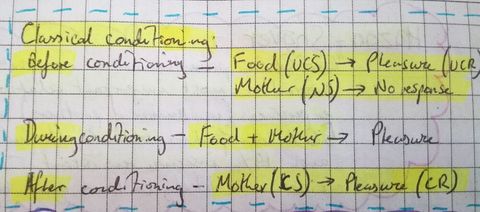
- 22Learning theoryProposes that all behaviour is learned through classical or operant conditioning
- 23Classical Conditioning
- 24Operant Conditioningbabies cry for comfort- a response is given so it becomes a pleasant consequence
- 25Behaviourists and AttachmentSee attachment as a secondary drive as babies have a primary drive of hunger which is satisfied by the mother
- 26MonotropyInfants have one special emotional bond but can also form many secondary attachments
- 27Consequences of monotropyDevelopment of the internal working model later in adulthood
- 28Continuity hypothesisProposes that individuals who are strongly attached in infancy continue to be socially and emotionally competent
- 29Consequences of the internal working modelShort term- insight into the caregiver's behaviour and enables the child to influence this behaviour.
Long term- Acts as a template for future relationships. - 30Internal working model in parentingAffect the child's ability to parent their own children as people tend to base their parenting style on their own internal working model so attachment types are passed on in families
- 31Secure attachmentCharacterised by harmonious and cooperative interactions.
- 32Insecure avoidant attachmentShows the infant avoiding social situations and intimacy with others
- 33Insecure resistant attachmentInfants resist intimacy and social interactions
- 34BowlbyAttachments evolve to serve a biological function of protection of the infant. There should be little cultural variations
- 35Short Term Seperation- Protest
- Despair
-Detachment - 36Effects of Institutionalisation-Physical underdevelopment
-Intellectual underfunctioning
-Disinhibited attachment
-Poor parenting - 37Hazan and Shaver"Love Quiz" on current or most important relationships. Measured their attachment type. Those with secure attachments were most likely to have good and longer lasting relationships
- 38Ainsworth"Strange Situation" of 8 episodes to measure attachment types.
1. Parent and infant play
2. Parent passive
3. Stranger enters
4. Parent leaves. Stranger comforts
5. Parent returns, stranger leaves
6. Parent leaves. Child alone
7. Stranger enters
8. Parent returns - 39Van Ijzendoom and Kroonenberg32 studies of attachment behaviours in 8 countries. Wide variation. Secure attachment was most common but varied from 75% in Britain to 50% in China. Insecure resistant was least common, ranging from 3% in Britain to 30% in Israel
- 4044 Juvenile Thieves44 thieves studied, 44 as a control. Half of the thieves were "Affectionless psychopaths". 86% of the affectionless psychopaths suffered from early maternal separation compared to 17% of the other thieves and 0% of the control group
- 41Romanian Orphans165 Romanian orphans adopted in Britain. Physical, cognitive and emotional development was assessed at ages 4, 6, 11 and 15. Those adopted after 6 months of age showed disinhibited attachments directed indiscriminately towards all adults
Information
- Description
- A level Psychology (Attachment) Flashcards on Attachment AQA AS, created by Ewa Klonowicz on 18/03/2017.
- Created by
- Ewa Klonowicz
- Views
- 5
- Rating