
Flashcards
Sports Psychology
Cards in this deck (72)
- 1AbilitiesSkills and qualities which make it possible for you to achieve a task. These are stable and enduring characteristics which can be genetic.
- 2SkillsA skill is the combined ability and knowledge which allow you to complete a task to a high standard.
- 3Gross/Fine Continuum Skill> Fine : small movements, with small muscular contractions, e.g, as in an archery shot.
> Gross : large muscular contractions, dynamic movements, e.g, as during a butterfly swimming race - 4Discrete/ Serial/ Continuous Continuum Skill>Continuous: where movement repeats over and over, (cycling)
>Serial: where there are distinct parts within a movement ( Triple jump)
>Discrete: where there is a definite beginning and end. ( Diving) - 5Open/Closed Continuum SkillOpen: directly effected by the environment. (footballer choosing the correct pass based on the number of defenders closing down the space in front of them)
Closed: not directly effected by environment. skill is performed the same way every time (e.g throwing a javelin) - 6Internally (Self) Paced/ Externally Paced Continuum SkillSelf paced movements are controlled by the performer. They will decide the rate.
Externally paced skills are controlled by other players or factors - 7Fixed practiceThese are sometimes also known as drills and involves repeatedly practicing a whole skill in order to strengthen the motor programme. This type of practice is best with discrete, closed skills
- 8Massed practiceThis is a continuous form of practice which is best for simple skills. An example would be a rally in badminton where the learner must repeatedly perform drop shots. This causes fatigue and therefore simulates the late stages of a game
- 9Variable practiceThis is used best for open skills and involves repeating a skill in varying situations. For example shooting practice in football, where the coach may set up drills and alter the starting position and involvement of defenders. This helps to build up schema to use in game situations
- 10Distributed practiceAttempts at the skill are divided up with intervals in between to allow for rest and mental rehearsal. This is best used in difficult, dangerous or fatiguing skills and with young or lowly motivated individuals
- 11Whole methodThe skill is first demonstrated and then practiced as a whole. It helps the learner to get a feel for skill, timings and end product. Used for fast skills which cannot easily be separated into sub-parts, such as a javelin throw. It is unsuitable for people with low attention spans, complex or dangerous skills.
- 12Part methodParts of skill are practiced in isolation which is useful for complicated and serial skills often good for maintaining motivation and focusing on specific elements of the skill. It is possible, that the transfer of the skills from parts, to a whole may not be effective and it may also reduce the kinaesthetic awareness (feel) for the full skill.
- 13Whole-part-whole methodWhole skill is demonstrated and practiced, before being broken down into sub-routines (then put back together) effective in skills which have sub-parts, where the whole skill together is complex. Gives performer a feel before they break it down and improve on the weak aspects of the performance
- 14Progressive part method"Chaining method", parts of a skill are practiced individually, before being linked together and expanded. This is slow process but allows weaknesses to be targeted and for the performer to understand the relationship of the sub-routines.
- 15Positive TransferWhen two skills are similar in some way. Having already mastered one of the skills, makes learning the second skill easier. Sure the individual know similarities between them and by making sure that the basics of the first skill are well learnt so that they transfer easily into the second skill. e.g serve in tennis to volleyball
- 16Negative TransferHaving learnt one skill, makes learning the second skill more difficult. This more often happens when a stimulus common to both skills requires a different response. Can be avoided by making sure the athlete is aware of the differences. Squash player and tennis
- 17Proactive TransferA skill learnt in the past affects a skill currently being learnt or to be learnt in the future
- 18Retroactive TransferLearning a new skill affects a previously learned skill.
- 19Bilateral TransferWhere the learning of one skill is transferred from one limb to the other e.g. a footballer learning to pass with their left foot when they have previously learned this skill with their right foot.
- 20Zero TransferWhere there are no transferable elements between previously learned skills and the new one about to be learned e.g. bowling in cricket and skipping.
- 21Operant ConditioningAn individual changes its behavior because of the consequences (results) of the behavior. The person or animal learns its behavior has a consequence. That consequence may be. Reinforcement: a positive or rewarding event.
- 22Trial and Error LearningA method of problem solving. It is characterised by repeated, varied attempts which are continued until success, or until the agent stops trying.
- 23S-R Bondsstimulus-response (SR) connections helps strengthen them and reinforce the correct skill
- 24Thorndike's Law> Law of exercise (skill repeated)
> Law of effect ( Skill to be repeated if successful )
> Law of readiness ( physically and mentally able complete task well) - 25Cognitive/ Insight LearningAlso known as the Gelstalt theory, the performer needs to understand the whole problem before performing the skill correctly. They base their response on their previous experiences and the current situation. Perceptual ability is used to decide on the response based on their skill level and the task at hand.
- 26Observational Learning Developed by Bandura, observational learning states that performers learn new skills by observing others." Attention "- Performers need to watch a suitable demonstration of the skill
"Retention" - Creating the mental picture of the skill require
"Motor Production - The physical movement to perform the skill
"Motivation" - The learners need, want or desire to replicate the skilled action. - 27Cognitive Stage of learningPerformances are inconsistent and not success is not guaranteed. Performing the skill requires all of the athletes attention and so they rely on the coach for cues. This is a process of trial and error with a success rate of 2 or 3 out of 10 attempts. Correct performances must be reinforced through external feedback.
- 28Associative Stage of learningAlso known as the "practice phase". Performances are becoming more consistent as motor programmed are being formed. While the simpler parts of the skill now look fluent and are well learned, the more complex elements requires most of the spare attention. The athlete is starting to get a sense of internal 'kinaesthetic'
- 29Autonomous Stage of learningIn the final stage of learning, performances have become consistent, fluid and aesthetically pleasing. The motor programmers are involved are well learned and stored in the long-term memory. There is now spare attention which can be focused on opponents and tactics.
- 30Intrinsic feedbackThis comes from within the athlete, during the performance. The feeling that a tennis shot was good or that a distance runner has 'plenty left in the tank' are examples of intrinsic feedback
- 31Extrinsic feedbackThis occurs after the performance from someone other than the athlete, usually a coach or family/friends. It is sometimes also called augmented feedback. Extrinsic feedback can be subdivided into:
Knowledge of results (KR) - Feedback on the consequences of a performance - e.g. the score/winning/loosing
Knowledge of performance (KP) - Feedback about the way the skill was performed - e.g. video analysis - 32Terminal FeedbackFeedback given at the end of a performance. Often this type is best used on beginners so that they do not have to split their attention between performing and listening to instruction
- 33Augmented feedbackFeedback from other source e.g video tape or coach
- 34Positive FeedbackOften praise or positive comments
- 35Negative FeedbackForm of criticism and may concentrate on poor aspects
- 36Visual Guidancea demonstration to help guide the performer to form a mental picture and reproduce the movement. The demonstration, or model, must be as perfect as possible and must be realistic. Forms of demonstration other than live models can be used, for example photos, diagrams (although very static) and video.
- 37Verbal GuidanceThe teacher provides cues for the athlete to remind them of parts of the skill, for example, saying "keep your eyes on the ball" to a batter, just before a ball is bowled in rounders. It is important to consider, when using verbal guidance, if the performer understands what is being said, if they can remember the information being given and if they can translate this into an action.
- 38Manual GuidanceCan come from another person or an object to help the performer learn a movement whilst building confidence and getting a sense of how it should feel. Examples of guidance are a teacher moving a students arms through the required motion for a tennis shot, and using armbands or a float when learning to swim. The kind of guidance where the teacher guides the student through a movement is known as forced response
- 39Effects of arousal1) Drive Theory: Drive theory states that the more arousal and anxiety an individual experiences, the higher their performance.
2) Inverted U Hypothesis: This theory posits that their is a medium amount of arousal and anxiety that causes one to perform higher - too little anxiety/arousal and too much anxiety/arousal will cause performance to be poorer.
3) Catastrophe Model: The catastrophe model posits that as long as there are lower thoughts of anxiety, then performance will be best at a medium level of physical arousal. If there is a high level of anxious thoughts (worry), performance will be better at a medium level of physical arousal but will suddenly drop off and become very poor. There is a breaking point. - 40Type A personalityType A personality generally lives at a higher stress level. This is driven by
> They enjoy achievement of goals, with greater enjoyment in achieving of more difficult goals. They are thus constantly working hard to achieve these.
> They find it difficult to stop, even when they have achieved goals.
> They feel the pressure of time, constantly working flat out.
>They are highly competitive and will, if necessary create competition.
>They hate failure and will work hard to avoid it - 41Type B personalityThe Type B personality generally lives at a lower stress level and are typically:
> They work steadily, enjoying achievements but not becoming stressed when they are not achieved.
> When faced with competition, they do not mind losing and either enjoy the game or back down.
> They may be creative and enjoy exploring ideas and concepts.
> They are often reflective, thinking about the outer and inner worlds. - 42Stable Personality• Display predictable emotions in appropriate situations
• Their moods are predictable
• They tend not to experience intense stress
• Their recovery from stress is rapid - 43Unstable/ Neurotic Personality• Display extreme and unpredictable emotions in the form of mood swings
• Their moods are unreliable
• They experience high degrees of stress
• Their recovery from stress is slow - 44Extroversion Personality• Affiliate well to other people
• Outgoing, gregarious and sociable
• Become aroused more slowly than introverts
• There is low sensitivity of the reticular activating system (RAS) - 45Introversion Personality• Tend to be shy and reserved
• Prefer isolation from others
• Become aroused more quickly than extroverts
• There is high sensitivity of the reticular activating system (RAS) - 46Social learning perspectiveSocial learning theory, in direct contrast to trait theory, proposes that all behaviour is learned.
Learning occurs by way of environmental
experiences and through the influence of otherpeople. Personality is, therefore, not genetically programmed.
Social learning theory is depicted as:
Behaviour = Function of Environment (B = F(E)) - 47Social learning theoryThe social learning approach was presented by the psychologist Bandura. He believed learning was stimulated by environmental experiences. Two processes are involved in social learning:
• the behaviour of others being imitated through observation
• new behaviour being acquired after
observation, but only when it is endorsed
through social reinforcement. - 48Narrow Band Theory Girdano was another trait theorist. He proposed that there are two distinct personality types – Type A and Type B.Type A characteristics Type B characteristics
Highly competitive Non-competitive
Works fast Works more slowly desire to succeed
Lacking in desire to
succeed
Likes control Does not enjoy
control
Prone to suffer stress Less prone to stress - 49Interactionist approachB = F (P.E)
Behaviour is the Function of Personality and Environment
1. Psychological core
This is the most internal of the personality
levels and is thought to be the true self.
2. Typical responses
Typical responses are changeable and are
learned behaviours. They become modified
as the person responds to environmental
situations.
3. Role-related behaviour
This is the most external of the personality
levels. It is therefore the level that is dynamic and changeable. An individual may have to adjust in order to fulfil many different roles inone day - 50Attitudes DefinitionA mental state of readiness organised through
experiences that influences the response of an
individual towards any object or situation with
which it is related.’ - 51The triadic model of attitude (components of attitudes)1. Cognitive component
This component reflects beliefs and knowledge that an individual holds about the attitude object. For example, a person may know that jogging three times a week is beneficial.
2 Affective component
This consists of feelings or an emotional response toward an attitude object. It is here that an evaluation of an attitude object is made. For
example, jogging is a pleasurable activity.
3 Behavioural component
This concerns how a person intends to behave or respond towards an attitude object. For example, the individual will continue to jog three times in the week. - 52Cognitive dissonance theoryThis theory was described by a psychologist
named Festinger and states that if two attitude components can be made to oppose or comeinto conflict with each other, then the individual experiences emotional discomfort. This emotional discomfort is called dissonance. - 53Persuasive communication theory Persuasive communication could be applied within cognitive dissonance as an additional technique in changing attitude. It is highlighted here as a separate theory. There are four elements to Persuasive Communication Theory.1 Persuader
This person needs to be one who is perceived to be significant and to have high status, for example the swimming instructor.
2 Message
The message needs to be presented in a way
that makes the recipient want to change an
attitude, for example learning to swim will
enhance the possibility of a balanced, active
and healthy lifestyle.
3 Recipients
The attitude is more easily changed if the
recipient really wishes to be changed, for
example the student understands the task and realises the benefits of learning to swim.
4 Situation
Attitudes are easier to change if there are other persuaders present, for example other students help the persuasion by emphasising the social and physical benefits of swimming. - 54Intrinsic motivation This is motivation from within. A desire to perform well and succeedRehearsal of successful habits until they are perfect . A feeling of pride and enjoyment in performing the skill. Repeated goal setting in order to progress and maintain motivation
Goals must be all of the following in order to be attainable:
-Smart
-Measurable
-Agreed
-Realistic
-Time related
-Exciting
-Recorded - 55Extrinsic motivationExtrinsic motivation comes from a source outside of the performer. These are things which can encourage the athlete to perform and fall into two groups:
- 56Drive TheoryAn increase in arousal is proportional to an increase in the quality of performance.
The quality of performance depends on how well the skill has been learned.
Criticisms
Together with an observation of real life situations and extensive research high class athletes have been seen to fail in high arousal situations. High class athletes are supposed to have grooved skills and therefore perform well in highly aroused states. Therefore, this approach has lost credibility. - 57Inverted U LawIndicates or predicts that as arousal increase so does the quality of performance. However, quality improves up to a point, midway on the axis. This is called the optimum point.If arousal occurs beyond the optimum point the performer becomes over-aroused and the capacity both to learn or perform a motor skill are deteriorated
- 58Catastrophe TheoryPoint A This is the optimum point is the cognitive arousal can be maintained. If high cognitive arousal occurs with high somatic arousal you can tip over the edge. Point B
Point B the performance drops dramatically ‘performer has a catastrophe’. - 59State anxiety Trait anxietyThe athletes emotional state at any given time - variable from situation to situation
An athletes disposition to interpreting a situation as threatening and responding with an increase in state anxiety - 60Controlling anxietyCognitive
Imagery
Mental rehearsal
Stress management
Somatic
Biofeedback
Centring
Breathing control
Muscle relaxation - 61Goal settingSpecific - make them as precise and detailed as possible
Measurable - a method by which you can quantify or rate your current position and then determine the amount of improvement required
Accepted - goals need to be shared and negotiated with all others involved
Realistic - the goal is realistic yet challenging
Time phased - date is set for when the goal is to be achieved by
Exciting - goal motivates the individual
Recorded - the goal and progress towards it are recorded - 62INSTINCT THEORY (TRAIT PERSPECTIVE)- ‘Aggression is genetically inherited
and that trait of violence lies within everyone
due to a basic instinct to dominate.’
- ‘Death instinct’ (FREUD)
- ‘Aggressive energy is constantly building
up and needs to be released’ (LORENZ) - 63SOCIAL LEARNING THEORYAggression is not biologically based
but is nurtured through environmental forces.
Learned by watching and copying
role models and it becomes an
excepted mode of behaviour if reinforced - 64AGGRESSION CUE HYPOTHESISFrustration leads to an increase in arousal which, in some situations will result in aggression.
Cues = baseball bats, violent acts being witnessed, nature of the game will trigger aggression if arousal is high.
Best players have the ability/temperament
to control frustration and arousal - 65SOCIAL FACILITATION: SOCIAL INHIBITION:The presence of an audience positively increases arousal levels and performance is enhanced.
A negative effect on performance is experienced due to the attendance of an audience - 66Strategies to Combat Social Inhibition:> Practice selective attention.
>Use imagery, mental rehearsal to block out audience effects.
>Ensure essential skills are over-learned and grooved.
>Introduce evaluative others into practice.
>Raise athletes’ awareness of the zone of optimal functioning.
> Incorporate stress management into training.
> Appropriate use of attribution - 67Groups Group CohesionGroups are those social aggregates that involve mutual awareness and the potential for interaction
The extent to which a group sticks together in pursuit of a common goal - 68Steiner’s ModelForming
The forming stage is where team members first meet and they familiarise themselves with other team mates
Storming
This stage is categorised by resistance to the leader and their rules they have implemented within the environment. This resistance occurs when team rules are made
Norming
ndividuals work together toward common goals and group cohesion is increased as members pull together
Performing
The role within the team are well defined. - 69Faulty ProcessesA co-ordination loss that leads to a breakdown in team work is called the RINGLEMANN EFFECT. Problems with team co-ordination are more likely to increase as the number of team members increase.
A motivation loss that leads to a reduction in effort is called SOCIAL LOAFING. This is called when an individuals efforts go unnoticed or when someone feels like the others on their team are not trying hard enough. People with low SC tend to be loafers. - 70SELF EFFICACY THEORY (Bandura)1 Performance accomplishments - What you have done before
2 Vicarious experience -Seeing others do it
3 Verbal persuasion - Encouragement
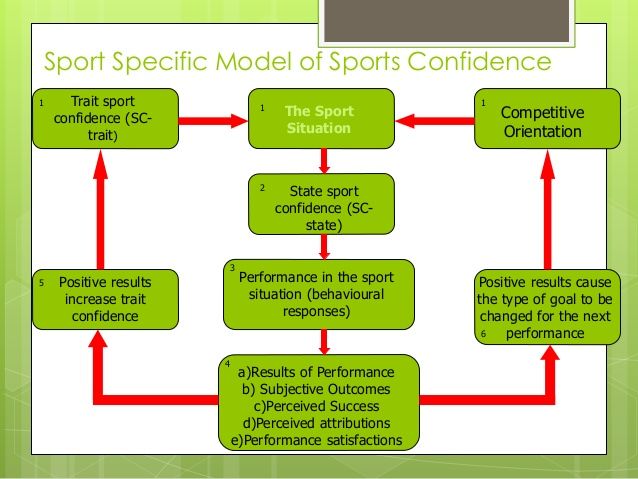
4 Emotional arousal - Your level of anxiety - 71Trait confidence State confidenceIs innate confidence shown in most situations
Is situation specific, e.g. taking a penalty - 72Veleays models of self efficacy
Information
- Description
- A level Physical Education (PE) Flashcards on Sports Psychology, created by Nathan Young on 22/05/2017.
- Created by
- Nathan Young
- Views
- 10
- Rating