Flashcards
Adaptive Immunity II
Cards in this deck (36)
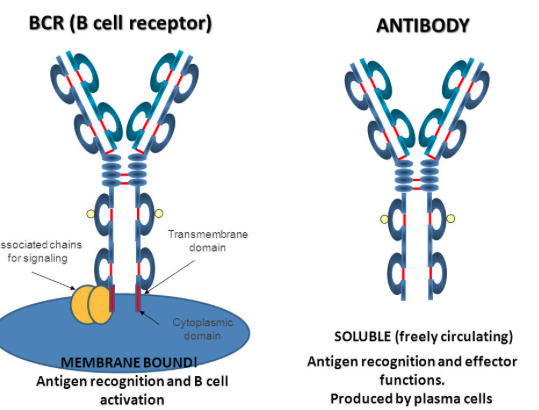
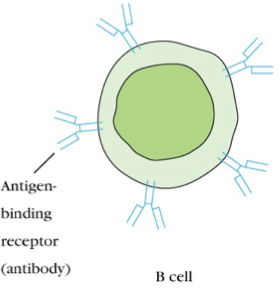
- 1B CELLSSurface receptor = Immunoglobulin (Ig)
Humoral Immunity - 2B CELLSInvolved in ANTIBODY PRODUCTION
in addition to MANY other roles (see figure below)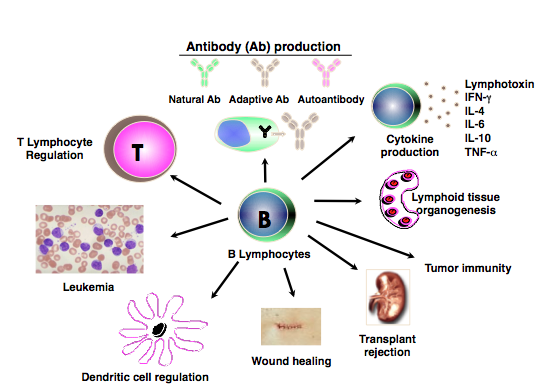
- 3B CELL RECEPTOR Antibody and T cell Receptor (as comparison) STRUCTURES-Constant region: Fc portion (bottom part) -determines the function that antibodies exert
-Variable region: Fab portion, antigen binding site, responsible for diversity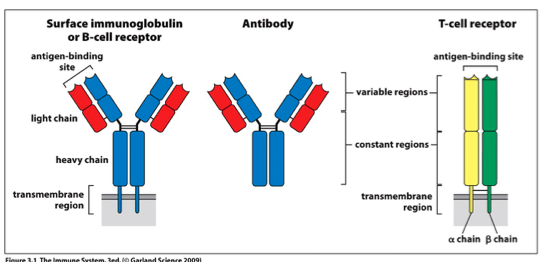
- 4B CELLS are made and MATURE in the BONE MARROWIf it reacts with self-antigen it gets "STUCK" and is retained in the bone marrow
-if it doesn't react with self-antigen, then it can move out of the bone marrow to the blood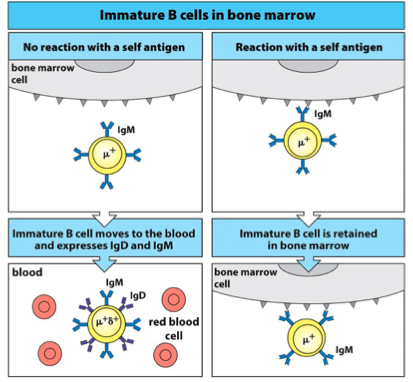
- 5Allelic Exclusionsuccessful rearrangement of 1 allele excludes rearrangement of the other allele
The cell “knows” when it has done an unproductive rearrangement and vice versa (gets 2 chances)!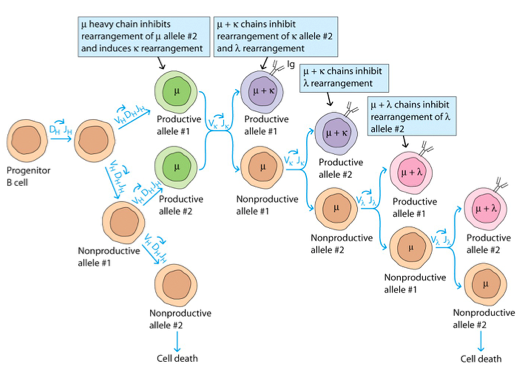
- 6—-In the bone marrow, the immature B cell starts with IgM (the pentamer - "snow-flake")
-in the 2° lymphoid organs and circulation: go from IgM to IgM and IgD (rearrangement) -only ONE will be functional however!
-then class switching occurs SWAP out the heavy chains (Fc region) depending on function needed (specificity - the Fab portion or "arms" stays the SAME)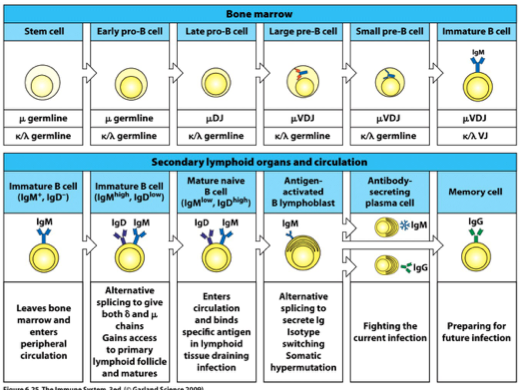
- 7B1 and B2 CELLSB1 cells: 1st produced when fetus,
makes non-specific antibody (general passive immunity) MORE IgM, self-renewing, no memory, no somatic hypermutation
B2 cells: !st produced AFTER birth, replaced from bone marrow, MORE IgG, YES for MEMORY and Somatic Hypermutation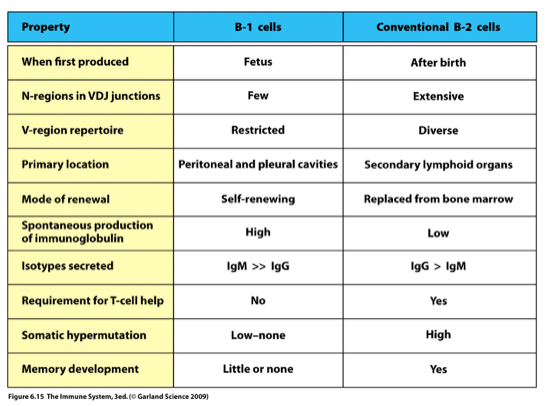
- 8CLASSES (ISOTYPES) OF IMMUNOGLOBULINS Heavy chain ClassificationClasses based on constant region (Fc portion ) of heavy chains:
Immunoglobulin M (IgM)
Immunoglobulin D (IgD)
Immunoglobulin G (IgG)
Immunoglobulin E (IgE)
Immunoglobulin A (IgA)
"My Dog Gracie Eats Apples"
Differentiation of heavy chains:
Length of C region,
location of disulfide bonds,
hinge region,
distribution of carbohydrate
For heavy chains, classes have DIFFERENT EFFECTOR functions! - 9CLASSES (ISOTYPES) OF IMMUNOGLOBULINS ADDITIONAL CLASSIFICATION (light chains)Additional classification based on light chains:
Kappa
Lambda
Each IG has either kappa or lambda,
NOT BOTH:
IgG kappa
OR
IgG lambda
*NO functional differences b/w light chains - 10IgG-70-75% of total immunoglobulin
Secreted in high quantities in secondary exposures (2°)
Can cross the placenta (passive immunity ~6 months)
Major functions / applications (essentially ALL effector functions!)
-neutralize microbes and toxins
-opsonize antigens for phagocytosis
-activate the complement
-protect newborns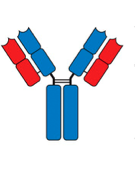
- 11IgMSecreted initially during primary infection (FIRST - 1°)
CANNOT cross the placenta
Major functions / applications:
secreted first during 1° exposure
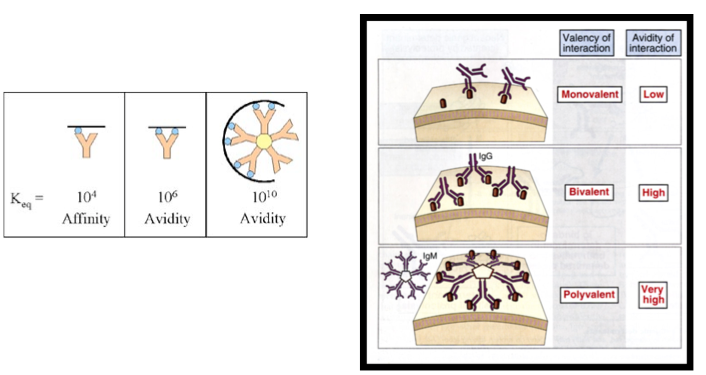
activates the complement (most POTENT activator of complement because HIGH AVIDITY - low affinity)
used as a biomarker of recent infection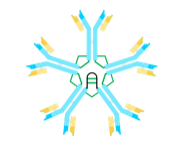
- 12IgAMONOMERIC in SERUM (SINGLE Y shape)
DIMERIC w/J chain in the LUMEN of the gastro-intestinal tract and in the respiratory tract (MUCOSAL IMMUNITY)
Major function / application:
-neutralizes microbes and toxins
-component in breast milk (protect intestinal tract of breast-fed infants)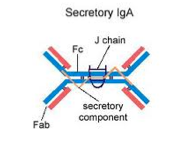
- 13IgDMONOMERIC
Major functions / applications:
present on the surface of B lymphocytes
functions as membrane receptor (along w/IgM)
ROLE UNCLEAR
has a role in antigen stimulated B cell differentiation - 14IgE SAY Ig "E" AllerGIEEES!MONOMERIC
Mediates TYPE I hypersensitivity “ALLERGIES”
Major functions / applications:
-associated with anaphylaxis
-plays a role in immunity to helminthic parasites - 15BURNET'S CLONAL SELECTION THEORY-Each lymphocyte produces ONE type of ANTIGEN (Ag) receptors ONLY
-antigen selects and stimulates cells carrying receptors SPECIFIC for that ANTIGEN
-once SPECIFICALLY SELECTED: B cells will clonally EXPAND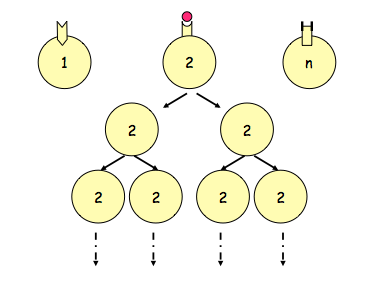
- 16—ALWAYS end up HIGHER than when you started (1° exposure)
HIGHER SET POINT
-SAME principle in T cells!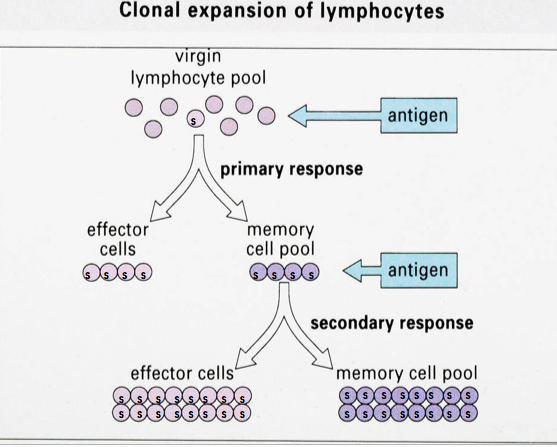
- 17GENERATION OF ANTIBODY DIVERSITYThe big question: How do you get all those different antibodies?
Two other big questions- getting different classes with the same variable regions, and getting secreted and membrane-bound forms of the same class
Answer: GENE REARRANGMENT : Think about the CHAIRS in a ROW example! - 18GENERATION OF ANTIBODY DIVERSITY OVWERVIEW: THE BIG PICTUREDIVERSITY produced by combining a number of VARIABLE REGIONS with at least one joining region, plus the constant regions.
Diversity is increased by the total number of possible rearrangements.
The regions in between are deleted.
Both light and heavy chains variable regions involved.
We have multiples of multiples resulting in millions of combinations from ~245 gene segments. - 19Both light and heavy chains variable regions involved in gene rearrangement!Light chains/VARIABLE (Fab) Regions-top arms of antibody: responsible for DIVERSITY of antibodies, but once it is made from GERM-LINE code, it remains the SAME
Heavy chains/CONSTANT (Fc) Regions-bottom of antibody: are responsible for the effector function of the different Ig Classes (Fc CHANGES) - 20ANTIBODY CLASS SWITCHINGOccurs within ONE B cell and is TIGHTLY CONTROLLED
-CONSTANT region determines CLASS/TYPE of antibody it is (the heavy chain)
CHAIR EX: CUT OUT pieces of DNA in order to express DIFFERENT Ig's BUT you CANNOT go back to the previous Ig's
My (Cμ) Dog (Cδ ) Gracie (Cγ) Eats (Cε) Apples (Cα)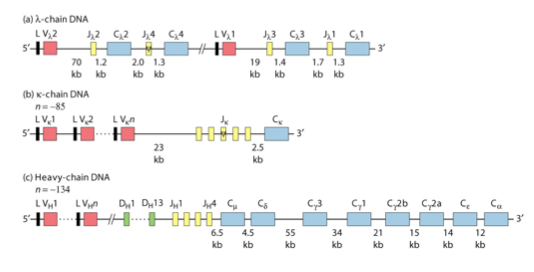
- 21SEQUENTIAL IgM-IgG HUMORAL RESPONSEIgM : produced as a first response to many antigens
levels remain high transiently (SHORT half-lives)
IgG: produced AFTER IgM
higher levels persist in small amounts throughout life (LONG half life)
-produced in large amounts during secondary (2°) response
-persistence of antigen sensitive ‘memory cells’ after primary response - 22IgM – IgG SEQUENTIAL RESPONSE1° response: IgM ONLY (have NOT class switched yet)
2° response: class switching has occurred so now there are LARGE amounts of IgG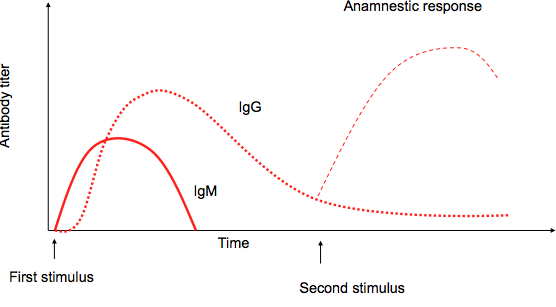
- 23SOMATIC HYPERMUTATIONProcess by which the rearranged gene will be mutated to be BETTER over time
It can: Have No Effect
Make it BETTER
Make it WORSE
As this process occurs in activated b cells, the rate limiting factor is ANTIGEN RECOGNITION.
They can DIE if they don’t see antigens.
But the mutations that enter that make the antibody function better, or bind the target better, bind better and make the B Cell live.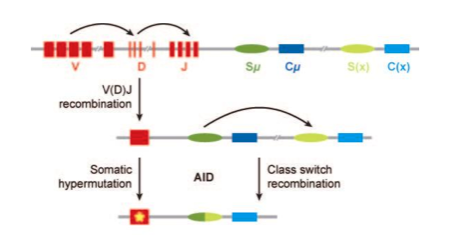
- 24SUMMARY OF Ig's
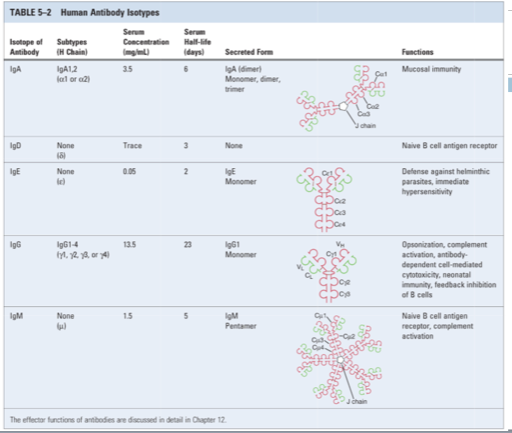
- 25ANTIBODY SPECIFICITYAntibodies that RECOGNIZE the Measles virus will NOT RECOGNIZE the Influenza virus
VERY SPECIFIC !!!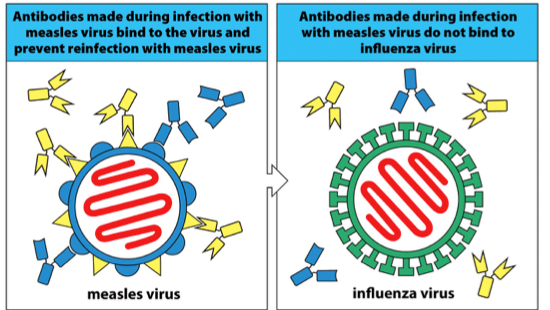
- 26ANTIGEN : ANTIBODY INTERACTIONSANTIGENS: Any substance which provokes an adaptive immune response
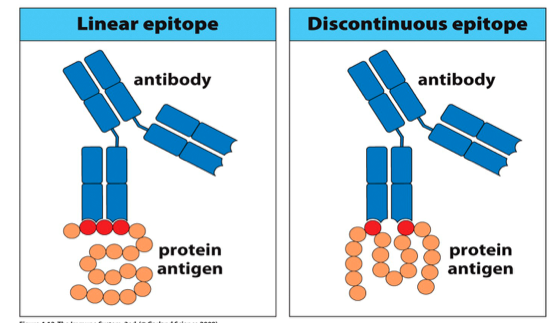
EPITOPES: Site on an antigen recognized by an antibody (small red portion in figure)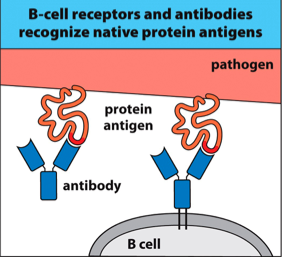
- 27EPITOPE RECOGNITION BY ANTIBODIESA single antigen can have repeating epitopes that are the SAME (on right) OR a single antigen can have many DIFFERENT epitopes (on left)
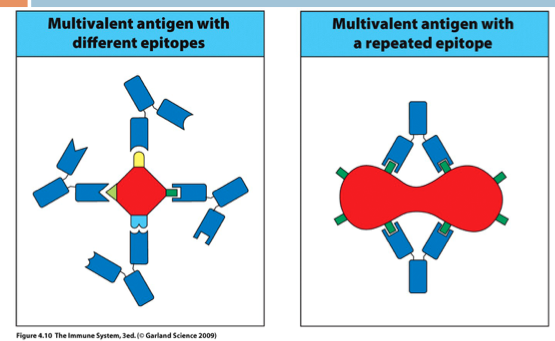
- 28EPITOPE TYPES Linear vs. Discontinuous
- 29ANTIBODY BINDING STRENGTH AFFINITY vs. AVIDITYAffinity:
the strength of the reaction between a SINGLE antigenic determinant and a single combining site on the antibody
Avidity:
a measure of the overall STRENGTH of binding of an antigen with MANY antigenic determinants and multivalent antibodies - 30ANTIBODY BINDING STRENGTH AFFINITY vs. AVIDITY -higher avidity = less class switching
- 31B CELLS IN MEDICINEWhat happens when development goes wrong?
What if you can’t turn off cellular proliferation?
B CELLS CAN CAUSE CANCER!
Therapies targeting B cells or antibodies
Rituximab
Belimumab
Omalizumab - 32DRUGS SUFFIX MEANINGS-MAB: means it is a Monoclonal AntiBody
-VIR: means it is an antiVIRal drug - 33Therapies targeting B cells or antibodies: RITUXIMABanti-CD20 chimeric monocloncal antibody (stop production of antibodies)
Rheumatoid arthritis & SLE (Lupus)
"R AND R" - 34Therapies targeting B cells or antibodies: BELIMUMABanti-Blys monoclonal antibody
SLE
(Lupus ONLY) - 35Therapies targeting B cells or antibodies: OMALIZUMABanti-IgE monocloncal antibody
Allergic asthma - 36Difference b/w SURFACE and SECRETED antibody BOTH can recognize SAME Antigen!