
Mind map
Animal Nutrition
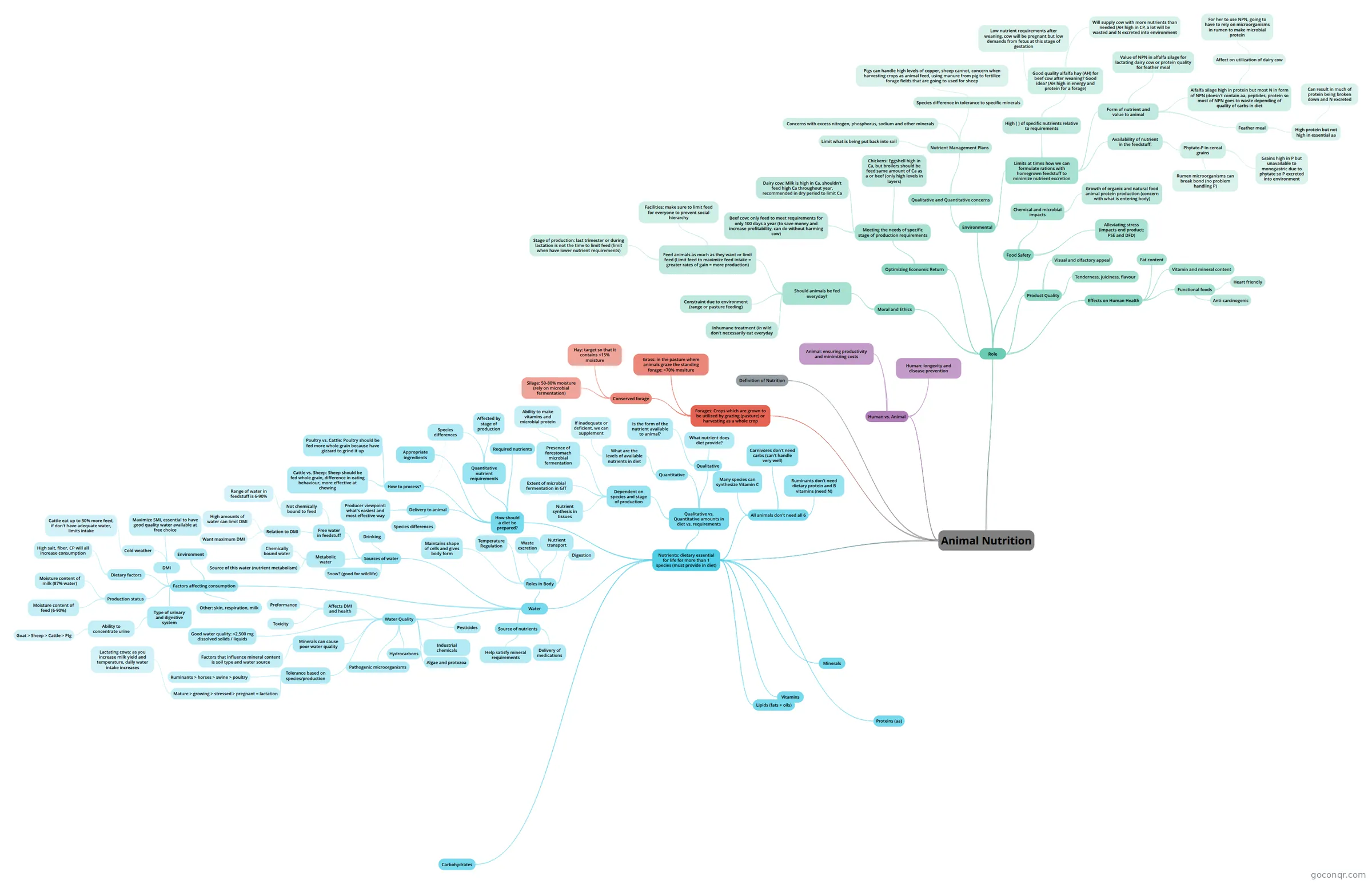
Mind map: Animal nutrition
Map content
Animal Nutrition
Definition of Nutrition
Human vs. Animal
- Human: longevity and disease prevention
- Animal: ensuring productivity and minimizing costs
Role
- Moral and Ethics
- Should animals be fed everyday?
- Inhumane treatment (in wild don't necessarily eat everyday
- Constraint due to environment (range or pasture feeding)
- Feed animals as much as they want or limit feed (Limit feed to maximize feed intake = greater rates of gain = more production)
- Facilities: make sure to limit feed for everyone to prevent social hierarchy
- Stage of production: last trimester or during lactation is not the time to limit feed (limit when have lower nutrient requirements)
- Should animals be fed everyday?
- Optimizing Economic Return
- Meeting the needs of specific stage of production requirements
- Beef cow: only feed to meet requirements for only 100 days a year (to save money and increase profitability, can do without harming cow)
- Dairy cow: Milk is high in Ca, shouldn't feed high Ca throughout year, recommended in dry period to limit Ca
- Chickens: Eggshell high in Ca, but broilers should be feed same amount of Ca as a or beef (only high levels in layers)
- Meeting the needs of specific stage of production requirements
- Environmental
- Qualitative and Quantitative concerns
- Nutrient Management Plans
- Limit what is being put back into soil
- Concerns with excess nitrogen, phosphorus, sodium and other minerals
- Species difference in tolerance to specific minerals
- Pigs can handle high levels of copper, sheep cannot, concern when harvesting crops as animal feed, using manure from pig to fertilize forage fields that are going to used for sheep
- Nutrient Management Plans
- Limits at times how we can formulate rations with homegrown feedstuff to minimize nutrient excretion
- High [ ] of specific nutrients relative to requirements
- Good quality alfalfa hay (AH) for beef cow after weaning? Good idea? (AH high in energy and protein for a forage)
- Low nutrient requirements after weaning, cow will be pregnant but low demands from fetus at this stage of gestation
- Will supply cow with more nutrients than needed (AH high in CP, a lot will be wasted and N excreted into environment
- Good quality alfalfa hay (AH) for beef cow after weaning? Good idea? (AH high in energy and protein for a forage)
- Form of nutrient and value to animal
- Value of NPN in alfalfa silage for lactating dairy cow or protein quality for feather meal
- Alfalfa silage high in protein but most N in form of NPN (doesn't contain aa, peptides, protein so most of NPN goes to waste depending of quality of carbs in diet
- Affect on utilization of dairy cow
- For her to use NPN, going to have to rely on microorganisms in rumen to make microbial protein
- Affect on utilization of dairy cow
- Feather meal
- High protein but not high in essential aa
- Can result in much of protein being broken down and N excreted
- High protein but not high in essential aa
- Availability of nutrient in the feedstuff:
- Phytate-P in cereal grains
- Grains high in P but unavailable to monogastric due to phytate so P excreted into environment
- Rumen microorganisms can break bond (no problem handling P)
- Phytate-P in cereal grains
- High [ ] of specific nutrients relative to requirements
- Qualitative and Quantitative concerns
- Food Safety
- Chemical and microbial impacts
- Growth of organic and natural food animal protein production (concern with what is entering body)
- Alleviating stress (impacts end product: PSE and DFD)
- Chemical and microbial impacts
- Product Quality
- Visual and olfactory appeal
- Tenderness, juiciness, flavour
- Effects on Human Health
- Fat content
- Vitamin and mineral content
- Functional foods
- Heart friendly
- Anti-carcinogenic
- Moral and Ethics
Forages: Crops which are grown to be utilized by grazing (pasture) or harvesting as a whole crop
- Grass: in the pasture where animals graze the standing forage: >70% mositure
- Conserved forage
- Hay: target so that it contains <15% moisture
- Silage: 50-80% moisture (rely on microbial fermentation)
Nutrients: dietary essential for life for more than 1 species (must provide in diet)
- Water
- Roles in Body
- Digestion
- Nutrient transport
- Waste excretion
- Temperature Regulation
- Maintains shape of cells and gives body form
- Sources of water
- Drinking
- Free water in feedstuff
- Not chemically bound to feed
- Range of water in feedstuff is 6-90%
- Relation to DMI
- High amounts of water can limit DMI
- Want maximum DMI
- Not chemically bound to feed
- Metabolic water
- Chemically bound water
- Source of this water (nutrient metabolism)
- Snow? (good for wildlife)
- Factors affecting consumption
- DMI
- Maximize SMI, essential to have good quality water available at free choice
- Cold weather
- Cattle eat up to 30% more feed, if don't have adequate water, limits intake
- Environment
- Dietary factors
- High salt, fiber, CP will all increase consumption
- Production status
- Moisture content of milk (87% water)
- Moisture content of feed (6-90%)
- Type of urinary and digestive system
- Ability to concentrate urine
- Goat > Sheep > Cattle > PIg
- Ability to concentrate urine
- Other: skin, respiration, milk
- DMI
- Water Quality
- Affects DMI and health
- Preformance
- Toxicity
- Good water quality: <2,500 mg dissolved solids / liquids
- Minerals can cause poor water quality
- Factors that influence mineral content is soil type and water source
- Pathogenic microorganisms
- Algae and protozoa
- Hydrocarbons
- Pesticides
- Industrial chemicals
- Tolerance based on species/production
- Ruminants > horses > swine > poultry
- Mature > growing > stressed > pregnant = lactation
- Lactating cows: as you increase milk yield and temperature, daily water intake increases
- Affects DMI and health
- Source of nutrients
- Help satisfy mineral requirements
- Delivery of medications
- Roles in Body
- Carbohydrates
- Proteins (aa)
- Lipids (fats + oils)
- Vitamins
- Minerals
- All animals don't need all 6
- Ruminants don't need dietary protein and B vitamins (need N)
- Carnivores don't need carbs (can't handle very well)
- Many species can synthesize Vitamin C
- Qualitative vs. Quantitative amounts in diet vs. requirements
- Dependent on species and stage of production
- Presence of forestomach microbial fermentation
- Ability to make vitamins and microbial protein
- Extent of microbial fermentation in GIT
- Nutrient synthesis in tissues
- Presence of forestomach microbial fermentation
- Qualitative
- What nutrient does diet provide?
- Is the form of the nutrient available to animal?
- Quantitative
- What are the levels of available nutrients in diet
- If inadequate or deficient, we can supplement
- What are the levels of available nutrients in diet
- Dependent on species and stage of production
- How should a diet be prepared?
- Required nutrients
- Quantitative nutrient requirements
- Affected by stage of production
- Species differences
- Appropriate ingredients
- How to process?
- Poultry vs. Cattle: Poultry should be fed more whole grain because have gizzard to grind it up
- Cattle vs. Sheep: Sheep should be fed whole grain, difference in eating behaviour, more effective at chewing
- Delivery to animal
- Producer viewpoint: what's easiest and most effective way
- Species differences
- Water
Information
- Description
- Veterinary Medicine Mind Map on Animal Nutrition, created by Elanna Azulay on 07/10/2017.
- Created by
- Elanna Azulay
- Views
- 10
- Rating