
Mind map
Elizabethan Religious Settlement
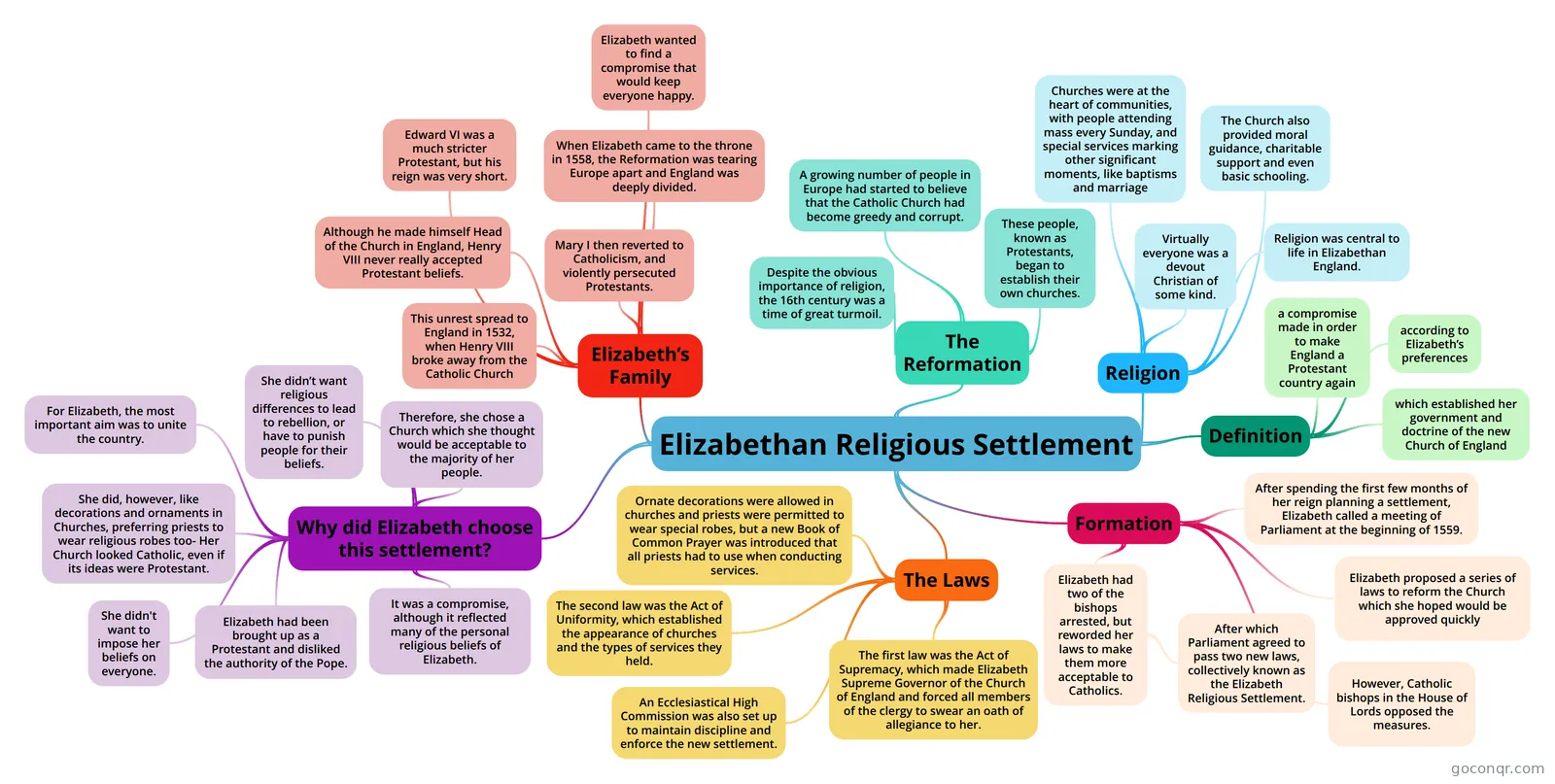
Mind map: Elizabethan Religious Settlement
Map content
Elizabethan Religious Settlement
Definition
- a compromise made in order to make England a Protestant country again
- according to Elizabeth’s preferences
- which established her government and doctrine of the new Church of England
Formation
- After spending the first few months of her reign planning a settlement, Elizabeth called a meeting of Parliament at the beginning of 1559.
- However, Catholic bishops in the House of Lords opposed the measures.
- Elizabeth proposed a series of laws to reform the Church which she hoped would be approved quickly
- Elizabeth had two of the bishops arrested, but reworded her laws to make them more acceptable to Catholics.
- After which Parliament agreed to pass two new laws, collectively known as the Elizabeth Religious Settlement.
Why did Elizabeth choose this settlement?
- It was a compromise, although it reflected many of the personal religious beliefs of Elizabeth.
- Elizabeth had been brought up as a Protestant and disliked the authority of the Pope.
- She did, however, like decorations and ornaments in Churches, preferring priests to wear religious robes too- Her Church looked Catholic, even if its ideas were Protestant.
- For Elizabeth, the most important aim was to unite the country.
- She didn’t want religious differences to lead to rebellion, or have to punish people for their beliefs.
- Therefore, she chose a Church which she thought would be acceptable to the majority of her people.
- She didn't want to impose her beliefs on everyone.
Religion
- Religion was central to life in Elizabethan England.
- Virtually everyone was a devout Christian of some kind.
- Churches were at the heart of communities, with people attending mass every Sunday, and special services marking other significant moments, like baptisms and marriage
- The Church also provided moral guidance, charitable support and even basic schooling.
The Reformation
- Despite the obvious importance of religion, the 16th century was a time of great turmoil.
- A growing number of people in Europe had started to believe that the Catholic Church had become greedy and corrupt.
- These people, known as Protestants, began to establish their own churches.
Elizabeth’s Family
- This unrest spread to England in 1532, when Henry VIII broke away from the Catholic Church
- Although he made himself Head of the Church in England, Henry VIII never really accepted Protestant beliefs.
- Edward VI was a much stricter Protestant, but his reign was very short.
- Mary I then reverted to Catholicism, and violently persecuted Protestants.
- When Elizabeth came to the throne in 1558, the Reformation was tearing Europe apart and England was deeply divided.
- Elizabeth wanted to find a compromise that would keep everyone happy.
The Laws
- The first law was the Act of Supremacy, which made Elizabeth Supreme Governor of the Church of England and forced all members of the clergy to swear an oath of allegiance to her.
- An Ecclesiastical High Commission was also set up to maintain discipline and enforce the new settlement.
- The second law was the Act of Uniformity, which established the appearance of churches and the types of services they held.
- Ornate decorations were allowed in churches and priests were permitted to wear special robes, but a new Book of Common Prayer was introduced that all priests had to use when conducting services.
Information
- Description
- GCSE History (Elizabethan England: Government and Religion) Mind Map on Elizabethan Religious Settlement, created by Shannon Dhillon on 16/11/2017.
- Created by
- Shannon Dhillon
- Views
- 26
- Rating
More on Elizabethan religious settlement