
Mind map
Psychology Topics
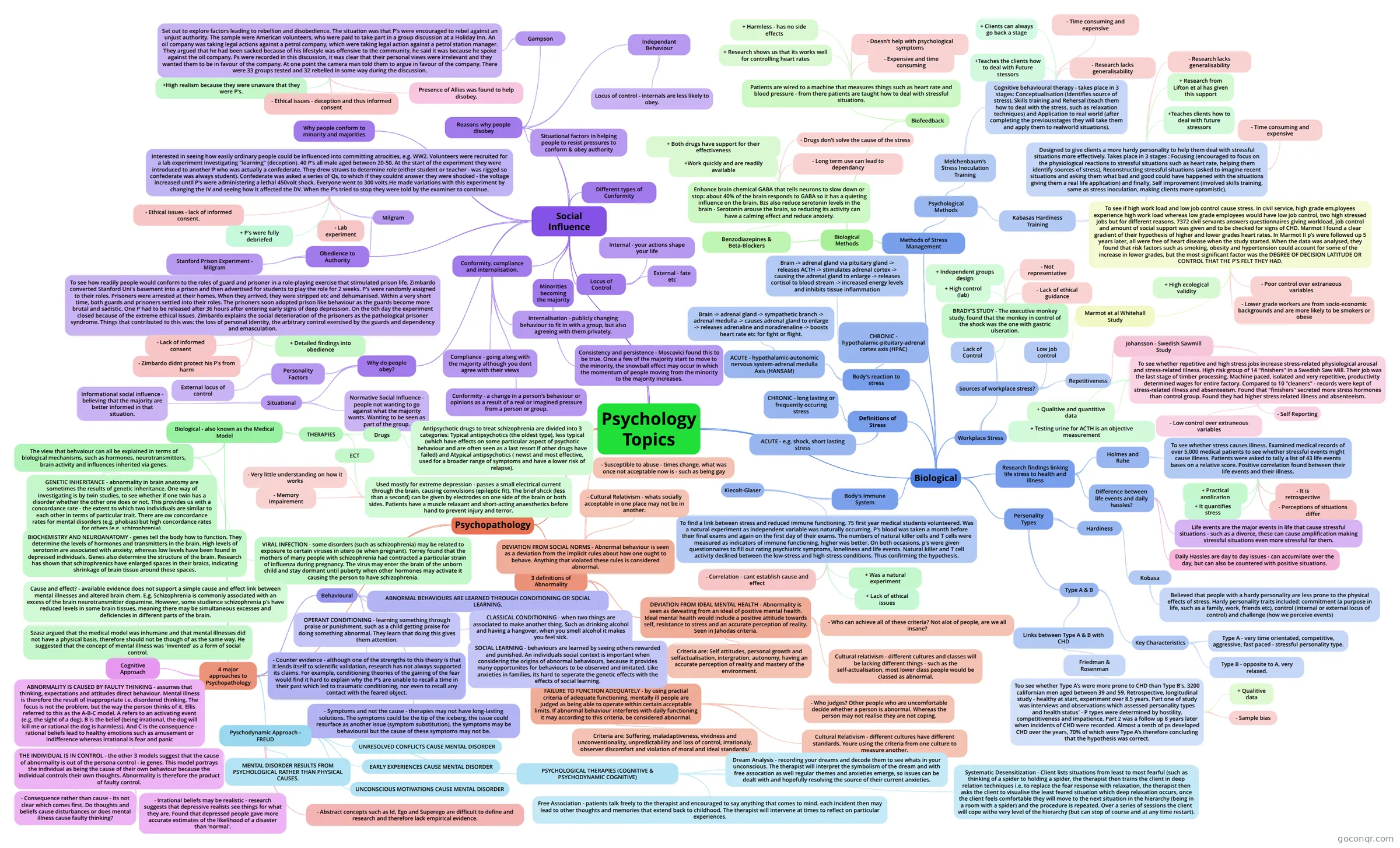
Mind map: Psychology topics
Map content
Psychology Topics
Biological
- Definitions of Stress
- ACUTE - e.g. shock, short lasting stress
- CHRONIC - long lasting or frequently occuring stress
- Body's reaction to stress
- ACUTE - hypothalamic-autonomic nervous system-adrenal medulla Axis (HANSAM)
- Brain -> adrenal gland -> sympathetic branch -> adrenal medulla -> causes adrenal gland to enlarge -> releases adrenaline and noradrenaline -> boosts heart rate etc for fight or flight.
- CHRONIC - hypothalamic-pituitary-adrenal cortex axis (HPAC)
- Brain -> adrenal gland via pituitary gland -> releases ACTH -> stimulates adrenal cortex -> causing the adrenal gland to enlarge -> releases cortisol to blood stream -> increased energy levels and inhibits tissue inflammation
- ACUTE - hypothalamic-autonomic nervous system-adrenal medulla Axis (HANSAM)
- Body's Immune System
- Kiecolt-Glaser
- To find a link between stress and reduced immune functioning. 75 first year medical students volunteered. Was a natural experiment as independent variable was naturally occurring. P's blood was taken a month before their final exams and again on the first day of their exams. The numbers of natural killer cells and T cells were measured as indicators of immune functioning, higher was better. On both occasions, p's were given questionnaires to fill out rating psychiatric symptoms, loneliness and life events. Natural killer and T cell activity declined between the low-stress and high-stress conditions. Thus confirming the hypothesis.
- + Was a natural experiment
- + Lack of ethical issues
- - Correlation - cant establish cause and effect
- To find a link between stress and reduced immune functioning. 75 first year medical students volunteered. Was a natural experiment as independent variable was naturally occurring. P's blood was taken a month before their final exams and again on the first day of their exams. The numbers of natural killer cells and T cells were measured as indicators of immune functioning, higher was better. On both occasions, p's were given questionnaires to fill out rating psychiatric symptoms, loneliness and life events. Natural killer and T cell activity declined between the low-stress and high-stress conditions. Thus confirming the hypothesis.
- Kiecolt-Glaser
- Research findings linking life stress to health and illness
- Difference between life events and daily hassles?
- Life events are the major events in life that cause stressful situations - such as a divorce, these can cause amplification making stressful situations even more stressful for them.
- Daily Hassles are day to day issues - can accumilate over the day, but can also be countered with positive situations.
- Holmes and Rahe
- To see whether stress causes illness. Examined medical records of over 5,000 medical patients to see whether stressful events might cause illness. Patients were asked to tally a list of 43 life events bases on a relative score. Positive correlation found between their life events and their illness.
- + Practical application
- + It quantifies stress
- - It is retrospective
- - Perceptions of situations differ
- To see whether stress causes illness. Examined medical records of over 5,000 medical patients to see whether stressful events might cause illness. Patients were asked to tally a list of 43 life events bases on a relative score. Positive correlation found between their life events and their illness.
- Difference between life events and daily hassles?
- Workplace Stress
- Sources of workplace stress?
- Lack of Control
- BRADY'S STUDY - The executive monkey study, found that the monkey in control of the shock was the one with gastric ulseration.
- + High control (lab)
- + Independent groups design
- - Lack of ethical guidance
- - Not representative
- BRADY'S STUDY - The executive monkey study, found that the monkey in control of the shock was the one with gastric ulseration.
- Low Job control
- Marmot et al Whitehall Study
- To see if high work load and low job control cause stress. In civil service, high grade em,ployees experience high work load whereas low grade employees would have low job control, two high stressed jobs but for different reasons. 7372 civil servants answers questionnaires giving workload, job control and amount of social support was given and to be checked for signs of CHD. Marmot I found a clear gradient of their hypothesis of higher and lower grades heart rates. In Marmot II p's were followed up 5 years later, all were free of heart disease when the study started. When the data was analysed, they found that risk factors such as smoking, obesity and hypertension could account for some of the increase in lower grades, but the most significant factor was the DEGREE OF DECISION LATITUDE OR CONTROL THAT THE P'S FELT THEY HAD.
- + High ecological validity
- - Poor control over extraneous variables
- - Lower grade workers are from socio-economic backgrounds and are more likely to be smokers or obese
- To see if high work load and low job control cause stress. In civil service, high grade em,ployees experience high work load whereas low grade employees would have low job control, two high stressed jobs but for different reasons. 7372 civil servants answers questionnaires giving workload, job control and amount of social support was given and to be checked for signs of CHD. Marmot I found a clear gradient of their hypothesis of higher and lower grades heart rates. In Marmot II p's were followed up 5 years later, all were free of heart disease when the study started. When the data was analysed, they found that risk factors such as smoking, obesity and hypertension could account for some of the increase in lower grades, but the most significant factor was the DEGREE OF DECISION LATITUDE OR CONTROL THAT THE P'S FELT THEY HAD.
- Marmot et al Whitehall Study
- Repetitiveness
- Johansson - Swedish Sawmill Study
- To see whether repetitive and high stress jobs increase stress-related physiological arousal and stress-related illness. High risk group of 14 "finishers" in a Swedish Saw Mill. Their job was the last stage of timber processing. Machine paced, isolated and very repetitive, productivity determined wages for entire factory. Compared to 10 "cleaners" - records were kept of stress-related illness and absenteeism. Found that "finishers" secreted more stress hormones than control group. Found they had higher stress related illness and absenteeism.
- + Qualitive and quantitive data
- + Testing urine for ACTH is an objective measurement
- - Self Reporting
- - Low control over extraneous variables
- To see whether repetitive and high stress jobs increase stress-related physiological arousal and stress-related illness. High risk group of 14 "finishers" in a Swedish Saw Mill. Their job was the last stage of timber processing. Machine paced, isolated and very repetitive, productivity determined wages for entire factory. Compared to 10 "cleaners" - records were kept of stress-related illness and absenteeism. Found that "finishers" secreted more stress hormones than control group. Found they had higher stress related illness and absenteeism.
- Johansson - Swedish Sawmill Study
- Lack of Control
- Sources of workplace stress?
- Personality Types
- Type A & B
- Key Characteristics
- Type A - very time orientated, competitive, aggressive, fast paced - stressful personality type.
- Type B - opposite to A, very relaxed.
- Links between Type A & B with CHD
- Friedman & Rosenman
- Too see whether Type A's were more prone to CHD than Type B's. 3200 californian men aged between 39 and 59. Retrospective, longitudinal study - healthy at start, experiment over 8.5 years. Part one of study was interviews and observations which assessed personality types and health status' - P types were determined by hostility, competitiveness and impatience. Part 2 was a follow up 8 years later when incidents of CHD were recorded. Almost a tenth of ps developed CHD over the years, 70% of which were Type A's therefore concluding that the hypothesis was correct.
- + Qualitive data
- - Sample bias
- Too see whether Type A's were more prone to CHD than Type B's. 3200 californian men aged between 39 and 59. Retrospective, longitudinal study - healthy at start, experiment over 8.5 years. Part one of study was interviews and observations which assessed personality types and health status' - P types were determined by hostility, competitiveness and impatience. Part 2 was a follow up 8 years later when incidents of CHD were recorded. Almost a tenth of ps developed CHD over the years, 70% of which were Type A's therefore concluding that the hypothesis was correct.
- Friedman & Rosenman
- Key Characteristics
- Hardiness
- Kobasa
- Believed that people with a hardy personality are less prone to the physical effects of stress. Hardy personality traits included: commitment (a purpose in life, such as a family, work, friends etc), control (internal or external locus of control) and challenge (how we perceive events)
- Kobasa
- Type A & B
- Methods of Stress Management
- Psychological Methods
- Melchenbaum's Stress Inoculation Training
- Cognitive behavioural therapy - takes place in 3 stages: Conceptualisation (Identifies source of stress), Skills training and Rehersal (teach them how to deal with the stress, such as relaxation techniques) and Application to real world (after completing the previousstages they will take them and apply them to realworld situations).
- +Teaches the clients how to deal with Future stessors
- + Clients can always go back a stage
- - Time consuming and expensive
- - Research lacks generalisability
- Cognitive behavioural therapy - takes place in 3 stages: Conceptualisation (Identifies source of stress), Skills training and Rehersal (teach them how to deal with the stress, such as relaxation techniques) and Application to real world (after completing the previousstages they will take them and apply them to realworld situations).
- Kabasas Hardiness Training
- Designed to give clients a more hardy personality to help them deal with stressful situations more effectively. Takes place in 3 stages : Focusing (encouraged to focus on the physiological reactions to stressful situations such as heart rate, helping them identify sources of stress), Reconstructing stressful situations (asked to imagine recent situations and asking them what bad and good could have happened with the situations giving them a real life application) and finally, Self improvement (involved skills training, same as stress inoculation, making clients more optomistic).
- +Teaches clients how to deal with future stressors
- + Research from Lifton et al has given this support
- - Time consuming and expensive
- - Research lacks generalisability
- Designed to give clients a more hardy personality to help them deal with stressful situations more effectively. Takes place in 3 stages : Focusing (encouraged to focus on the physiological reactions to stressful situations such as heart rate, helping them identify sources of stress), Reconstructing stressful situations (asked to imagine recent situations and asking them what bad and good could have happened with the situations giving them a real life application) and finally, Self improvement (involved skills training, same as stress inoculation, making clients more optomistic).
- Melchenbaum's Stress Inoculation Training
- Biological Methods
- Benzodiazepines & Beta-Blockers
- Enhance brain chemical GABA that tells neurons to slow down or stop: about 40% of the brain responds to GABA so it has a quieting influence on the brain. Bzs also reduce serotonin levels in the brain - Serotonin arouse the brain, so reducing its activity can have a calming effect and reduce anxiety.
- +Work quickly and are readily available
- + Both drugs have support for their effectiveness
- - Long term use can lead to dependancy
- - Drugs don't solve the cause of the stress
- Enhance brain chemical GABA that tells neurons to slow down or stop: about 40% of the brain responds to GABA so it has a quieting influence on the brain. Bzs also reduce serotonin levels in the brain - Serotonin arouse the brain, so reducing its activity can have a calming effect and reduce anxiety.
- Biofeedback
- Patients are wired to a machine that measures things such as heart rate and blood pressure - from there patients are taught how to deal with stressful situations.
- + Research shows us that its works well for controlling heart rates
- + Harmless - has no side effects
- - Expensive and time consuming
- - Doesn't help with psychological symptoms
- Patients are wired to a machine that measures things such as heart rate and blood pressure - from there patients are taught how to deal with stressful situations.
- Benzodiazepines & Beta-Blockers
- Psychological Methods
- Definitions of Stress
Social Influence
- Conformity, compliance and internalisation.
- Conformity - a change in a person's behaviour or opinions as a result of a real or imagined pressure from a person or group.
- Internalisation - publicly changing behaviour to fit in with a group, but also agreeing with them privately.
- Compliance - going along with the majority although you dont agree with their views
- Different types of Conformity
- Why people conform to minority and majorities
- Obedience to Authority
- Milgram
- Interested in seeing how easily ordinary people could be influenced into committing atrocities, e.g. WW2. Volunteers were recruited for a lab experiment investigating "learning" (deception). 40 P's all male aged between 20-50. At the start of the experiment they were introduced to another P who was actually a confederate. They drew straws to determine role (either student or teacher - was rigged so confederate was always student). Confederate was asked a series of Qs, to which if they couldnt answer they were shocked - the voltage increased until P's were administering a lethal 450volt shock. Everyone went to 300 volts.He made variations with this experiment by changing the IV and seeing how it affected the DV. When the P's tried to stop they were told by the examiner to continue.
- - Ethical issues - lack of informed consent.
- - Lab experiment
- + P's were fully debriefed
- Interested in seeing how easily ordinary people could be influenced into committing atrocities, e.g. WW2. Volunteers were recruited for a lab experiment investigating "learning" (deception). 40 P's all male aged between 20-50. At the start of the experiment they were introduced to another P who was actually a confederate. They drew straws to determine role (either student or teacher - was rigged so confederate was always student). Confederate was asked a series of Qs, to which if they couldnt answer they were shocked - the voltage increased until P's were administering a lethal 450volt shock. Everyone went to 300 volts.He made variations with this experiment by changing the IV and seeing how it affected the DV. When the P's tried to stop they were told by the examiner to continue.
- Stanford Prison Experiment - Milgram
- To see how readily people would conform to the roles of guard and prisoner in a role-playing exercise that stimulated prison life. Zimbardo converted Stanford Uni's basement into a prison and then advertised for students to play the role for 2 weeks. P's were randomly assigned to their roles. Prisoners were arrested at their homes. When they arrived, they were stripped etc and dehumanised. Within a very short time, both guards and prisoners settled into their roles. The prisoners soon adopted prison like behaviour as the guards become more brutal and sadistic. One P had to be released after 36 hours after entering early signs of deep depression. On the 6th day the experiment closed because of the extreme ethical issues. Zimbardo explains the social deterioration of the prisoners as the pathological prisoner syndrome. Things that contributed to this was: the loss of personal identity, the arbitrary control exercised by the guards and dependency and emasculation.
- - Lack of informed consent
- + Detailed findings into obedience
- - Zimbardo didnt protect his P's from harm
- To see how readily people would conform to the roles of guard and prisoner in a role-playing exercise that stimulated prison life. Zimbardo converted Stanford Uni's basement into a prison and then advertised for students to play the role for 2 weeks. P's were randomly assigned to their roles. Prisoners were arrested at their homes. When they arrived, they were stripped etc and dehumanised. Within a very short time, both guards and prisoners settled into their roles. The prisoners soon adopted prison like behaviour as the guards become more brutal and sadistic. One P had to be released after 36 hours after entering early signs of deep depression. On the 6th day the experiment closed because of the extreme ethical issues. Zimbardo explains the social deterioration of the prisoners as the pathological prisoner syndrome. Things that contributed to this was: the loss of personal identity, the arbitrary control exercised by the guards and dependency and emasculation.
- Milgram
- Why do people obey?
- Situational
- Normative Social Influence - people not wanting to go against what the majority wants. Wanting to be seen as part of the group.
- Informational social influence - believing that the majority are better informed in that situation.
- Personality Factors
- External locus of control
- Situational
- Reasons why people disobey
- Independant Behaviour
- Locus of control - internals are less likely to obey.
- Gampson
- Set out to explore factors leading to rebellion and disobedience. The situation was that P's were encouraged to rebel against an unjust authority. The sample were American volunteers, who were paid to take part in a group discussion at a Holiday Inn. An oil company was taking legal actions against a petrol company, which were taking legal action against a petrol station manager. They argued that he had been sacked because of his lifestyle was offensive to the community, he said it was because he spoke against the oil company. Ps were recorded in this discussion, it was clear that their personal views were irrelevant and they wanted them to be in favour of the company. At one point the camera man told them to argue in favour of the company. There were 33 groups tested and 32 rebelled in some way during the discussion.
- Presence of Allies was found to help disobey.
- +High realism because they were unaware that they were P's.
- - Ethical issues - deception and thus informed consent
- Set out to explore factors leading to rebellion and disobedience. The situation was that P's were encouraged to rebel against an unjust authority. The sample were American volunteers, who were paid to take part in a group discussion at a Holiday Inn. An oil company was taking legal actions against a petrol company, which were taking legal action against a petrol station manager. They argued that he had been sacked because of his lifestyle was offensive to the community, he said it was because he spoke against the oil company. Ps were recorded in this discussion, it was clear that their personal views were irrelevant and they wanted them to be in favour of the company. At one point the camera man told them to argue in favour of the company. There were 33 groups tested and 32 rebelled in some way during the discussion.
- Situational factors in helping people to resist pressures to conform & obey authority
- Independant Behaviour
- Locus of Control
- Internal - your actions shape your life
- External - fate etc
- Minorities becoming the majority
- Consistency and persistence - Moscovici found this to be true. Once a few of the majority start to move to the minority, the snowball effect may occur in which the momentum of people moving from the minority to the majority increases.
- Conformity, compliance and internalisation.
Psychopathology
- 3 definitions of Abnormality
- DEVIATION FROM SOCIAL NORMS - Abnormal behaviour is seen as a deviation from the implicit rules about how one ought to behave. Anything that violated these rules is considered abnormal.
- - Susceptible to abuse - times change, what was once not acceptable now is - such as being gay
- - Cultural Relativism - whats socially acceptable in one place may not be in another.
- DEVIATION FROM IDEAL MENTAL HEALTH - Abnormality is seen as deveating from an ideal of positive mental health. Ideal mental health would include a positive attitude towards self, resistance to stress and an accurate perception of reality. Seen in Jahodas criteria.
- - Who can achieve all of these criteria? Not alot of people, are we all insane?
- Cultural relativism - different cultures and classes will be lacking different things - such as the self-actualisation, most lower class people would be classed as abnormal.
- Criteria are: Self attitudes, personal growth and selfactualisation, intergration, autonomy, having an accurate perception of reality and mastery of the environment.
- FAILURE TO FUNCTION ADEQUATELY - by using practial criteria of adequate functioning, mentally ill people are judged as being able to operate within certain acceptable limits. If abnormal behaviour interferes with daily functioning it may according to this criteria, be considered abnormal.
- - Who judges? Other people who are uncomfortable decide whether a person is abnormal. Whereas the person may not realise they are not coping.
- Cultural Relativism - different cultures have different standards. Youre using the criteria from one culture to measure another.
- Criteria are: Suffering, maladaptiveness, vividness and unconventionality, unpredictability and loss of control, irrationaly, observer discomfort and violation of moral and ideal standards/
- DEVIATION FROM SOCIAL NORMS - Abnormal behaviour is seen as a deviation from the implicit rules about how one ought to behave. Anything that violated these rules is considered abnormal.
- 4 major approaches to Psychopathology
- Biological - also known as the Medical Model
- The view that behvaiour can all be explained in terms of biological mechanisms, such as hormones, neurotransmitters, brain activity and influences inherited via genes.
- GENETIC INHERITANCE - abnormality in brain anatomy are sometimes the results of genetic inheritance. One way of investigating is by twin studies, to see whether if one twin has a disorder whether the other one does or not. This provides us with a concordance rate - the extent to which two individuals are similar to each other in terms of particular trait. There are ow concordance rates for mental disorders (e.g. phobias) but high concordance rates for others (e.g. schizophrenia).
- Cause and effect? - available evidence does not support a simple cause and effect link between mental illnesses and altered brain chem. E.g. Schizophrenia is commonly associated with an excess of the brain neurotransmitter dopamine. However, some studience schizophrenia p's have reduced levels in some brain tissues, meaning there may be simultaneous excesses and deficiencies in different parts of the brain.
- VIRAL INFECTION - some disorders (such as schizophrenia) may be related to exposure to certain viruses in utero (ie when pregnant). Torrey found that the mothers of many people with schizophrenia had contracted a particular strain of influenza during pregnancy. The virus may enter the brain of the unborn child and stay dormant until puberty when other hormones may activate it causing the person to have schizophrenia.
- BiOCHEMISTRY AND NEUROANATOMY - genes tell the body how to function. They determine the levels of hormones and transmitters in the brain. High levels of serotonin are associated with anxiety, whereas low levels have been found in depressed individuals. Genes also determine the structure of the brain. Research has shown that schizophrenics have enlarged spaces in their braics, indicating shrinkage of brain tissue around these spaces.
- Szasz argued that the medical model was inhumane and that mental illnesses did not have a physical basis, therefore should not be though of as the same way. He suggested that the concept of mental illness was 'invented' as a form of social control.
- GENETIC INHERITANCE - abnormality in brain anatomy are sometimes the results of genetic inheritance. One way of investigating is by twin studies, to see whether if one twin has a disorder whether the other one does or not. This provides us with a concordance rate - the extent to which two individuals are similar to each other in terms of particular trait. There are ow concordance rates for mental disorders (e.g. phobias) but high concordance rates for others (e.g. schizophrenia).
- THERAPIES
- Drugs
- Antipsychotic drugs to treat schizophrenia are divided into 3 categories: Typical antipsychotics (the oldest type), less typical (which have effects on some particular aspect of psychotic behaviour and are often seen as a last resort if other drugs have failed) and Atypical antipsychotics ( newst and most effective, used for a broader range of symptoms and have a lower risk of relapse).
- ECT
- Used mostly for extreme depression - passes a small electrical current through the brain, causing convulsions (epileptic fit). The brief shcck (less than a second) can be given by electrodes on one side of the brain or both sides. Patients have a muscle relaxant and short-acting anaesthetics before hand to prevent injury and terror.
- - Very little understanding on how it works
- - Memory impairement
- Used mostly for extreme depression - passes a small electrical current through the brain, causing convulsions (epileptic fit). The brief shcck (less than a second) can be given by electrodes on one side of the brain or both sides. Patients have a muscle relaxant and short-acting anaesthetics before hand to prevent injury and terror.
- Drugs
- The view that behvaiour can all be explained in terms of biological mechanisms, such as hormones, neurotransmitters, brain activity and influences inherited via genes.
- Behavioural
- ABNORMAL BEHAVIOURS ARE LEARNED THROUGH CONDITIONING OR SOCIAL LEARNING.
- SOCIAL LEARNING - behaviours are learned by seeing others rewarded and punished. An individuals social context is important when considering the origins of abnormal behaviours, because it provides many opportunites for behaviours to be observed and imitated. Like anxieties in families, its hard to seperate the genetic effects with the effects of social learning.
- CLASSICAL CONDITIONING - when two things are associated to make another thing. Such as drinking alcohol and having a hangover, when you smell alcohol it makes you feel sick.
- OPERANT CONDITIONING - learning something through praise or punishment, such as a child getting praise for doing something abnormal. They learn that doing this gives them attention.
- - Counter evidence - although one of the strengths to this theory is that it lends itself to scientific validation, research has not always supported its claims. For example, conditioning theories of the gaining of the fear would find it hard to explain why the P's are unable to recall a time in their past which led to traumatic conditioning, nor even to recall any contact with the feared object.
- - Symptoms and not the cause - therapies may not have long-lasting solutions. The symptoms could be the tip of the iceberg, the issue could resurface as another issue (symptom substitution), the symptoms may be behavioural but the cause of these symptoms may not be.
- ABNORMAL BEHAVIOURS ARE LEARNED THROUGH CONDITIONING OR SOCIAL LEARNING.
- Cognitive Approach
- ABNORMALITY IS CAUSED BY FAULTY THINKING - assumes that thinking, expectations and attitudes direct behaviour. Mental illness is therefore the result of inappropriate i.e. disordered thinking. The focus is not the problem, but the way the person thinks of it. Ellis referred to this as the A-B-C model. A refers to an activating event (e.g. the sight of a dog). B is the belief (being irrational, the dog will kill me or rational the dog is harmless). And C is the consequence - rational beliefs lead to healthy emotions such as amusement or indifference whereas irrational is fear and panic
- THE INDIVIDUAL IS IN CONTROL - the other 3 models suggest that the cause of abnormality is out of the persona control - ie genes. This model portrays the individual as being the cause of their own behaviour because the individual controls their own thoughts. Abnormality is therefore the product of faulty control.
- - Consequence rather than cause - its not clear which comes first. Do thoughts and beliefs cause disturbances or does mental illness cause faulty thinking?
- - Irrational beliefs may be realistic - research suggests that depressive realists see things for what they are. Found that depressed people gave more accurate estimates of the likelihood of a disaster than 'normal'.
- Pyschodynamic Approach - FREUD
- MENTAL DISORDER RESULTS FROM PSYCHOLOGICAL RATHER THAN PHYSICAL CAUSES.
- UNRESOLVED CONFLICTS CAUSE MENTAL DISORDER
- EARLY EXPERIENCES CAUSE MENTAL DISORDER
- UNCONSCIOUS MOTIVATIONS CAUSE MENTAL DISORDER
- - Abstract concepts such as Id, Ego and Superego are difficult to define and research and therefore lack empirical evidence.
- PSYCHOLOGICAL THERAPIES (COGNITIVE & PSYCHODYNAMIC COGNITIVE)
- Free Association - patients talk freely to the therapist and encouraged to say anything that comes to mind. each incident then may lead to other thoughts and memories that extend back to childhood. The therapist will intervene at times to reflect on particular experiences.
- Dream Analysis - recording your dreams and decode them to see whats in your unconscious. The therapist will interpret the symbolism of the dream and with free assocation as well regular themes and anxieties emerge, so issues can be dealt with and hopefully resolving the source of their current anxieties.
- Systematic Desensitization - Client lists situations from least to most fearful (such as thinking of a spider to holding a spider, the therapist then trains the client in deep relation techniques i.e. to replace the fear response with relaxation, the therapist then asks the client to visualise the least feared situation which deep relaxation occurs, once the client feels comfortable they will move to the next situation in the hierarchy (being in a room with a spider) and the procedure is repeated. Over a series of sessions the client will cope withe very level of the hierarchy (but can stop of course and at any time restart).
- Biological - also known as the Medical Model
- 3 definitions of Abnormality
Information
- Description
- A-Levels Psychology Mind Map on Psychology Topics, created by hogg_ethan on 02/06/2013.
- Created by
- hogg_ethan
- Views
- 58
- Tags
- Rating